Feeds:
Posts
Comments

Archive for the ‘Illinois State Board of Elections’ Category

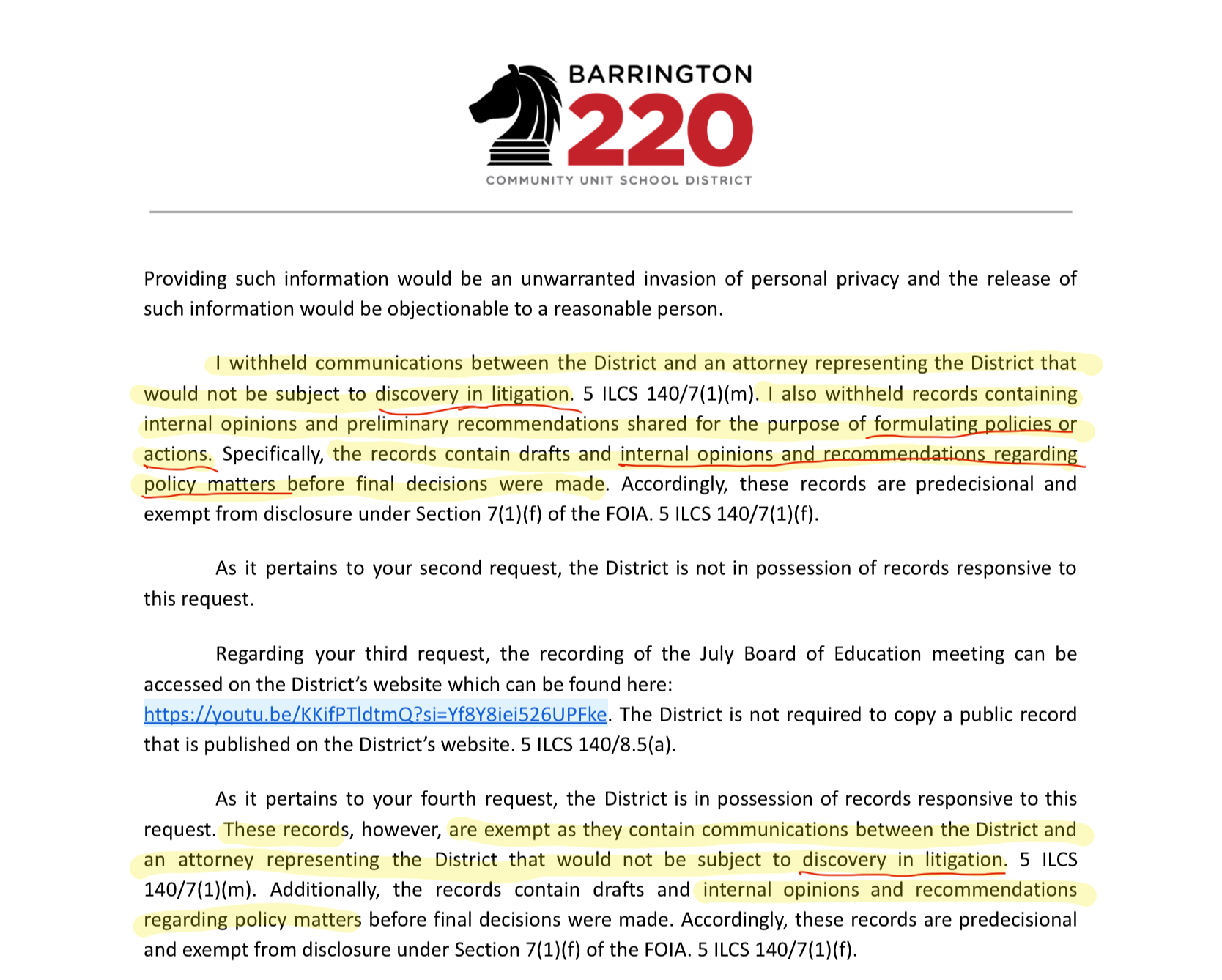
On April 22, 2025, the Barrington School District 220 election results were certified. Among the successful candidates was incumbent Erin Chan Ding.

The new members were installed at the May 6, 2025, School Board meeting. Ding previously won election in 2021 and had served as a School Board member for 4 years before winning reelection. During those years of service from May 4, 2021, through her reelection and installation on May 6, 2025, Barrington 220 School District policies, including the Code of Conduct, were discussed, revised and voted upon. Ding vowed to uphold these policies when she took her oath of office, the most recent being her swearing in on May 6, 2025. Among these policies are:

2:80-E Exhibit – Board Member Code of Conduct

Each member of the Community Unit School District 220 Board of Education ascribes to the following code of conduct:

  1. I will represent all school district constituents honestly and equally and refuse to surrender my responsibilities to special interest or partisan political groups.

  2. I will avoid any conflict of interest or the appearance of impropriety which could result from my position, and shall not use my Board of Education membership for personal gain or publicity.

Board records show that the Board discussed and voted to reaffirm the Code of Conduct on September 5, 2023, where Ding seconded the motion. Ding further serves on the Board’s Policy Committee that once again reviewed and recommended this Code of Conduct on August 24, 2024.

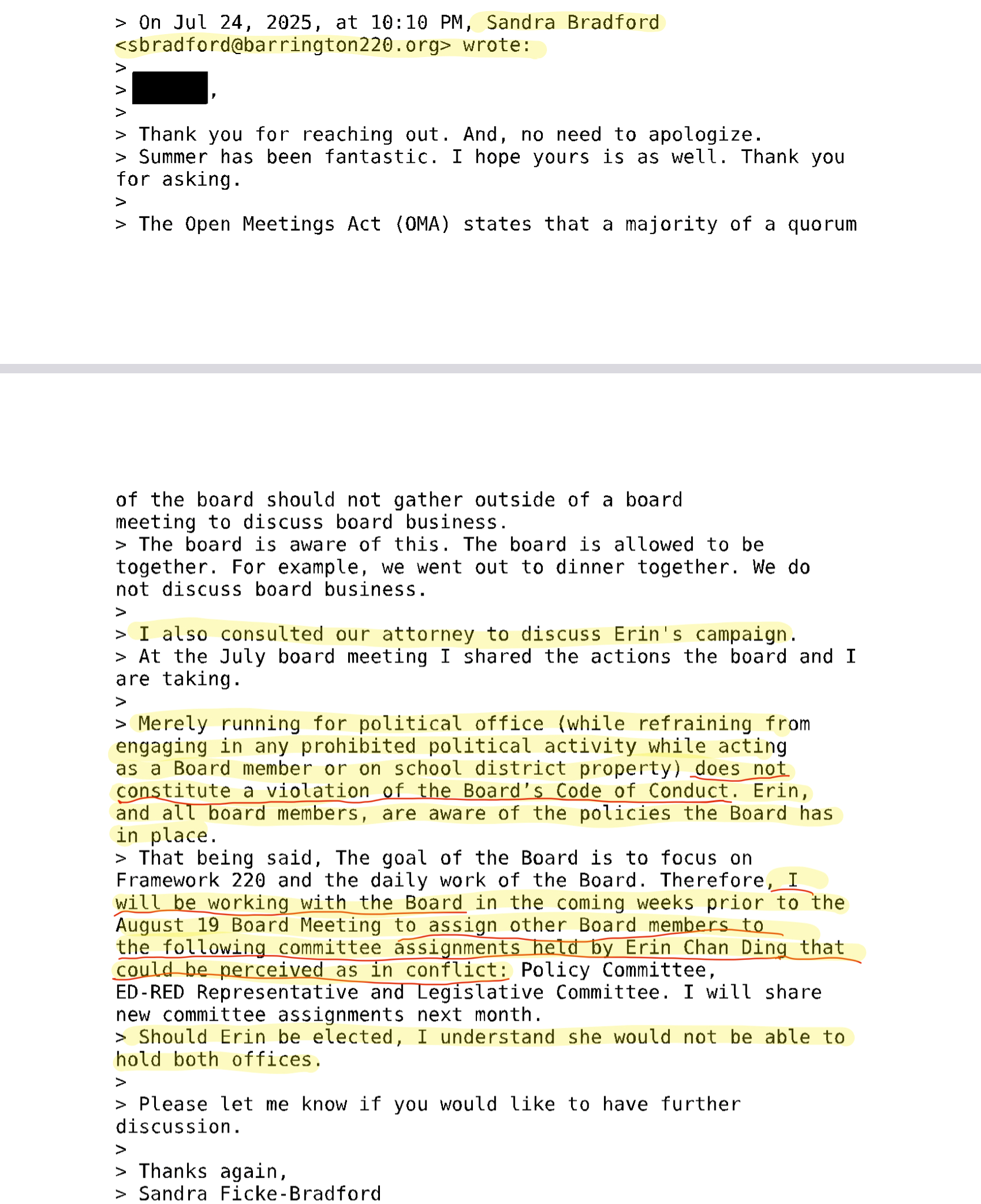
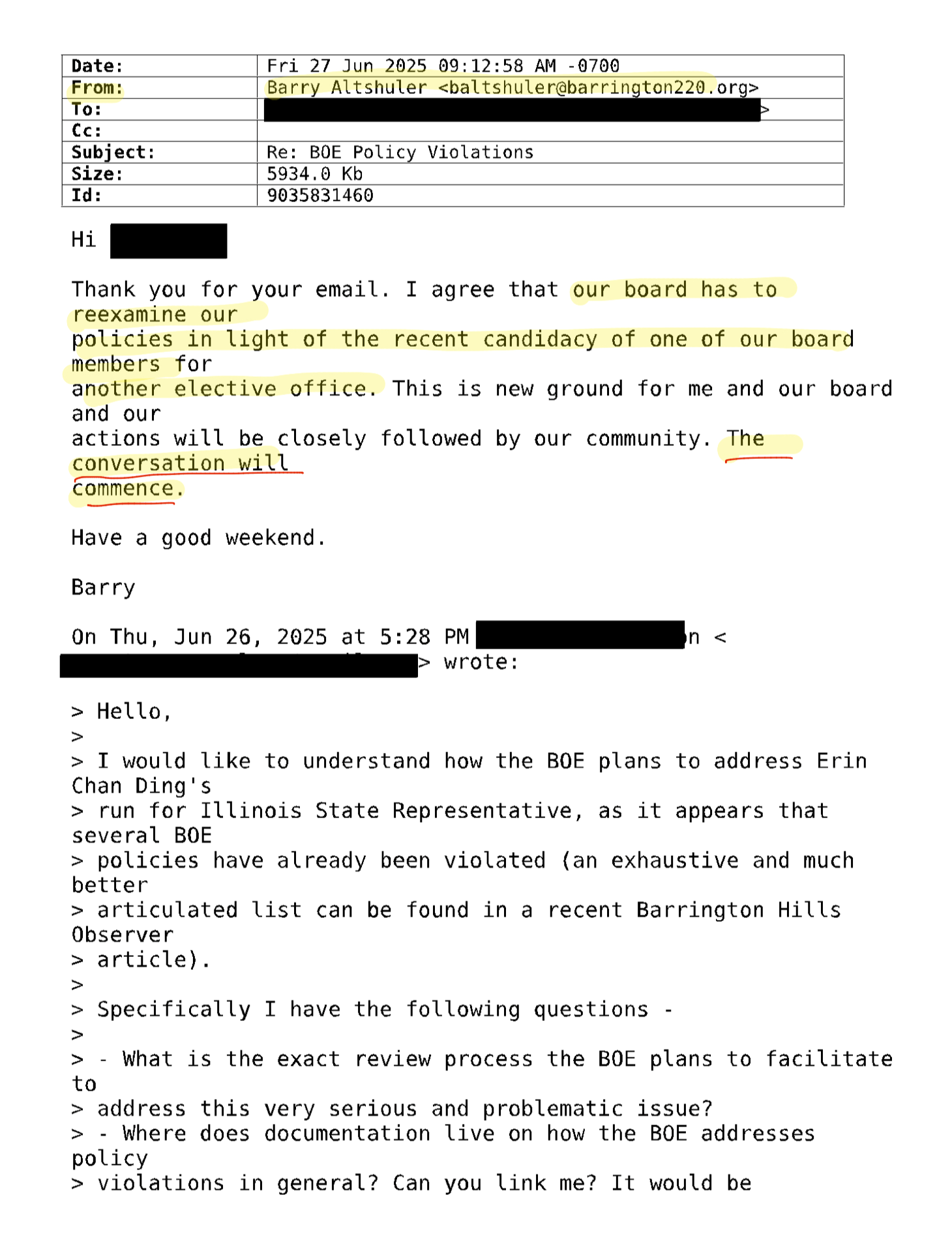
As seen in recent publications, on June 18th, Ding officially launched her candidacy in the Democratic primary in the 52nd House District. In doing so, Ding has squarely violated the Board Member Code of Conduct. In Sec. 2:80-E(1), Ding swore to:

“refuse to surrender (her) responsibilities to special interest or partisan political groups…”

Yet, on June 18 she launched a decidedly partisan campaign for a Democratic position. In Sec. 2:80-E(2), Ding swore to “not use (her) Board of Education membership for personal gain or publicity.” Yet, as seen on her social media pages and in media releases, Ding has published and been quoted using her Board of Education position as a boon for her Democratic campaign:

“As a twice-elected school board member, I care deeply about ensuring all children and people feel valued and seen — and confident that their local representatives will work for them.” (Daily Herald article)

Ding has violated her oath of office and her commitment to non-partisan representation of the Community Unit School District 220 Board of Education. One of the Illinois Democratic Party’s largest funding comes from Illinois Teachers Unions.

Wirepoints recently reported: “In the last four years alone, Illinois lawmakers and political candidates have taken nearly $30 million in contributions from teachers unions and their national affiliates. Nearly $26 million, or 94%, of those contributions have been accepted by Democrats… Since 2020, 19 of the top 20 recipients of teacher union political contributions were Democrats or Democratic Party-supported initiatives.” (https://wirepoints.org/teacher-unions-have-spent-nearly-30-million-on-elections-in-four-years-wirepoints/)

In fact, Illinois Federation of Teachers endorsed the Democratic challenger, Maria Peterson, in the last election for the 52nd House District. (https://www.ift-aft.org/candidates).

You’ll be hard pressed to find a Republican among these endorsements, although there are a few. And, Peterson’s D-2’s for her run for the 52nd exhibits over $37,000.00 in donations from Illinois Federation of Teachers and Lake County Federation of Teachers.

(Click on images to enlarge)

It is implausible to believe that Ding will not be beholden to the teachers’ unions or disavow endorsements and donations from their lobbyists. Similarly, JB Pritzker’s $50,000.00 will be in play,

(Click on image to enlarge)

not to mention the other hundreds of thousands of dollars from the Democratic Party that built up Peterson’s $2,821,571.28 war chest. Ding simply cannot avoid the “appearance of impropriety” while she panders to these partisan special interest groups in order to build her own war chest.

And, of course, she votes on the union contract for the D220 teachers as well as on any disciplinary actions to be taken against a teacher. Yet, she lists among her endorsements multiple “public educators” in Barrington 220. How does this not present a “conflict of interest” and an “appearance of impropriety”?

Beyond these clear violations of the Code of Conduct, in seeking these endorsements Ding has also violated Sec. 2:105 Ethics & Gift Ban, which prohibits acceptance of political favors.

It is also implausible to believe that Ding did not conceive of running for the 52nd at the same time she was running for 220 School Board. Ding deceived the voters in running for her current position on the Community Unit School District 220 Board of Education. In fact, she has commingled her Erin for Illinois social media page with that of her Erin for 220 page as if there’s no distinction.

Friends of Erin Chan Ding” is listed as being responsible for her “Erin for Illinois” Facebook page in her run for the 52nd District and is the committee that ran Ding’s School Board election. This is another clear violation of her oath and the Code of Conduct. She boldly states: “And yes, I’ll continue to serve on the Barrington 220 school board with my whole heart during this campaign,” as though she has the unfettered right to defy the rules that govern her School Board conduct.

We call upon and urge all voters to demand Ding’s immediate resignation from Community Unit School District 220 Board of Education as she has violated the Board Code and demonstrated her clear partisan representation of the public in this position.

Editorial note: We’d be remiss in failing to point out that two other Community Unit School District 220 Board of Education members have participated in Ding’s announcement that she’s running for higher office, with both Barry Altshuler and Harathi Srivistava appearing at Ding’s announcement party (both pictured in the photo above).

While this may not rise to the level of an OMA violation, it certainly evidences the very partisan (Democratic) nature of your current District 220 Board of Education. Indeed, Srivistava was widely endorsed and largely funded by the Illinois Democratic Party.

Related: Chan Ding running in Democratic primary in 52nd,” “Three (3) Democratic candidates queued to run for the IL 52nd District House seat in 2026

Read Full Post »

Jesse Rojo, Erin Chan Ding and Maria Peterson

Three Democratic candidates have declared, or will declare shortly, their candidacies for the Illinois 52nd District House seat currently held by Representative Martin McLaughlin. McLaughlin has held this seat for four and a half years now having won election three times.

On Tuesday, the Daily Herald posted, “Former Barrington village board candidate running for State house seat,” namely Jesse Rojo. Records indicate Rojo, 29, moved to Barrington in March of 2023 from Des Plaines. His social media pages indicates he will be active this Flag Day at “No Kings” events, so look him there today.

Recently reelected CUSD 220 Board of Education member Erin Chan Ding is hosting a “Launch Party” event this coming Wednesday in Barrington to officially announce her candidacy.

And last, Maria Peterson, who ran in the November 2024 52nd District election against Martin McLaughlin, has announced her campaign kickoff event will be held June 23rd in Barrington. Peterson also ran for office in 2022 against former Senate Senator Dan McConchie in the 26th District.

The General Primary Election is on Saint Patrick’s Day, March 17, 2026.

Read Full Post »

Illinois Attorney General Kwame Raoul talks with new ‘Republican’ state Sen. Darby Hills, of Barrington Hills, on the Senate floor on May 30, 2025. | Capitol News Illinois photo by Jerry Nowicki

By Peter Hancock | Capitol News Illinois

SPRINGFIELD – In a year when many state agencies received little or no funding increase, state lawmakers this year approved an increase of $15.7 million, or 22.4%, for general operating expenses in Attorney General Kwame Raoul’s office.

That General Revenue Fund increase is significantly more than some other constitutional officers received for their operating expenses in the upcoming fiscal year. It’s also more than the $15 million that Raoul himself requested when he appeared before House and Senate appropriations committees this year – although reductions in revenue from other state funds left Raoul’s all-funds budget roughly flat from a year ago.

Raoul’s office did not respond to repeated requests to comment for this story about why lawmakers approved a larger general operating budget than he had requested, and why the budget reflected such significant cuts in two specific non-GRF funds.

During budget hearings in April, Raoul said he needed additional funding to hire attorneys and other staff to handle the increased workload that his office now manages. Some of that workload, he said, is the result of legislation that has given the attorney general’s office more responsibility.

But he also mentioned the increased workload that stems from more than a dozen lawsuits his office has joined challenging actions of the Trump administration as well as defending the state against legal actions the administration has filed against Illinois.

Read more here.

Read Full Post »

Scott Stantis editorial cartoon for Wednesday, June 11, 2025, on Don Harmon and need for campaign finance reform. | Scott Stantis/For the Editorial Board

By The Editorial Board | Chicago Tribune

Even lawmakers who’ve been around Springfield a long time were taken aback at the audacity of Senate President Don Harmon slipping a provision into a broader elections reform bill that would have gotten his campaign off the hook for a potential penalty well into the millions.

The Senate president’s problem stems from a March ruling by the Illinois State Board of Elections that his campaign had improperly accepted more than $4 million in donations in 2024 — a finding that stemmed from this newspaper’s questions about the campaign’s fundraising. If Harmon’s appeal of that determination is unsuccessful, his campaign could be subject to a penalty as steep as $6.1 million.

Harmon’s language in the broader reform bill would have deemed the grounds for his campaign’s appeal correct, both going forward and retroactively. House Democrats concluded the provision would have ended the board’s enforcement action, wiping the slate clean for the Harmon campaign.

The Senate president’s attempted slick move only confirmed what many voters already believe about Springfield — that those in power regularly speak in support of good government and clean campaigns but, when push comes to shove, do what they feel is necessary to preserve their authority. The maneuver deserved the condemnation it received — including from members of Harmon’s own party. Thankfully, there was no vote on that elections reform package in the most recent session of the General Assembly.

Beyond the unseemly legislative maneuvering, the Harmon story to our minds underscores how Springfield’s past efforts at campaign finance have failed so miserably. The issue at the heart of Harmon’s woes is a provision in the state’s 2009 campaign finance reform law that was meant to neutralize the effect of big money on Illinois politics. Back then, worries about independently wealthy candidates effectively buying elections led state lawmakers to lift donation limits when “self-funding” got to a certain level so that opponents could compete.

More here.

Read Full Post »

For those confused about the recent appointment of Darby Hills to the Illinois State Senate, let’s clarify the facts and the legal process unfolding in McHenry County.

The judge in this case was asked to rule on two critical issues. First, whether the Lake County Republican Chairman could retroactively remedy the fact that Ms. Hills was not a Republican after McConchie‘s retirement. Brin appointed Hills as a republican precinct committeeperson —something both she and the chairman acknowledged needed to be done to remedy this deficit. The court allowed the chairman to appoint Ms. Hills as a precinct committeeperson weeks after Senator McConchie vacated his seat, arguably ignoring the statutes requirements and effectively temporarily enabling the appointment.

The second, and more consequential issue—the heart of the lawsuit—is whether Ms. Hills was a Republican at the time of the vacancy. Rather than interpret the relevant statute, requiring a nominee have valid Republican credentials the judge declined to rule on that core question. The case is now on appeal, and the Appellate Court will be asked to determine whether state law was properly followed and whether Hills was legally eligible for appointment under party rules and Illinois statutes.

Regardless of how one defines “Republican,” Ms. Hills’ voting record in Springfield speaks volumes. In just a short time, she has cast key votes that are out of step with Republican principles—votes that were anti-Second Amendment, pro-DEI mandates, anti-business, and in lockstep with teachers’ union interests.

The outcome of this legal appeal will be watched closely. If the Appellate Court finds that Ms. Hills was ineligible for appointment, it raises serious questions:

  • Will she be allowed to retain her Senate seat?
  • Will her votes be invalidated?
  • Will she be required to return taxpayer funds paid in salary during her disputed tenure?

Of course, there remains a straightforward path to public office: campaign, knock on doors, earn support, and win an election—both in a Republican primary and a general contest. But for now, it seems, Ms. Hills has taken a shortcut, bypassing voters in favor of backroom maneuvering.

Observers, constituents, and constitutional conservatives across the state will be following this case closely—not only for what it reveals about one Senate seat, but for what it says about process, transparency, the integrity of some in the Republican party and our electoral system.

Related:Residents deserve full disclosure – an update,” “Residents deserve full disclosure,” “’No more dog and pony shows, please!” “Gun rights advocacy group expresses displeasure with terms like ‘RINO, Backstabbing Traitor’ and ‘Botox Queen’ describing a senator’s vote on Senate Bill 8,” “Darby Hills Sworn In to Represent Illinois’ 26th Senate District,” “Darby Hills chosen — again — to succeed Dan McConchie in state Senate,” “’The Fix’ is in?,” “Darby Hills’ appointment to state Senate on hold as Republicans reopen applications for McConchie’s seat,” “26th Legislative District Committee meeting cancelled,” “State Senator seat at any price?,” ”26th Legislative District Committee meeting tomorrow,” “Do Over Scheduled for Meeting to Replace State Senator Dan McConchie,” “Restraining order sought to block 26th Senate appointment amid legal fight,” “Lawsuit challenges legality of GOP appointment to 26th State Senate seat,” “McConchie’s would-be successor isn’t a Republican and can’t serve, lawsuit alleges,” “Darby Hills Appointed as New State Senator for Illinois’ 26th Senate District

Read Full Post »

The Village Board of Trustees will be conducting their regular monthly meeting this evening beginning at 6:30 PM. A copy of their agenda can be viewed and downloaded here.

Read Full Post »

The Barrington Hills Park District Board/Riding Club of Barrington Hills will hold their monthly meeting this evening in person and via Zoom at 7:00 PM. Some topics on their agenda include:

  • Appointment of New Commissioner
  • Assignment of Officers
  • Approval of the April 2025 Park District Financials
  • Administrator’s Report
  • Trainer Applications (Suzanne Galdan, John Staples, Charles Campbell)
  • Riding Center Advisory Committee Report

A copy of their agenda can be viewed here. Instructions for accessing the meeting remotely can be found here.

Read Full Post »

The District 220 Board of Education meets this evening at 6:00 PM at the District Administration Center, 515 W. Main Street. Items on their agenda include:

  • FOIA Report
  • REVISED Personnel Report
  • Approve the Consolidated District Plan
  • Consideration to Approve a Resolution Authorizing the Honorable Dismissal Due to Reduction in Force of Part Time or Full Time Educational Support Staff
  • Consideration of Resolution Approving Change in School Student Assignment Areas for New Development Located on Main Street in Barrington, west of the district admin center, south of Barrington High School and east of Pederson Nature Preserve
  • Calendar Survey Update
  • BHS Graduation Update
  • Teaching and Learning/Extended and Equity Update

A copy of the agenda can be viewed here. The meeting will be live-streamed on the district YouTube channel.

Read Full Post »

Representative Martin McLaughlin (R) 52nd District

Illinois’ recent consolidated elections have sent a clear and undeniable message: mail-in ballot initiatives targeting low-propensity voters work. Not only do they boost turnout in general elections, but they’re also quietly and effectively increasing participation in local, consolidated elections—the very elections where most of your hard-earned tax dollars are spent.

For more than two and a half years, I’ve urged Republican leaders at every level—party officials, county chairs, and consultants—to invest in low-propensity Republican voter outreach through vote-by-mail registration. Unfortunately, many of those conversations have fallen on deaf ears. There remains a stubborn belief that door-knocking alone is the silver bullet. I support knocking on doors—if we’re also registering voters for mail-in ballots while we do it. But we’re not. Why? Because some still believe it’s unpatriotic to make voting more convenient.

That belief might carry weight—if our voters actually turned out. But they didn’t. In the most recent cycle, turnout in some areas was a dismal 12% to 16%. That’s not only discouraging—it’s devastating. Meanwhile, Democrats maintain a 2-to-1 or even 3-to-1 advantage in mail-in ballot returns. And it’s working.

When Grandma receives her ballot in late January or September, it sits on her kitchen table, quietly nudging her to vote. She might ask a friend, a neighbor, or a relative, “Who should I vote for in the school board or park district race?” That ballot becomes a conversation starter—and more often than not, it gets mailed back. That simple process is helping tip the scales in local elections across Illinois in favor of progressive candidates.

It’s long past time for Republican leadership to stop ignoring this reality. We must build, fund, and execute a comprehensive low-propensity mail-in registration program in Illinois. Doing so would make it far more difficult for candidates who don’t reflect balanced or conservative values to coast to victory by default.

Money alone doesn’t win elections-smart money does. And this is the smartest investment we can make in the next 18 months.

To put this in perspective: in state elections, a well-funded Republican campaign typically spends around $10 per vote. Democrats, who often enjoy a significant financial advantage, routinely spend three to ten times that amount in top-tier races. But when we successfully register a Republican or right-leaning independent for mail-in voting, we’re not just gaining one vote—we’re gaining up to 20 votes per ballot across down-ballot races. That drives the cost per vote down to about 50 cents—an incredible return on investment.

I’ve seen these results firsthand. I recently won in a district that leans 52.7% Democrat. I had no financial support from state party leadership. What I did have was 70 dedicated volunteers, a year and a half of strategic low-propensity targeting, and a mail-in ballot program. That is what made the difference—not blind door-knocking, not last-minute yard signs, and certainly not candidate charisma.

We must stop putting forward candidates with no community ties, asking them to quit their jobs and knock on doors for two years, and then failing to equip them with the infrastructure that actually turns out votes. We must stop pretending we can out-organize the left in person while they’re winning by mail—from dorm rooms, beach vacations, and kitchen tables across Illinois.

Meanwhile, we cling to outdated traditions—standing in six inches of snow, braving freezing rain, waiting in long lines, taking time off work—believing our neighbors are doing the same. Sadly, they’re not. At least not our Republican and conservative-leaning neighbors. We need to stop trying to hail cabs in an Uber or Lyft economy. We certainly aren’t cabbing or Ubering to our polling places in numbers required to win.

Change in Illinois is possible. But only if we adapt. We have 18 months. Let’s stop arguing—and start organizing.

Sincerely,

Martin J. McLaughlin
Illinois State Representative, 52nd District

Read Full Post »

The District 220 Board of Education meets for the 3rd time this month this evening at 6:00 PM at the District Administration Center, 515 W. Main Street. Normally the Board meets only twice a month and on Tuesdays.

Items on their agenda include:

  • FOIA Report
  • Personnel Report
  • Consideration to Approve a Resolution Authorizing the Honorable Dismissal Due to Reduction in Force of Groups 2 and 3 Teachers
  • Motion to Approve Finance Lease Agreement with Apple Financial Services, to Lease for 36 Months Technology Equipment at a Cost Not to Exceed $4,349,000.00, and Service Agreement With Apple Inc.
  • Consideration to Approve Finance Lease Agreement With Apple Financial Services, to Lease for 48 Months of Technology Equipment at a Cost Not to exceed $1,318,500.00, and a Service Agreement With Apple Inc.
  • Consideration to Approve Destruction of Verbatim Recordings
  • Consideration to Approve Non-BSEO Classified Staff Compensation and Benefits
  • Consideration to Approve the Adoption of Multi-Year, Performance-Based Contracts for Anthony Bradburn, Sunny Hill Elementary Principal; Kelly Haradon, Grove Elementary Principal; Cindy Ruesch, Rose Elementary Principal; Lisa West, North Barrington Elementary Principal; Paul Kirk, Roslyn Elementary Principal; Sarah Lager, Assistant Superintendent for Business Services; and Matt Fuller, Assistant Superintendent of Technology and Innovation
  • Consideration to Approve All Other Administrative Compensation and Benefits

A copy of the agenda can be viewed here. The meeting will be live-streamed on the district YouTube channel.

Read Full Post »

« Newer Posts - Older Posts »