Feeds:
Posts
Comments

Archive for the ‘Village Government’ Category

The Village Board of Trustees will be conducting their regular monthly meeting Tuesday evening beginning at 6:30 PM. Topics on their agenda include:

  • [Vote] Board of Health Appointment:
    Frank Konicek – Chairman, one-year term
  • [Vote] Riding Club Commission Appointments:
    Elaine Ramesh – Chairman & Member, each a one-year term
    Mary Beth Holsteen – Member, one-year term
    Susan Helenowski – Member, one-year term
    Vicki Kelly – Member, one-year term
  • [Vote] Plan Commission Appointments:
    Matthew Vondra – Chairman, one-year term & Member, 3-year term
    Christopher Geier – Member, three-year term
    Brent Burval – New Nominee* for Member, three-year term
  • [Vote] Zoning Board of Appeals Appointments:
    Gina Koertner – Member, five-year term
    John Gigerich – Member, five-year term
  • [Vote] Police Pension Board Trustees Appointments:
    Christopher Krzysko, Two-year term
    George Panos, Two-year term
  • Register Now: Land We Love Run 5K/10K Celebrating America250 on June 28, 2026

A copy of their agenda, including info on listening to the meeting, can be viewed and downloaded here.

*No bio provided

Read Full Post »

Posted yesterday, May 15:

“This week, I attended the Northwest Municipal Conference meeting where one of the major topics discussed was a status update regarding the proposed Build Illinois Act (BUILD).

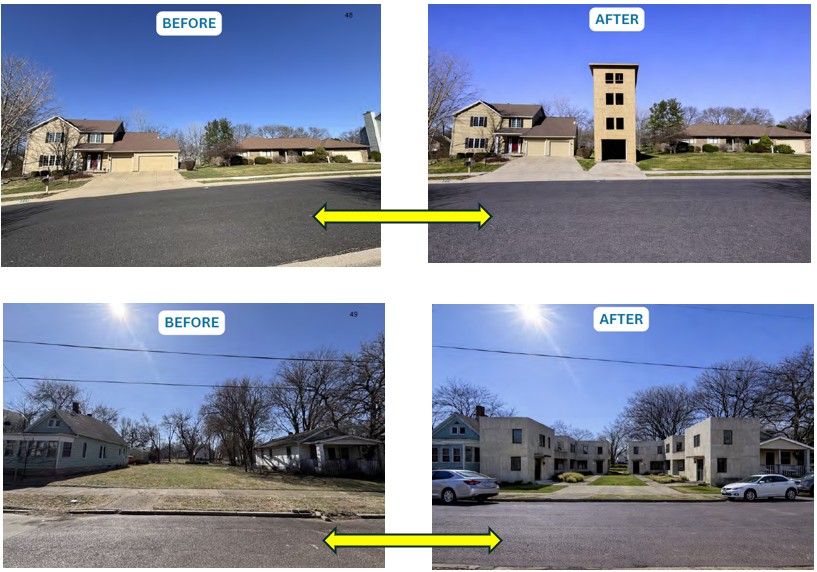
As many of you know, the Governor and state legislators are working to advance legislation that could significantly impact local zoning authority throughout Illinois. If passed, the BUILD Act would allow the State greater control over zoning and development decisions that have historically been managed at the local level by municipalities and their residents.

While supporters argue the bill is intended to address housing shortages and increase development opportunities, many communities, including ours, are concerned about the potential loss of local control and the one-size-fits-all approach the legislation could create.  Every community has unique infrastructure, traffic patterns, environmental considerations, and development goals, and many believe these decisions are best made locally rather than mandated at the state level.  One of the things the Bill requires is that municipalities allow up to 8- unit multi-family buildings in all single-family zoning districts while drastically reducing the minimum lot sizes and setback requirements.

Below are some of the examples and challenges on this part of the bill that communities may face should this bill pass.

Both the Illinois Municipal League (IML), representing 1,294 municipalities statewide, and the Metropolitan Mayors Caucus, representing approximately 275 cities, towns, and villages, oppose the bill in its current form. For those concerned, I encourage all residents to contact your Legislators and Governor’s office and make your voices heard regarding your concerns with this proposed legislation.

Darby Hills, State Senate
Springfield Office: 217-782-8010, District Office: 224-662-4544

Marty McLaughlin, State Representative
RepMcLaughlin@gmail.com
Springfield Office: 217-782-1517, District Office: 224-634-8300

Nabeela Syed, State Representative
info@repsyed.com
Springfield Office: 217-782-3696, District Office: 773-916-6553

Governors Office

Springfield
817-782-6830 or 217-782-6831
Chicago
312-814-2121 or 312-814-2122

IMPORTANT AND HELPFUL LINKS BELOW:

  • Full Building Up Illinois Act HERE
  • Informative presentation put together by the City of Peoria with more examples of what the suggested changes could look like in our community: LINK HERE

Thank you so much, Mayor McCombie!

Related:Pritzker’s affordable housing plan gets Senate hearing as municipalities remain opposed,” “Village of Barrington President shares perspectives on Pritzker’s BUILD plans,” “(Ignoring public opinion) Pritzker says of BUILD Plan for homes would not cost taxpayers,” “Gov. JB Pritzker’s ambitious housing plan for Illinois: More four-flats, looser rules,” “Pritzker to propose statewide zoning laws to spur homebuilding, limit local control,” “McLaughlin’s press conference video recording regarding Pritzker’s proposed municipal zoning powers grab posted,” “It’s just a bad idea’: Suburban officials oppose Pritzker’s plan to reduce local control over residential It’s just zoning

Read Full Post »

Surveillance video captured a half-dozen suspects forcing entry to ReStyle Designers of Barrington, 121 South Cook Street in Barrington, and stealing nearly all of the products in just a minute early in the morning on December 28. | Background: Screengrab; Inset: Provided

By Sam Borcia | Lake & McHenry County Scanner

Police have announced charges against one of six masked suspects who allegedly ransacked a boutique retailer in Barrington, stealing over $100,000 worth of merchandise in December.

The Barrington Police Department responded around 5 a.m. on December 28 to ReStyle Designers of Barrington, 121 South Cook Street, following reports of a disturbance.

Barrington Police Chief David Daigle said a resident living above the business called 911 after hearing multiple males yelling loudly outside and witnessing two vehicles speeding away from the scene.

Officers discovered that the front door of ReStyle Designers had been forced open.

The business owner, who was notified of the incident, responded to the scene and provided officers with surveillance footage that captured a burglary, Daigle said.

ReStyle Designers of Barrington said nearly all of the store’s inventory was stolen, leading to years of hard work and trust “gone in seconds.”

“We are devastated, but we are not giving up. This store has always been about community, and our clients and consignors are more than customers, you are our family,” the store owners said.

“We are grateful to the Barrington Police Department for their prompt response and ongoing assistance,” the store said.

The police department announced the arrest of Jeremiah K. Brown, 21, on Wednesday and said he was charged with burglary, a Class 2 felony, following an investigation.

Report and video can be found here.

Read Full Post »

The Barrington Hills Park District Board/Riding Cult of Barrington Hills will hold their monthly meeting this evening in person and via Zoom at 6:00 PM. Some topics on their agenda include:

  • Approval of the April 2026 Park Board Meeting Minutes (Not provided)
  • Treasurer’s Report Review, Approval of the April 2026 Park District Financials (Not Provided)
  • Advisory Committee Report (Not Provided)

A copy of their agenda can be viewed here. Instructions for accessing the meeting remotely can be found here.

Read Full Post »

The Village Finance Committee meets this afternoon at 1:00 PM. Topics on their agenda include:

  • Year-To-Date-Review
  • Financial Forecasting
  • Financial Efficiencies and Modernizations

A copy of their agenda can be viewed and downloaded here.

Read Full Post »

Matt Paprocki

By Matt Poprocki | Posted to the Daily Herald

Gov. JB Pritzker is marketing himself as a champion of affordability. A proposal to impose the largest passenger toll increase in state history cuts directly against that message.

The plan would raise tolls 45 cents for passenger vehicles and 30% for commercial vehicles. If approved, it would generate an additional $1 billion annually starting in 2027, with automatic increases tied to inflation every two years beginning in 2029, capped at 4% annually.

State leaders have framed the proposal as forward-looking, but in reality it’s another cash grab — for a system that doesn’t need the money.

State leaders approved the potential toll hike in November 2025 to secure labor support for a broader transit funding agreement. But the tollway does not need more money: Toll revenues have exceeded operating and maintenance costs for decades. In 2024 alone, the tollway collected nearly $1.44 billion — the most in its history.

With cost of living a top concern in Illinois, residents and businesses do not need something disconnected from necessity or announced projects.

The Illinois Tollway board has a choice. It can approve a record-setting unnecessary increase that drivers and businesses cannot afford, or it can decline the increase and recognize that Illinoisans already pay enough. Nothing will change; the state still has enough money to run road projects and has a surplus sitting in tollway reserves right now.

Since 2019, Illinois drivers have paid roughly $1,500 more in gas taxes and vehicle fees. Higher tolls would affect not only commuters, but ripple through the broader economy.

Commercial tolls are set to rise by 30%, and those costs will be passed on to consumers through higher prices on everyday goods. Nearly everything purchased in Illinois travels by truck at some point, making this toll increase a broad, indirect tax on households statewide.

The proposal is even more troubling because of its automatic inflation-linked increases. That lets lawmakers avoid future accountability. Costs will simply rise in the background, removed from public debate or oversight.

This approach raises serious concerns about how transportation dollars are being managed. Voters approved the 2016 transportation “lockbox” amendment to ensure money would be used appropriately. While this proposal may comply with that framework, it undermines its spirit by layering on new, permanent revenue streams instead of emphasizing the efficiency and restraint voters were looking for.

Illinois has seen this pattern before. In 2019, Pritzker and lawmakers tied the state’s gas tax to inflation, creating automatic annual increases. The result has been one of the highest gas taxes in the nation and billions in surplus revenue. Now, the same approach is proposed for tolls, despite clear evidence that existing funds are more than sufficient.

Spiking fees beyond what’s needed for road maintenance is unfair to drivers, who should pay only for the actual cost of maintaining infrastructure. Using fees collected from residents and businesses to set aside billions to satisfy unions is directly opposed to improving affordability and economic growth in Illinois.

State leaders could pursue meaningful relief. Georgia and Indiana implemented temporary gas tax holidays to help offset rising fuel costs. With Illinois’ transportation funds running a surplus, lawmakers could provide similar relief without jeopardizing long-term funding.

The board responsible for approving the hike is composed of Pritzker appointees, and the governor himself sits on it as an ex-officio member. If the increase moves forward, it will do so with the backing of the same leadership that claims to want to ease the burden on families.

Will Pritzker allow another unnecessary cost increase on Illinoisans, or will he step in and stop it?

For a governor who says he’s focused on affordability, the answer should be clear.

     – Matt Paprocki is the president and CEO of the Illinois Policy Institute

Read Full Post »

What you need to know about the hyperscale data centers coming to the Midwest | Credit: Illustration by Shira Friedman-Parks

By Siri Chilukuri | Chicago Reader

The explosion of proposed data centers across Illinois has sparked a fierce, bipartisan backlash and even legislation to curb the long-lasting effects on people’s air quality, water quality, and energy bills. In town halls from Pekin to Joliet to Chicago’s southeast side, people have packed rooms and spent hours discussing the impact of potential developments on their communities. As residents grapple with project proposals, it’s never been more important to understand the impact of data centers.

Everything from the emails you send to the photos you save on your phone is stored in a data center. For decades, data centers have been central to the architecture of the Internet, especially the digital lives we lead today. But the rise of artificial intelligence, in particular generative AI—which uses computer models to produce text, images, videos, and more—is driving the development of facilities that use more energy and water than ever before. The size of these so-called hyperscale data centers, and the profit motives driving the rush to get them online quickly, can cause pollution.

Sarah Moskowitz, executive director of the Citizens Utility Board, has been working with utility customers for decades on issues of affordability and climate change. The CUB is an advocacy organization for Illinois ratepayers, which has been watching the rise of data center projects in Illinois and learning more in the process about what they actually do. For Moskowitz, the distinction between next-generation hyperscale data centers that have roiled communities and the existing data center infrastructure is an important one to make. At the most basic level, “a data center is a physical facility containing equipment to store, process, and disseminate digital information,” Moskowitz said. “A hyperscaler is basically a large version of that. Generally, we think of hyperscalers as gigantic facilities, largely deployed to process artificial intelligence.”

Even the term “hyperscale” is imprecise, though, according to Helena Volzer, senior source water policy manager at the Alliance for the Great Lakes. “There’s really no hard and fast definition of what hyperscale even means. It just means a large facility,” Volzer said. Economists at the University of Virginia expect an average hyperscale data center to be about 300,000 square feet by 2030.

Hyperscale data centers are energy intensive not just because of their massive size but also because of what they process. The power used by generative AI is staggering—the computational power needed to train the large language models that power chatbots, such as OpenAI’s ChatGPT or Anthropic’s Claude, and the power needed to perform basic functions once they’re up and running far outpaces the demands of existing data centers. One Goldman Sachs report estimates that AI will spur a 165 percent increase in data center power consumption by 2030.

“What makes the data center problem unique is the fact that these facilities are being built in a specific location, or specific locations, and they are being built en masse,” said Yury Dvorkin, an engineering professor at Johns Hopkins University. “[If] you put a lot of electricity demand in a very constrained location, what happens is that it’s harder for the grid to deliver power in that specific location.”

Report continues here.

Related:Illinois lawmakers begin days of deep dives on data centers,” “Do you trust our Board of Trustees? We don’t. But you decide for yourself once we have finished. (Part 4),” “Do you trust our Board of Trustees? We don’t. But you decide for yourself once we have finished. (Follow-up),” “Do you trust our Board of Trustees? We don’t. But you decide for yourself once we have finished. (Part 3),” “Do you trust our Board of Trustees? We don’t. But you decide for yourself once we have finished. (Part 2),” “Do you trust our Board of Trustees? We don’t. But you decide for yourself once we have finished. (Part 1),” “110 Acre AI data center campus pitched to Village Board

Read Full Post »

The monthly Village Adjudication Hearing(s) is scheduled for today at 11 AM in the MacArthur Board Room.

Read Full Post »

Before the Plan Commission
Village of Barrington Hills
Plat of Subdivision – Lot Consolidation

Notice is hereby given that a Public Meeting will be held on Thursday, May 28, 2026 at 6:30 p.m. by the Plan Commission of the Village of Barrington Hills at the Barrington Hills Village Hall, 112 Algonquin Road, Barrington Hills, IL, concerning an Application filed by the owner of 19 & 21 Peraino Circle, Barrington Hills, IL to request approval of a final plat of subdivision consolidating Lots 8 and 21 of the Subdivision of Barrington Ridge in Barrington Hills, IL to create a single lot. Affected properties are identified by PIN 13-33-301-024-0000 and 13-33-301-016-0000.

A copy of the application and proposed plat for lot consolidation is available for examination in the office of the Village Clerk at the Village Hall, by appointment, during hours of operation. Any interested party will be given an opportunity to provide comment. Written comments on the application for lot consolidation, which will be provided to the members of the Plan Commission, will be accepted in the Office of the Village Clerk through 3:00 PM, May 27, 2026.

By: Village Clerk
Village of Barrington Hills
Clerk@vbhil.gov
112 Algonquin Road
Barrington Hills, IL 60010

Source

Read Full Post »

Before the Plan Commission
Village of Barrington Hills
Plat of Subdivision – Lot Consolidation

Notice is hereby given that a Public Meeting will be held on Thursday, May 28, 2026 at 6:30 p.m. by the Plan Commission of the Village of Barrington Hills at the Barrington Hills Village Hall, 112 Algonquin Road, Barrington Hills, IL, concerning an Application filed by the owner of 60 Spring Creek Road, Barrington Hills, IL to request approval of a final plat of subdivision consolidating property commonly known as 56 Ridge Road and 60 Spring Creek Road in Barrington Hills, IL to create a single lot. Affected properties are identified by PIN 20-29-400-006, 20-29-400-007, and 20-29-400-017.

A copy of the application and proposed plat for lot consolidation is available for examination in the office of the Village Clerk at the Village Hall, by appointment, during hours of operation. Any interested party will be given an opportunity to provide comment. Written comments on the application for lot consolidation, which will be provided to the members of the Plan Commission, will be accepted in the Office of the Village Clerk through 3:00 PM, May 27, 2026.

By: Village Clerk
Village of Barrington Hills
Clerk@vbhil.gov
112 Algonquin Road
Barrington Hills, IL 60010

Source

Read Full Post »

« Newer Posts - Older Posts »