Feeds:
Posts
Comments

Archive for the ‘Illinois Policy Institute’ Category

By Bryce Hill | Illinois Policy Institute

Illinois lost a larger share of income from outmigration than any other state in 2023, according to IRS data.

Federal tax returns show that Illinois lost a net of nearly 56,000 residents and more than $6 billion in income in 2023, the latest data available. When adjusting for total income per state, Illinois’ losses to net outmigration are the worst in the country — more than $11 for every $1,000 previously earned in the state.

While California ($13 billion) and New York ($10.6 billion) lost more income from outmigration, Illinois lost the largest share of a state total.

Meanwhile, South Carolina and Florida, two of the top three states adding the most total income from people moving in, also added the most as a share of their total income.

Part of why Illinois sees so much wealth flight is that high-income Illinoisans are leaving at twice the rate of other groups. People in all income brackets are moving out of the state, but those earning more than $200,000 a year have been leaving the fastest.

Article continues here.

Read Full Post »

A net of nearly 56,000 people and $6 billion in income left the state in 2023, according to IRS data.

By Bryce Hill | Illinois Policy Institute

Illinoisans who leave take a lot of money with them.

Federal tax returns show the state lost 55,609 people and $6 billion in adjusted gross income on net in 2023, the most recent IRS data available.

Most of those people were high-income. While people of all income levels left Illinois in 2023, the heaviest loss was among those making more than $100,000 a year. They made up 60% of the state’s net migration losses.

The economic impact of those departures is even greater: Filers making more than $100,000 took more than $5.5 billion with them — 90% of the state’s income loss.

Illinois lost residents to 38 states and the District of Columbia in 2023. By far the largest share of individuals and income was lost to Florida, which gained 10,583 residents and $2.4 billion in income from Illinois.

Texas was No. 2, adding 7,795 residents and $488 million in income from Illinois.

Article continues here.

Read Full Post »

The governor should say yes to a program that would provide donated education money for Illinois families.

By Lilly Rossi | Illinois Policy Institute

A billion dollars for Illinois students is on the line.

Gov. J.B. Pritzker can opt into a new program and allow Illinois families and students access to almost that much in donated education money.

Or he can watch the money flow to other states.

new program allows donors to take a tax credit of up to $1,700 for qualified donations. If just 30% of filers in Illinois took the full credit, the state could gain nearly $1 billion a year in new education resources to be used for millions of students.

The money would help students afford a tutor, attend ACT or SAT prep sessions, pay tuition or fees, get special education services or assist with other academic needs.

Starting next year, any taxpayer can get the credit for a qualified contribution up to $1,700 to a scholarship-granting organization.

The only cost of the program is minimal foregone income tax revenue to the federal government. There is no cost to participating states, only the benefit of more help flowing directly to students.

A number of taxpayer-participation scenarios show that “even modest taxpayer engagement could translate into significant resources,” according to an analysis from Education Reform Now. Based on an estimated participation rate of taxpayers eligible to receive the full $1,700 tax credit in Illinois, students in the state could see as much as $1 billion.

Article continues here.

Read Full Post »

The governor pins the issue on local governments, but state law and decisions contribute to the problem.

By LyLena Estabine | Illinois Policy Institute

Gov. J.B. Pritzker isn’t as innocent as he wants us to think when it comes to Illinois’ property tax woes.

“I want to remind you that property taxes are not determined by the state of Illinois, but rather by local governments…including school boards, park boards, library boards, municipalities, etc.,” he said last month.

He put special emphasis on school boards.

Pritzker is right that local taxing bodies set levies, but suggesting those decisions have nothing to do with him is naive at best and dishonest at worst. State mandates, pension obligations and funding choices he oversees play a significant role.

Under the governor, property taxes have risen nearly 27% — from $31.8 billion in 2018 just before he took office to $40.37 billion in 2024.

State decisions shape some of the largest pressures behind those tax bills.

Illinois public schools are primarily funded by property taxes. But school districts are forced to rely so heavily on those taxes in part because the state diverts a growing share of its education spending to pensions instead of classrooms.

Article continues here.

Read Full Post »

Drivers paid nearly $27 billion in tolls from 2024 back to 1973, the year the roads were to become toll-free. Now the largest passenger toll hike in Illinois history is possible.

By Patrick Andriesen | Illinois Policy Institute

In the 53 years since they were supposed to become free, drivers have paid nearly $27 billion to use Illinois’ toll roads.

Those drivers now face the possibility of the largest passenger toll increase in state history.

In a move to gain union support, last year’s transit bailout bill allows the Illinois State Toll Highway Authority board to implement a hike that could raise $1 billion more in tolls a year starting in 2027.

Passenger drivers could see an increase of 45 cents per toll, driving the average up to $1.24, based on the most recent data. Commercial tolls could rise 30%.

That’s despite the fact that since 1973, the authority has collected more in tolls each year than it needed to operate and maintain the system. The agency reported more revenue from tolls in 2024 than any year in the tollway’s history.

For a hike to take effect Jan. 1, the board must vote by Dec. 2.

Record toll revenue in 2024

Illinois has five toll roads totaling almost 300 miles, mainly in Northern Illinois. The tollway authority took in nearly $1.44 billion in tolls in 2024, the most in any year since tolls were first charged in 1959.

Commercial drivers paid $742 million of that, again more than any other year in the tollway’s history, and passenger drivers paid $697 million. The total of almost $1.44 doesn’t count revenue recovered from fare evasion and penalties.

Article continues here.

Read Full Post »

Outside Chicago, only a fourth of municipal property taxes collected this year for police and fire are going to services.

By LyLena Estabine | Illinois Policy Institute

The vast majority of the police and fire levies in last year’s Cook County property tax bills funded pensions, not protection.

The 2024 police and fire levies for cities outside Chicago total $599 million. Just over $450 million of that is for pensions, according to the Illinois Department of Revenue.

First-installment bills are due April 1. Many in the county may still be recovering from the delayed property tax bills that were due Dec. 15. Some of those bills grew by record-setting amounts.

Since 1996, the amount Cook County municipalities outside Chicago have levied to keep up with police and fire pensions has grown by 416%, while the amount levied for services hasn’t even doubled.

The amount going to fund protection increased by about $2 million in 2024 levies over 2023. The amount for pensions rose $27 million.

Police and firemen deserve generous pensions given the risk in their work. But when those benefits become too generous — as they are in Illinois — they undermine retirement security and reduce the amount of money available for service.

Article continues here.

Read Full Post »

Counter to the governor’s claims, Illinois students’ scores on a national assessment have dropped despite more education spending.

By Hannah Schmid | Illinois Policy Institute

Gov. J.B. Pritzker recently touted Illinois eighth-graders’ reading and math scores as proof of increased public school funding’s effect on student success.

Here’s the reality: Illinois students’ scores have dropped despite that increased spending. And there’s more to the data than Pritzker let on about Illinois students outperforming those in other states.

If the governor wants to help students, he should join the majority of states that are opting into a federal program that provides donor money for students’ targeted needs.

Illinois student scores drop despite increased education spending

In his budget address last month, Pritzker said “historic investments” in public education have boosted student success. But Illinois student performance in both reading and math fell over the most recent 10 years of the National Assessment for Educational Progress.

Those declines weren’t just because of COVID-era shutdowns. Both eighth- and fourth-grade scores were dropping in both reading and math even before schools were closed.

During that same period from 2013 to 2024, the state’s spending on K-12 education rose by nearly $10 billion. That’s a 44% increase over a period when enrollment declined 10%.

Counter to Pritzker’s claims, the increased spending on Illinois schools has not improved student achievement.

Article continues here.

Read Full Post »

Gov. J.B. Pritzker wants more federal funding. A new program would provide donor money— but he must opt in.

By Mailee Smith | Illinois Policy Institute

Gov. J.B. Pritzker wants a bipartisan effort from Illinois lawmakers to demand more education money from the federal government.

Yet Pritzker himself hasn’t taken a simple step to get more funding for Illinois students.

If he wants to keep money in Illinois and away from the Trump administration, the answer is easy: Opt into the Federal Scholarship Tax Credit Program, which provides a tax credit to donors who give money that can go to public, private or homeschool students.

If the governor doesn’t opt in, that money will flow out of the state — exactly where he doesn’t want it to go.

Pritzker demands more money from the federal government

Pritzker didn’t mince words in his annual budget address last month. He blames the Trump administration for stripping Illinoisans of billions of dollars — and he wants it back.

“I want to say to anyone on either side of the aisle: If you want to talk about our (fiscal) 2027 budget, you must first demand the return of the money and resources this president has taken from the people of Illinois,” he said.

Two days later, the governor sent a letter to President Donald Trump demanding a refund of $1,700 for every Illinois family. The letter followed the U.S. Supreme Court’s decision striking down the presidents’ tariffs. Pritzker says the tariffs have cost Illinoisans over $8.6 billion.

But Pritzker has the means to keep at least some Illinois tax money from flowing to Washington. The Federal Scholarship Tax Credit Program would do exactly what he wants: keep money in the state while costing nothing.

To do that, he must opt into the program.

Pritzker could get more money for kids

The Federal Scholarship Tax Credit Program provides a dollar-for-dollar annual tax credit up to $1,700 for donors to scholarship-granting organizations. Those organizations then provide money to eligible public, private or homeschool children for tutoring, fees for dual enrollment, educational therapies for students with disabilities and other academic needs.

It’s a win-win-win: Students get much-needed education funding, donors get tax credits, and no money is diverted from public schools.

Pritzker must opt the state into the program for students to get the money. Donors will get the tax credit even if he doesn’t.

If Pritzker doesn’t act, that money will go out of Illinois — either to students in other states as education donations or to the federal government in the form of taxes.

To date, at least 28 states have indicated they will opt into the program.

Article continues here.

Read Full Post »

The state’s data center boom is reshaping energy, water use and taxes. Here’s what residents should know about the costs, jobs and incentives involved.

By Brennan Park | Illinois Policy Institute

Data centers are expanding across Illinois amid the tech industry’s rising demand for cloud computing. Supporters say the facilities bring investment and jobs, while critics worry about rising energy costs, environmental effects and tax incentives.

Illinois lawmakers are considering passing more stringent regulations on the growth and operation of data centers, with bills recently introduced in the House and Senate. These bills would require “hyperscale” data centers to expand renewable energy and “strengthen equity, transparency, and labor standards in clean energy initiatives,” among other new rules.

Here’s what every Illinoisan should know about the data center boom and tradeoffs the state makes to be a part of it.

1: Illinois is already a major data center hub, with the growth accelerating

Illinois boasts the fourth-highest number of data centers in the country, at 244 sites. That’s because the state provides much of what data center developers need: energy, environment and space.

These facilities need large amounts of reliable, clean electricity. They also require a cool, stable climate and ready access to water to prevent overheating. Illinois’ weather, rivers and proximity to Lake Michigan provide those conditions.

Flat land and industrial sites also make it easier and cheaper to build large-scale facilities. Illinois has a lot of both.

Most of the current development is concentrated in Chicago and its suburbs, with new projects from companies such as STACK InfrastructurePrime Data Centers and Prologis.

Aurora is home to Prologis Project Steel, with 24 completed data center buildings, and Project Cardinal, with 14. Southern and central Illinois are also proving attractive. CyrusOne is slated to host a 600-megawatt data center campus in Springfield, one of the largest proposed in the state.

Article continues here.

Related: 110 Acre AI data center campus pitched to Village Board

Read Full Post »

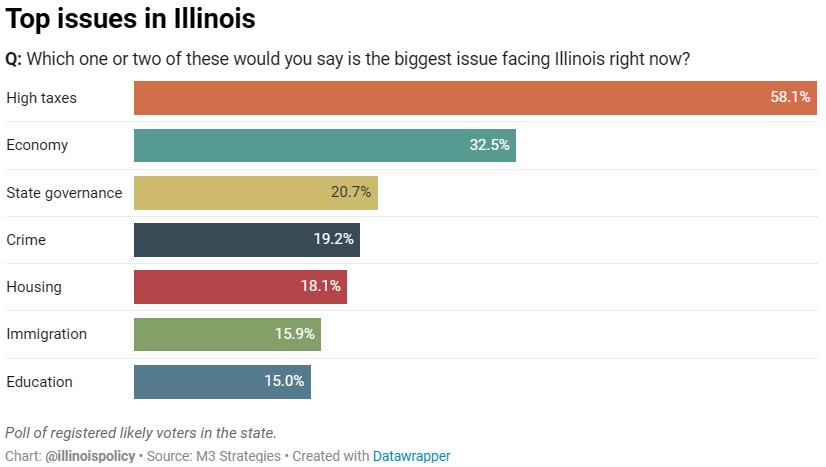
At least 49 tax hikes under Gov. J.B. Pritzker have driven state spending to record highs, even as Illinois’ economic growth has lagged the U.S.

By Ravi Mishra | Illinois Policy Institute

Illinois lawmakers frequently boast about economic growth and development, yet Illinois has posted one of the slowest gross domestic product growth rates in the nation while the budget has soared.

Illinois’ budget doesn’t reflect economic reality

Illinois’ budget has grown at an alarming rate during Gov. J.B. Pritzker’s tenure. While government spending is a component of GDP, rapid increases in public spending can crowd out private economic activity. Higher taxes used to finance this public spending can hurt consumption and private investment, a dynamic that seems to be playing out in Illinois.

Since 2018, Illinois’ economy has grown just 7.4% – among the slowest of any state. In that same time, the state budget has grown over 36%, nearly five times faster than the economy. The U.S. economy has grown 18%, 2.5 times faster than Illinois’.

If not the economy, what has driven the state’s budget surge?

Pritzker’s administration has enacted at least 49 tax hikes since 2019. Some of the most egregious examples include:

  • Doubling state gas taxes and tying annual increases to inflation thereafter, creating a $3.3 billion surplus in the state’s road fund.
  • Halting the repeal of the franchise tax, which had been agreed to in 2019.
  • Capping the retailers’ discounts – the portion of sales taxes retailers were allowed to keep as reimbursement for collecting the taxes – effectively raising sales taxes on brick-and-mortar businesses.

Not only have these hikes hit taxpayers and employers but have also weighed down Illinois’ economic performance. Illinois already has had among the highest corporate tax rates in the country, but recent changes have only made the system more complex and burdensome. The tax environment has led to the state losing businesses, and combined with high overall burden, has contributed to years of population decline.

Read more here.

Read Full Post »

Older Posts »