Feeds:
Posts
Comments

Archive for the ‘Democratic Socialists of America’ Category

Republican state Rep. Martin McLaughlin of Barrington Hills spoke out in February against Gov. JB Pritzker’s plan to reduce local control of residential zoning rules in a news conference in South Barrington. Flanking him were Algonquin Village President Debby Sosine, left, and South Barrington Mayor Paula McCombie. | Brian Hill/bhill@dailyherald.com

Daily Herald Editorial Board

In District 52, incumbent Republican Martin McLaughlin brings a lengthy Springfield record focused on fiscal responsibility. We endorsed him in 2020 for his energy and resourcefulness, in 2022 for his measured approach to state government and in 2024 as a steadfast voice for controlled spending. Democratic challenger Maria Peterson emphasizes lower costs for working families, affordable housing, gun-violence prevention, health care and tax changes. While Peterson is a strong candidate, McLaughlin’s experience and focus on fiscal restraint and oversight continue to make him the stronger choice. McLaughlin is endorsed.

Endorsement can be seen here.

Related: “Editorial: Martin McLaughlin for Illinois 52nd House District” – Chicago Tribune

Read Full Post »

By Steve Zalusky | Daily Herald

In the wake of four (4) school board members coming under investigation, Barrington Area Unit School District 220 has updated a key policy governing political activity by elected officials.

The update, approved by board members last week, allows board members seeking elected office to mention District 220 or use incidental photos of district property in campaign materials, but only as long as they don’t suggest a district endorsement.

“Not to say that the prior policy wasn’t great, but this, I think, clarifies a lot of things,” board member Steve Wang said.

The policy update comes after board member Erin Chan Ding was found to have violated district policies by using school resources, property and social media for prohibited political campaign activities related to her campaign for the Illinois House.

Fellow board members Leah Collister-Lazzari and Barry Altshuler also violated policies by posting images of students, district property and the district’s chess piece logo on campaign social media sites during their 2023 runs for school board.

School board President Sandra Ficke-Bradford was investigated and cleared of wrongdoing regarding a photo of her in front of Barrington High School that appeared in a news article related to the 2025 election.

The board next will be examining its ethics and gift ban policies, officials said

Report continues here.

Related: ““District 220 board members violated campaign policies, investigation finds,” “Proposed Policy Change Would Strip Anonymous Formal Grievances in Barrington District 220,” “CUSD 220 Board delivers second (slappier) slap on the wrist to member Erin Chan Ding,” “CUSD 220 Board of Education public comments we applaud,” “Over $100,000 in Special Interest Funding gifted to 220 Board member’s campaign in failed bid for State Rep job,” “New Evidence of Chan Ding’s Policy Violations and Conflicts of Interest,” “The D220 Board of Ed gets another ‘F’ in accountability & transparency,” “The Real Issue in Barrington 220 Isn’t Parking or Levies — It’s Leadership Culture,” “BOARD OF ED VOTES, MEMBER CHAN DING MADE FLAGRANT POLICY VIOLATIONS – Part 2,” “BOARD OF ED VOTES, MEMBER CHAN DING MADE FLAGRANT POLICY VIOLATIONS,” “District 220’s Lack of Transparency (Updated),” “District 220’s Lack of Transparency” and “Change.org Petition: ‘For the Resignation of Erin Chan Ding ~ D220 Resources are Not for Political Campaigns’”


Read Full Post »

Martin McLaughlin is a Republican running to represent Illinois’ 52nd House District. (George Papadakis)

By The Editorial Board | Chicago Tribune

Republican state Rep. Martin “Marty” McLaughlin barely survived his last election, defeating Democrat Maria Peterson by just 47 votes in 2024. The two are facing off again in this northwest suburban district.

McLaughlin, 61, an investment manager and former Barrington Hills village president, has been a consistent voice for fiscal restraint in Springfield. He identifies property taxes as the district’s most pressing problem and has helped residents navigate the appeals process. “If government is going to keep raising the bill, taxpayers at least deserve to know how to fight an unfair assessment,” he told us.

McLaughlin’s fiscal conservatism is important in a state that desperately needs greater discipline in that area.

Martin McLaughlin is endorsed.

Read the full editorial endorsement here.

Editorial note: Representative McLaughlin is also endorsed by:

  • Eleanor Sweet McDonnell, Mayor, North Barrington*
  • Paula McCombie, Village President, South Barrington*
  • Karen Darch, Former Mayor, Barrington*
  • Andrew Burke, Mayor, Lake Barrington*
  • Kevin Richardson, Former Mayor, Lake Barrington*
  • Keith Vogeler, Mayor, Port Barrington
  • Jeff Sode, Mayor, Wauconda
  • Debby Sosine, Village President, Algonquin
  • Ray Bogdanowski, Village President, Lake in the Hills
  • Donna Johnson, Mayor, Libertyville
  • Richard McLaughlin, Mayor, Island Lake
  • Steve Henley, Mayor, Volo

It’s important to note McLaughlin’s campaign rival lives in North Barrington yet she could not garner an endorsement for this or her prior campaigns.

*Present and former members of the Barrington Area Council Of Governments (BACOG).


Read Full Post »

By Sarah Roderick-Fitch | The Center Square

A majority of American voters are concerned with socialist candidates running and possibly winning political office, according to a new poll.

The Center Square Voters’ Voice poll found that 55% of American voters are concerned about Democratic Socialist candidates running for and winning elected office in the U.S., while 37% aren’t concerned.

A slew of candidates running as democratic socialists appears to be raising alarms with a majority of American voters.

Of the 55% who are concerned, 35% are very concerned, while 20% say they are “somewhat concerned.”

(Click on image to enlarge)

Of those not concerned, only 17% say they are not too concerned, while 20% say they are not at all concerned.

The poll comes as several Democratic Socialist candidates have risen in popularity across the country. The Democratic Socialists of America are touting 67 wins across the country, with 93 running. However, the group includes 62 DSA candidates who have lost.

Report continues here.


Read Full Post »

By Paul Vallas | John Kass News

October 11th, 2026

Illinois leadership is sustaining policies that have done nothing to improve equity or affordability while swapping out middle- and upper-income families for the poor and illegal migrants.

JB Pritzker’s greatest legacy will be the acceleration of the “Great Displacement,” the demographic upheaval in which Illinois is losing scores of affluent residents through outmigration while gaining relatively poorer ones through both interstate and international migration.

This shift is largely the product of the state’s so-called progressive policies. High taxes and fees remain the primary reason Illinoisans cite for leaving, followed by failing schools, rising crime, limited economic opportunity, and expansive sanctuary measures that encourage low-income in-migration.

According to Wirepoints, Illinois continues to hemorrhage wealthy residents. Since 2000, the state has lost roughly 1.6 million people — third most in the nation, behind only California and New York. Chicago’s population, even with the recent influx of migrants, is now at its lowest level in nearly a century. Almost every county in Illinois has experienced a decline in population. Even more troubling, Illinois isn’t merely losing residents — it’s losing income. [1]

The IRS reports that in 2022 alone, 87,311 residents left Illinois, taking with them $9.9 billion in adjusted gross income. The real damage runs deeper: The outflow disproportionately includes residents in their prime earning and spending years. This brain and income drain erodes the tax base, shrinking critical property, sales, and consumption tax revenues that support state and local budgets. [2]

A detailed Wirepoints analysis of IRS migration data for 2022 shows Illinois was the nation’s second-biggest loser of households aged 26-35 earning more than $200,000. Unsurprisingly, zero-income-tax states such as Florida and Texas were the leading destinations for these upwardly mobile millennials. Illinois has been bleeding this cohort for more than a decade, but the acceleration is alarming. [3]

Wirepoints also found that in 2022, the average adjusted gross income for these departing young households was $435,000. The exodus continues among those aged 35-45 with incomes over $200,000 — another key demographic of high earners. Illinois ranks 48th nationally for losses in this income bracket. More concerning, the average AGI among this group leaving approaches $700,000. [4]

Vallas’ report continues here.

Paul Vallas formerly ran the public school systems in Chicago, Philadelphia and the Louisiana Recovery School District. He was a candidate for Mayor of Chicago.

Read Full Post »

Data suggest the state is on pace to lose a U.S. representative in 2030.

By Lilly Rossi | Illinois Policy Institute

Illinois is on pace to lose its second congressional seat because of population loss under Gov. J.B. Pritzker.

Since Pritzker was elected in 2018, Illinois has lost more than 168,000 residents. In a recent poll of Illinois voters, more than half said they would leave the state if given the opportunity.

Of those who would leave, almost 69% cited taxes as a top one or two issue facing Illinois. In 2024, 95% of those leaving Illinois fled to states with lower tax burdens.

Pritzker entered office as Illinois was already struggling with outmigration. He identified reversing it as a goal in his 2019 economic plan.

Nearly eight years later, that has not happened.

Illinois lost a congressional seat after the 2020 census, continuing a decades-long decline in the state’s representation in Washington. Illinois has lost 10 U.S. House seats since 1910, falling from 27 to 17.

Now past the halfway point in the decade, census data suggest that Illinois is on pace to lose another House seat in the reapportionment after the 2030 census.

In 2030, a decennial census will tally the state’s population and determine how congressional seats are distributed nationwide. Despite small population increases from 2023 to 2025 because of international migration, Illinois has lost residents overall under Pritzker’s administration. Also, international migration to Illinois is declining while the state continues to struggle with outmigration.

Read more here.

Read Full Post »

Maria Peterson is running for the IL House District 52 seat. Nabeela Syed is running for IL Senate District 26. Currently both choose only to campaign publicly as “Democrats.” | Images courtesy Facebook

Much has been said and written about the, “Democratic Socialists of America (DSA),” in recent months leading to the mid-term elections. Their website states:

“Capitalism is a system designed by the owning class to exploit the rest of us for their own profit. We must replace it with democratic socialism, a system where ordinary people have a real voice in our workplaces, neighborhoods, and society.

We believe there are many avenues that feed into the democratic road to socialism. Our vision pushes further than historic social democracy and leaves behind authoritarian visions of socialism in the dustbin of history.

  • We want a democracy that creates space for us all to flourish not just survive and answers the fundamental questions of our lives with the input of all.
  • We want to collectively own the key economic drivers that dominate our lives, such as energy production and transportation.
  • We want the multiracial working class united in solidarity instead of divided by fear.
  • We want to win “radical” reforms like:
    • Single-payer Medicare for All,
    • Defunding the police/refunding communities,
    • The Green New Deal, and
    • More as a transition to a freer, more just life.

We want a democracy powered by everyday people. The capitalist class tells us we are powerless, but together we can take back control.”

They have further stated their priorities, including:

That’s pretty much all we needed to read to form our opinions, and most who have read these pages for nearly two decades know what they likely are.

However, feel free to visit the Democratic Socialists of America website to learn more so that you might be enlightened before reaching your own opinions before casting your ballots.

Related: “Inside the DSA’s audacious quest for power in the Democratic Party“

Read Full Post »

Illinoisans can vote on races ranging from U.S. Senate and governor to state lawmakers and local officials in the Nov. 3 election.

By Jon Josko and Lilly Rossi | Illinois Policy Institute

Some recent Illinois state legislative races have been decided by just dozens or hundreds of votes.

A look since 2022 shows where the closest races have been, how few votes separated the candidates and what voters in competitive districts identified as their biggest concerns.

Casting a ballot gives Illinoisans a voice in who represents them, while understanding voters’ concerns gives lawmakers a clearer picture of what their constituents want addressed.

How close are races in Illinois?

In 2024, a mere 47 votes out of nearly 59,000 decided who represents Illinois’ 52nd House District. State Rep. Martin McLaughlin, R-Lake Barrington, held onto his seat over Democrat Maria Peterson by less than one-tenth of 1% of the votes.

That was the slimmest margin in Illinois’ most recent two election cycles, but not the only close one. Nine other state House and Senate races since 2022 were decided by fewer than 1,700 votes apiece — and they were concentrated in a handful of places worth knowing if you live nearby.

10 closest state legislative races 2022-2024

Margin of victory in the 10 closest Illinois House and Senate races, 2022-2024

Seven of the 10 sit in Chicago’s outer suburbs and exurbs, stretching from Lake and McHenry counties through DuPage, Kane and Will. The other three are downstate: one anchored around Danville and Champaign, one around Springfield and Decatur and one in the Metro East region across the river from St. Louis.

10 closest state legislative races 2022-2024

Margin of victory in the 10 closest Illinois House and Senate races, 2022-2024

How many people does it take to decide these races?

If you’ve ever wondered whether your vote matters in a state regarded as relatively uncompetitive, consider this: Among the 175 contested state House and Senate races since 2022, half were decided by a margin smaller than 1-in-10 of the eligible adults in that district. A quarter of contested races came down to fewer than 1-in-17.

90 contested legislative races decided by fewer than 1 in 10 adults

Number of contested state legislative races, 2022-2024, by win margin as share of district’s eligible adult population.

That pattern held across both chambers and both years, though state Senate races have generally been decided by a somewhat smaller share of eligible adults than House races. Roughly 6-in-10 Senate races came in under that 1-in-10 mark, versus about 46% of House races, consistent with Senate districts being larger and drawing more votes.

What do Illinoisans care about?

In districts with tighter election margins, candidates will have to make sure they are addressing their constituents’ major issues.

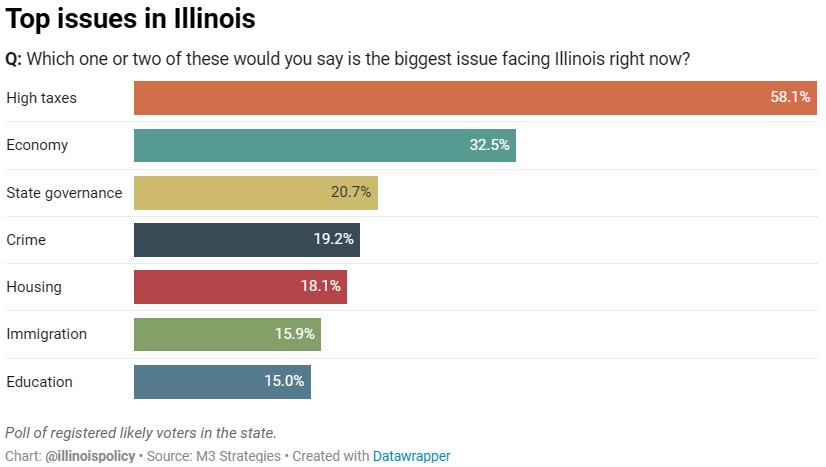
In the Illinois Policy Institute’s statewide tracking poll, fielded quarterly since 2025, high taxes has been the single most-cited concern every time, named by 52% to 60% of respondents as one of their top two issues, roughly double the next-closest answer.

In the most recent poll, from August 2026, 58.1% named high taxes as their No.1 or No. 2 issue, compared with 32.5% for the economy generally and 20.7% for state governance.

Property taxes in particular seem to be the aggravation behind that number. The May 2026 version of the same poll asked residents how satisfied they are with the value their community receives for the property taxes paid. Over 61% said they were dissatisfied, against just 23.5% satisfied.

Article continues here.

Read Full Post »

State Rep. Martin McLaughlin, R-Barrington Hills, and Maria Peterson debate issues at a League of Women Voters forum in Barrington on Tuesday ahead of the Nov. 3 election. | Steve Sadin/For the Lake County News-Sun

By Steve Sadin | For the Lake County News-Sun

A mere 27 votes separated state Rep. Martin McLaughlin, R-Barrington Hills, from his 2024 Democratic challenger and current reelection opponent, Maria Peterson of North Barrington.

While Peterson and McLaughlin agree that making changes in the tax laws is legislation they will attempt to tackle in the 105th Illinois General Assembly, their approach to easing taxpayers’ burdens is different.

McLaughlin said he lowered the real estate tax levy seven of the eight years he served as mayor of Barrington Hills. He sees providing municipalities the 10% of state income taxes they once received instead of the current 5% as giving the towns an alternative source of revenue.

“That money would come back to your community and your community could lower your property taxes,” he said.

State Rep. Martin McLaughlin, R-Barrington Hills, left, talks to a voter before a League of Women Voters forum in Barrington on Tuesday ahead of the Nov. 3 election. | Steve Sadin/For the Lake County News-Sun

McLaughlin and Peterson shared views on taxes, artificial intelligence, reduced federal funding, and more, campaigning for the Nov. 3 election before more than 150 people Tuesday at a Barrington forum sponsored by the League of Women Voters.

After the moderator asked the candidates what they would do to reduce property taxes for homeowners, she queried them several questions later about their top priorities should they be chosen to serve in the 105th General Assembly. Taxes were on both their lists.

Using tax credits as a form of relief, McLaughlin said he had ideas for both younger people and seniors. He would push for a tax credit for young families to “make life more affordable for young families so they can afford a home.”

“I will push for the senior tax credit to be increased to $75,000,” McLaughlin said. “If two seniors are in a home with Social Security, it’s too low. It should be higher, at least $95,000 so seniors can get a break on their property taxes.”

Read the full article here.

Related: “League of Women Voters 52nd District Candidate Forum recordings released”

Read Full Post »

People walk along North Michigan Avenue as tulips bloom April 12, 2026, in downtown Chicago. | Brian Cassella/Chicago Tribune

The last dumb idea from City Council

By The Editorial Board | Chicago Tribune

A new parking meter deal is done and dusted, as City Council on Tuesday approved a $2.53 billion agreement allowing Stonepeak Partners to take over the remaining 57 years of Chicago’s parking meter lease. Good. We were tired of writing about this historic disaster.

But that doesn’t mean there cannot be another one just ahead.

Now, aldermen are looking to the future. And as some gaze into their crystal ball, they see a brave new world in which suburbanites pay more to park.

An idea is floating around to bifurcate parking meter prices, adding a surcharge of 25 to 50 cents an hour for non-Chicagoans who park in the city, according to Ald. Walter “Red” Burnett, 27th.

Ald. Walter “Red” Burnett – Remember his face because we highly doubt this will be the last dumb idea he’ll have.It’ll raise revenue, he says, though he couldn’t say how much, and encourage public transit, though that doesn’t take into account the frequent inadequacy of those options from the suburbs, especially on evenings and weekends.What we know for sure is that such a move is crazy-town nonsense.

Ald. Walter “Red” Burnett – Remember his name and face since we highly doubt this will be the last dumb idea he’ll have.

“It’s easy to track, they already have the data now,” Burnett said. “We want our suburban counterparts to help when they’re clogging up the system.”

Clogging up the system? Oy.

We have an altogether different view of our neighbors to the north, south and west.

We view them not as bumbling annoyances from which to extract extra cash for the privilege of parking their car on the street, but value their awe and enjoyment of our city, even if they only stick around for a little while.

Editorial continues here.

Read Full Post »

Older Posts »