Feeds:
Posts
Comments

Archive for the ‘The Chicago Way’ Category

Chicago will have one of the highest big-city rates in the country when the transit tax inches up Aug. 1.

By Adam Gorcyca | Illinois Policy Institute

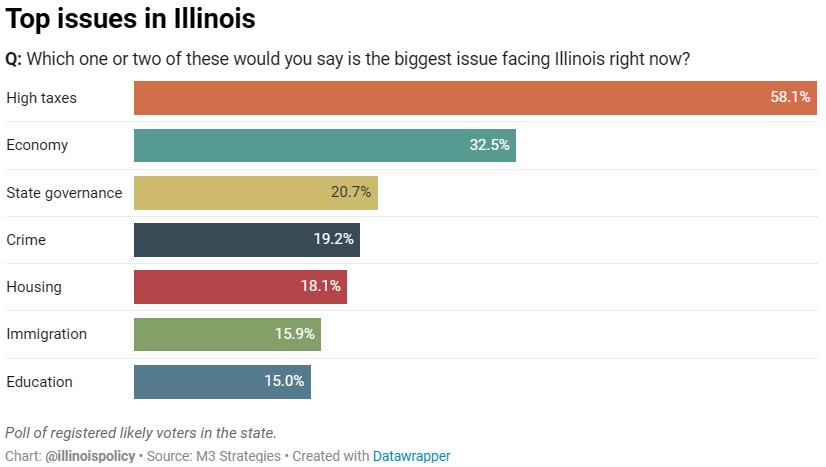
Illinois’ high sales taxes are about to get higher in the Chicago area.

Across Illinois, the combined state and average local sales tax is 8.98%, according to the Tax Foundation. That’s eighth-highest in the U.S. and highest in the Midwest.

The state did end its 1% grocery tax Jan. 1, though more than half the local governments in Illinois have one.

For over a decade Illinois has been one of the nation’s least competitive states in terms of sales tax. The last time Illinois placed outside the top 10 highest sales tax rates was 2013.

Of the states bordering Illinois, Missouri has the highest combined average rate, but it’s still over a half a percentage point lower than Illinois’.

Wisconsin in particular stands out in comparison with Illinois, with a combined average rate of 5.72%, and Kentucky is not far behind, at 6%.

Article continues here.

Read Full Post »

Illinois drivers have only a short window to comment on a $26.5 billion capital plan that includes the largest passenger tollway hike in state history.

By Shaw Carlson | Illinois Policy Institute

Drivers face up to 15 years of additional construction and congestion on Illinois toll roads under the system’s proposed capital plan.

They’ll also pay toll hikes continuing long after that.

The Driving Connections plan, announced in June, would spur projects on the Illinois Tollway system until 2042. The $26.5 billion plan would be funded with proposed toll hikes that Gov. J.B. Pritzker signed off on six months before the plan was released.

Former Tollway board member and state Sen. Bill Morris told the Daily Herald that “it appears they decided to raise tolls, and then they threw this together quickly for justification.”

The Tollway proposes raising tolls starting Jan. 1 by about 45 cents per toll for passenger drivers and 30% for commercial drivers. It would be the largest passenger toll hike in state history.

You can tell the Tollway Board to reject the tax hike here.

The board is hosting public meetings until July 24 and taking public comments online until noon Aug. 3. The next regular board meeting at which the hike could be approved is Aug. 19.

Lawmakers driven by road needs or union politics?

The proposed toll hike is tied to politics around last year’s mass-transit bailout. Lawmakers redirected about $1 billion a year from the Road Fund toward Chicago-area public transportation, a move opposed by construction unions objecting to losing that road money. The toll hike became the price for labor union support.

House Speaker Chris Welch said unions wanted something to point to that would “help keep working people working and keep roads getting repaired.”

Pritzker appoints the tollway board, and two of its members hold leadership positions in construction unions.

The Driving Connections plan would fund road-widening, reconstruction, bridge work and congestion relief across interstates 355, 88, 294, 80, 94, 90 and the Route 390/I-490 O’Hare-area projects.

Many of those toll roads have recently seen extended periods of construction.

I-294 remains tied up in Central Tri-State work, I-90 was modernized during the previous capital plan and Route 390/I-490 work has been going on for years.

Illinois spent $90,400 per lane-mile in 2023 on state-owned roads — about $16,700 more than the Reason Foundation’s model calculated it should have cost.

Article continues here.

Once again, you can tell the Tollway Board to reject the tax hike here.

Read Full Post »

A roadside sign reads “Welcome to Illinois, The Land of Lincoln,” next to highway signs for Chicago and Indianapolis. | Photo: Sarah Roderick-Fitch / The Center Square

By Sean Reed | The Center Square

While Illinois contemplates raising prices on tollways across the state, one state lawmaker wants increased transparency for drivers.

State Rep. Martin McLaughlin, R-Barrington Hills, announced he plans to introduce the “Truth in Toll Transparency Act,” which he said will give drivers on Illinois tollways a more advanced warning of the cost to enter a toll.

He told The Center Square he wanted to bring the measure forward because drivers often aren’t made aware of the actual cost of a toll until it’s too late to turn around.

“You will see a sign that says ‘toll ahead’ or ‘paid toll,’ but it does not define what the cost of that toll is going to be on the majority of tollways,” McLaughlin said. “If you’re going to continue to charge us for the tolls, the least you should expect would be to get an exact exact dollar amount before you enter a toll point, and that’s not happening today.”

McLaughlin said the proposed law may come at a small cost to update and place new signage near tollways, but he said that cost would come alongside the tollway already needing to update signs if it approves a rate hike.

McLaughlin noted he doesn’t feel proposed toll increases, which are set to be voted on by Illinois Tollway officials in the coming months, are necessary right now. The increase would be 45 cents per toll for IPASS users and a 30% rate hike for commercial IPASS users.

“To me this is just another opportunity to demand transparency from those in Illinois that have a spending addiction, but have a transparency problem and if you’re going to hit up me and my neighbors for these numbers, let us know in advance before we enter into the toll,” McLaughlin said.

Report continues here.

Read Full Post »

Lawmakers work in the Missouri House chamber on April 21, 2026, in Jefferson City, Missouri. Missouri is asking voters whether to gradually eliminate its income tax and shift more toward taxing consumption. (David A. Lieb/AP)

Missouri, Iowa, Indiana and Wisconsin all are thinking creatively about taxes

By The Editorial Board | Chicago Tribune

Illinoisans often assume high taxes are simply the unavoidable cost of living in the Land of Lincoln. But just across our borders, states are making some very different choices.

Missouri is asking voters whether to gradually eliminate its income tax and shift more toward taxing consumption. Indiana continues to emphasize fiscal restraint and has approved further tax reductions. Wisconsin used part of a multibillion-dollar surplus to enact income tax cuts and has continued debating additional relief. Iowa phased out its graduated individual income tax in favor of a flat rate of 3.8%.

Maybe you think Missouri is making a mistake or Iowa has gone too far. Maybe Wisconsin will reverse course. That’s not our point here. What stands out for us is that our Midwestern neighbors are at least practicing some creative taxation thinking.

Take what is going on in Missouri. On Aug. 4, voters get the chance to weigh in on whether Missouri should fundamentally rethink how it taxes its citizens; specifically whether the Show-Me State should gradually shift its tax burden away from income and toward consumption.

Ironically, Missouri currently has the very tax structure Illinois progressives have long sought: a graduated income tax. Even so, its top marginal income tax rate (4.7%) is lower than Illinois’ flat rate (4.95%).

Missouri’s average combined state and local sales tax rate also remains far below the rate in Illinois. Approval of the amendment could eventually narrow that gap, depending on how lawmakers implement the shift. Even then, Missouri would have a long way to go to match Chicago’s 10.25%.

Article continues here.

Related:(Meanwhile) Income tax CUT on Missouri ballot; Illinois may see more outmigration

Read Full Post »

The governor said Illinoisans wouldn’t be interested in a toll increase to keep the Bears. Then he signaled support for what would be the largest passenger toll hike in state history.

By Rich Witzel | Illinois Policy Institute

Gov. J.B. Pritzker said in June that Indiana would have to raise tolls and sales taxes to get the Chicago Bears to move there.

Illinoisans wouldn’t want a deal like that, he said.

The irony: Pritzker had already signed legislation authorizing a Chicago-area sales tax increase for transit, and he later defended proposed toll increases that would include the largest passenger hike in state history.

Late last year the governor signed the Chicago-area mass transit bailout bill, which replaced the Regional Transportation Authority with the Northern Illinois Transit Authority and created new funding for CTA, Metra and Pace.

Part of that funding comes from a 0.25 percentage-point increase in the existing RTA sales tax.

The tax is in Cook, DuPage, Kane, Lake, McHenry and Will counties. The RTA approved the increase last month, so as of Aug. 1 the higher, Pritzker-approved rates will be:

  • 1.25% on general merchandise in Cook County.
  • 1.50% on qualifying food, drugs and medical appliances in Cook County.
  • 1.0% sales tax on general merchandise and qualifying food, drugs and medical appliances in DuPage, Kane, Lake, McHenry and Will.

Report continues here.

Read Full Post »

The tax also risks being challenged in court.

By Adam Gorcyca | Illinois Policy Institute

Illinois’ new tax on digital asset transactions risks hurting trading volume and market liquidity, making the state unfriendly for the industry and prompting legal battles.

The fiscal 2027 state budget, which Gov. J.B. Pritzker signed in June, puts a 0.2% tax on the value of transactions in assets such as NFTs, bitcoin and other cryptocurrencies, starting Jan. 1. Such transactions include exchanges, transfers or custodial services.

It’s the first such tax in the country. Affected businesses include crypto exchanges, trades, wallet and custody providers holding customer assets and firms transmitting digital assets between accounts. The law applies to any digital asset broker with a place of business in Illinois and to any brokers that gross $100,000 or more in annual digital asset receipts with Illinois residents.

Compliance will require brokers to collect and retain customers’ personal online transaction history, account information, mailing address, IP address and other data to indicate Illinois is the customer’s place of primary use.

Because the tax targets transactions rather than profits, brokers must collect it even when a trade loses money or when assets are transferred between accounts. For gains, the new tax will be an addition to Illinois’ current 4.95% individual income tax, which applies to capital gains.

Lawmakers expect the tax to generate $60 million a year.

Read more here.

Read Full Post »

The law promised major infrastructure improvements, but the state’s roads aren’t in any better shape than when it took effect seven years ago.

By Jess Plowman | Illinois Policy Institute

The state has collected billions of dollars in taxes for road improvements from the massive 2019 Rebuild Illinois law, but drivers aren’t seeing the benefits.

Illinois is taking in tax dollars faster than it’s spending them on improving infrastructure, and the roads are in no better shape than they were seven years ago, when the hallmark legislation of Gov. J.B. Pritzker’s first term took effect.

Despite Road Fund revenue growing an average of 14% a year under the bill, fund expenditures grew by an average of just 5% yearly.

What’s more, most of that increased spending was front-loaded in the first two years of the program. Since 2022, Road Fund outlays have increased just 1.3% a year on average, not even the rate of inflation.

In other words, since passing Rebuild Illinois, the state is collecting more money for roads, but it isn’t spending more money on roads.

The Illinois Department of Transportation did not respond to the question of why spending on state roads and bridges appears to have leveled off.

Meanwhile, a “lockbox” provision in the Illinois Constitution prevents Road Fund money from being diverted to non-transportation spending (in theory). That, coupled with the imbalance between revenues and expenditures, has left the fund flush with cash. At the end of fiscal 2025 it held $3.7 billion.

Report continues along with video here.

Read Full Post »

The indictment of state Rep. Carol Ammons is a reminder that Illinois still relies on the honor system in conflicts of interest.

By Joe Tabor | Illinois Policy Institute

The federal indictment this week of a state representative is a reminder that Illinois lawmakers are on the honor system when it comes to conflicts of interest.

Rep. Carol Ammons was indicted July 7 on charges of wire fraud, making false statements to a federal investigator and obstruction of justice in an alleged apparent scheme to divert state grant money to herself and her daughter.

Key to the case is the alleged conflict of interest of Ammons aiding in arranging appropriations for state grants to go to Hood Votes Neighborhood Transformation, where her daughter was program director.

Voting for appropriations that will go to pay a close family member is a clear conflict of interest, but in Illinois, lawmakers are on the honor system there. State law reads:

When a legislator must take official action on a legislative matter as to which he has a conflict situation created by a personal, family, or client legislative interest, he should consider the possibility of eliminating the interest creating the conflict situation. If that is not feasible, he should consider the possibility of abstaining from such official action. (Emphasis added.)

Most states require lawmakers to disclose any conflict of interest before a vote, to recuse themselves from voting on any legislation where they have a conflict of interest, or both.

In those states, lawmakers who violate the requirements can face stiff civil and criminal penalties.

With such a recusal provision in place, Ammons’ alleged corruption might have been caught earlier.

Report continues here.

Read Full Post »

The entrance of the federal court in the Southern District of Illinois is shown in East St. Louis. Photo: Greg Bishop / The Center Squar

By Sean Reed | The Center Square

Illinois’ congressional district map is being challenged over what some argue are unconstitutional racial requirements for districts. A former Republican state representative sued Gov. J.B. Pritzker and the State Board of Elections late last week.

Jeanne Ives, a former representative of the state’s 42nd district, brought the case backed by J. Christian Adams, president and general counsel of the Public Interest Legal Foundation.

Filed in the U.S. District Court in the Central District of Illinois, the official complaint claims congressional maps drawn after the 2020 U.S. Census are unconstitutional because the Illinois Voting Rights Act of 2011 mandates the creation of “racial districts.”

Ives told The Center Square Daily that state Democrats have brazenly moved to draw maps based on racial lines.

“It’s very obvious to anybody looking at Illinois maps, and Illinois law, that these districts are in fact – they use race to design the districts and the SCOTUS decision makes it abundantly clear that you just can’t do that anymore,” Ives said.

Ives said a recent U.S. Supreme Court ruling, which determined Louisiana’s district map as unconstitutional because of an over-reliance on race, is what has explicitly made it clear that Illinois’ congressional map as unconstitutional.

Report continues here.

Related:U.S. Supreme Court decision puts brakes on Illinois redistricting amendment

Read Full Post »

Rendering of the proposed Chicago Bears stadium in Arlington Heights. | Provided by Manica Architecture

By Fran Spielman | Chicago Sun*Times

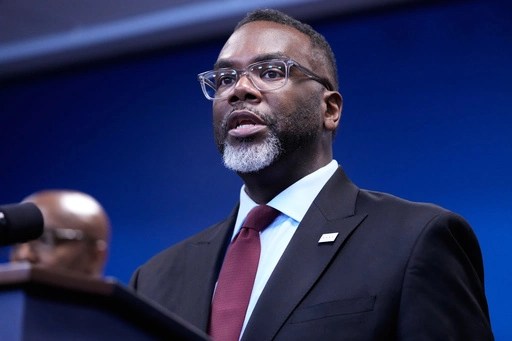
Mayor Brandon Johnson on Tuesday mounted the legislative equivalent of a goal-line stand against the Bears’ quest for the property tax break needed to pave the way for a domed stadium in Arlington Heights.

Johnson questioned why any lawmaker from Chicago would even think about providing a massive tax break for a professional sports team valued at nearly $9 billion, while ignoring the need for what he calls progressive revenue to increase school funding and help working people struggling to make ends meet.

“If we’re asking anyone to tighten the belt, we should look at whose belt is exploding — and that’s the ultra-rich. As their bellies get fat and our people are starving, this is not the time to balance the budget off the backs of working people,” the mayor said at his weekly news conference.

“The type of tax structure that they would set up for large corporations and billionaires without a clear pathway to provide certainty as well as equity for everyday working people, I believe that’s a mismatch there. And quite frankly, the infrastructure they’re even discussing in the suburbs — those infrastructure needs have been present on the lakefront for a very long time.”

Hours before joining fellow Chicago-area mayors in Springfield, where he has had little success, Johnson made it clear that he would use whatever political muscle he has to block the so-called megaprojects bill now before the Illinois Senate after clearing the Illinois House on April 22.

Though Chicago is no longer part of the conversation to build a domed stadium needed to keep the Bears in Illinois and stave off a move to Northwest Indiana, Johnson is still holding out hope to keep the Bears in the city.

Article continues here.

Read Full Post »

Older Posts »