Feeds:
Posts
Comments

Archive for the ‘Cost of Living’ Category

A recent survey also shows that fully half of residents would move out of the state given the opportunity.

By Todd J. Behme | Illinois Policy Institute

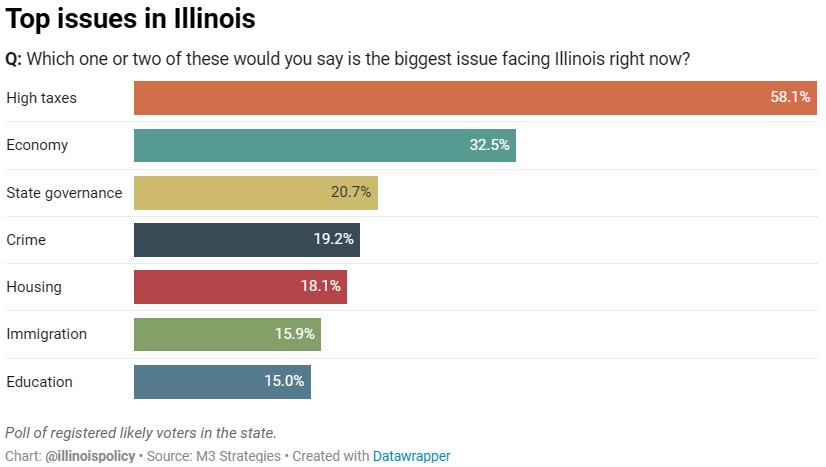
Pocketbook issues concern Illinoisans significantly more than other issues and account for why so many would leave if given the chance.

More than half of Illinois voters polled cited high taxes as a top issue in a list of seven issues facing Illinois, according to a survey conducted for the Illinois Policy Institute.

Next was the economy, selected by 41% of respondents. That percentage has risen sharply in the past year, from 24% at the beginning of 2025 to 35% in the first quarter of this year. The percentage citing taxes fell from 58% in the first quarter.

Voter irritation with property taxes is high. Over 61% said they were somewhat or very dissatisfied with the value their community gets for those taxes. Fewer than 24% were somewhat or very satisfied.

Illinois is tied with New Jersey for the highest effective residential property tax rate. State residents pay the highest combined state and local tax rate in the country. Per-capita state and local taxes were in the top 10 in the country in fiscal 2023.

The resulting financial stress has more residents considering an out-of-state move. Just over 51% of poll respondents would leave Illinois if they had the opportunity, the highest percentage in the past six quarters. About 39% would stay — lowest since the beginning of 2025 — and about 10% were unsure.

Report continues here.

Read Full Post »

By The Editorial Board | Chicago Tribune

Gov. JB Pritzker on Tuesday signed into law a new state budget that modestly increased state spending on K-12 education and related costs.

Yet most headlines ignored a more consequential education narrative — not one of how much is flowing to classrooms, but how much money never makes it there in the first place.

Pritzker’s budget allocates nearly $10.8 billion for K-12 education.

It also includes $7 billion for K-12 pension costs.

In 2000, the state spent about $705 million on K-12 pensions.

That’s not a typo.

Even after adjusting for inflation, Illinois’ spending on K-12 pensions has skyrocketed by roughly fivefold since the turn of the last century, ballooning to nearly 10 times the raw dollar amount spent in 2000.

For every dollar Illinois spends on education, it spends another 65 cents on pension obligations. Imagine how much more schools could do with even a sliver of that money.

These numbers help explain one major reason why costs continue to climb even as Illinois’ student population goes down. New data show Illinois lost more than 100,000 public school students in just the five years since 2019, more than twice the rate of decline for the Midwest as a whole. The state educates roughly 206,000 fewer public school students today than it did in 2000.

Yet total education spending continues to grow, though not necessarily in the best way for current and future students.

Editorial continues here.

Read Full Post »

Engineer John Zimmerman, left, and Commissioner George DeMent, right, view an automatic coin collector at the toll gate of the Calumet Skyway on April 10, 1958, to be opened to traffic. | George Quinn/Chicago Tribune

By The Editorial Board | Chicago Tribune

Illinois tollways were meant to be freeways decades ago.

Gov. JB Pritzker promised to reform the Illinois Tollway before he was elected, the latest in a long line of governors, from Rod Blagojevich to Jim Thompson, who vowed reform.

Remember, the tollways aren’t even supposed to be tollways anymore. The tolls were meant to be temporary until the bonds issued to build the roads were paid off. Many of our readers may remember that old promise that by 1973, our dear tollways would become freeways.

“Toll free in ‘73,” it turns out, is just another empty promise long forgotten.

After decades — and billions of dollars — in paid tolls later, drivers are further away than ever from those cost-free roads.

Now, they’re staring down the prospect of another toll hike.

The Illinois Tollway board is in the process of implementing a 45-cent toll increase for I-Pass users, meaning a 70-cent toll today could become $1.15 in 2027.

And the toll hikes won’t stop there. Starting in 2029, the proposal to be considered by the Illinois Tollway board sets up CPI-indexed toll hikes every two years.

Editorial continues here.

Read Full Post »

By Claire O’Brien | Shaw Media

As McHenry County officials express frustration at state legislation that they say erodes local control, they’re considering asking voters for permission to become home rule.

Home rule is a classification that allows a local government to enact laws as it sees fit, as long as they’re not in conflict with state laws. That includes more leeway to impose fees, restrictions and taxes.

Though some municipalities in McHenry County have home rule powers, Cook County is the only county in Illinois with such powers.

In recent years, solar farms have been a source of frustration for McHenry County officials because state law has limited the county’s ability to regulate such facilities.

Now, officials at the county and in several municipalities have expressed frustration over the proposed BUILD Act — Democratic Gov. JB Pritzker’s plan that would limit local authority on what types of housing structures can be built on land zoned for residential.

So McHenry County officials are considering asking voters to weigh in on a home-rule request during the November election.

Article continues here.

Related: “South Barrington Mayor Paula McCombie provides an update of Pritzker’s proposed BUILD Act,” “Village of Barrington President shares perspectives on Pritzker’s BUILD plans,” “(Ignoring public opinion) Pritzker says of BUILD Plan for homes would not cost taxpayers,” “Gov. JB Pritzker’s ambitious housing plan for Illinois: More four-flats, looser rules,” “Pritzker to propose statewide zoning laws to spur homebuilding, limit local control,” “McLaughlin’s press conference video recording regarding Pritzker’s proposed municipal zoning powers grab posted,” “‘It’s just a bad idea’: Suburban officials oppose Pritzker’s plan to reduce local control over residential It’s just zoning

Read Full Post »

A natural gas stove burner produces a blue flame while in use. Photo: KWON JUNHO / Unsplash

By Sean Reed | The Center Square

Consumer advocates have signaled heavy opposition to a proposed $221 million rate hike by Nicor Gas, arguing that the request is excessive, charging Illinoisans over five times what’s needed.

The request trailed just weeks behind the Illinois Commerce Commission’s approval of a $167.8 million hike last year. It would also be the sixth jump in delivery costs in the past decade.

Experts on the matter from the Citizens Utility Board, Illinois PIRG, and the Environmental Defense Fund came together early Monday to outline their opposition to the rate hike.

The same experts have also shared testimony to the ICC, which must approve or deny requested utility rate hikes before they can take effect.

Nicor’s spending has significantly increased since 2015 – mostly attributed to a state law that required the replacement of old delivery pipes. Despite the law’s sunset and all replacements having been completed by 2018, critics say the company’s spending has only continued to trend upward.

According to Jim Chilsen of the Citizen’s Utility Board, the proposed increase would add to the financial burden for all Nicor customers, 200,000 of whom are behind on their bills by $74 million total, as of last month.

“When the supply side of bills is so volatile, it just adds to the pain when you have a company like Nicor Gas going on a spending spree over the last decade and going before the commission to ask for six separate rate hikes. That’s been a hardship,” Chilsen said.

Report continues here.

Read Full Post »

By Brennan Park | Illinois Policy Institute

Illinoisans continue to pay the highest combined state and local tax rate in the country, according to WalletHub.

Effective state and local tax rates totaled almost 17% for a median Illinois household last year, compared with the national average of just over 11.02% and higher than No. 2 New York, at 14.95%.

The median amount of state and local taxes for an Illinois household was $12,538 last year, fourth-highest in the country. The national median was around $8,949. (These amounts use a different household measurement.)

Illinois’ burden is driven by property, sales and excise taxes that exceed national averages and those in neighboring states.

Property taxes are especially high, with an effective rate of 1.92% of the value of a typical home, more than double the national median of 0.89%.

Sales taxes are also elevated in Illinois, with a 6.25% state rate and a nearly 9% combined state and local rate on average.

Article continues here.

Read Full Post »

On July 1 the state tax will hit almost 50 cents a gallon. Lawmakers made yearly automatic.

By Dylan Sharkey | Illinois Policy Institute

Illinois drivers will see another gas tax increase July 1.

The state tax will rise to 49.6 cents per gallon because of the automatic annual inflation increase built into the 2019 “Rebuild Illinois” infrastructure program signed by Gov. J.B. Pritzker.

That means Illinois drivers will continue paying among the highest gas taxes in the country. Indiana and Georgia gave residents a gas tax holiday from high prices because of the war in Iran.

The average price of a gallon of gas in Illinois was $4.986 on May 6, up from about $3.40 a year ago, according to the AAA.

When Pritzker doubled the state gas tax from 19 cents to 38 cents in 2019, lawmakers also ensured Illinoisans would face automatic inflation-linked increases every year without another recorded vote.

Once federal, state and local taxes are combined, many Illinois drivers pay more than 85 cents per gallon in taxes alone at the pump. Only California and Michigan rival Illinois for the highest total gas taxes in the country.

Article continues here.

Read Full Post »

CUSD 220 has reportedly already requested the 1% county sales tax referendum be placed on the Nov. 3 Ballot.

By Steve Sadin | For the Lake County News-Sun

A referendum proposing a 1% countywide sales tax to fund education is a step closer to reality now that Lake County’s largest school district has joined a group asking Regional Superintendent of Education Michael Karner to take the necessary steps to place it on the Nov. 3 general election ballot.

If public school districts representing more than 50% of the students in Lake County approve resolutions asking Karner to certify the referendum to County Clerk Anthony Vega by Aug. 26, voters will decide the fate of a proposed 1% sales tax funding education.

Already directing Karner to place the referendum on the Nov. 3 ballot are: Barrington Community Unit School District 220 (3,489 students), Wauconda Community Unit School District 118 (3,504 students), Lake Zurich Community Unit School District 95 (5,777 students), Kildeer Countryside School District 96 (3,419 students), Lake Buff School District 65 (877 students) and Big Hollow School District 98 (1,653 students).

The full article can be read here.

Note: An attorney quoted in the article said, “proceeds from the sales tax can only be used for long-term capital improvements, such as building renovations or repairs, like a new roof, school resource officers, or mental health professionals.”

Read Full Post »

The governor has presided over $77 billion in increases while Illinois’ economic growth lags.

By Ravi Mishra | Illinois Policy Institute

Gov. J.B. Pritzker wants more tax and fee hikes even after presiding over at least 57 of them since 2019 and with Illinois’ budget still in dysfunction.

New tax and fee burdens under Pritzker have cost taxpayers more than $77 billion. Last year alone, Illinoisans paid $16.5 billion more in state taxes than they would have if taxes stayed consistent with 2018 levels.

The median Illinois household now pays nearly $1,400 more per year in state taxes than it would have under prior levels.

Examples of recent tax policy moves in Illinois:

  • The gas tax was doubled in 2019 from $0.19 to $0.38 per gallon and indexed to annual increases to inflation. It now stands at 48.3 cents per gallon.
  • The net-operating-loss deduction was capped in 2021, effectively double-taxing Illinois companies.
  • Late last year Pritzker signed a bill decoupling Illinois from federal business tax cuts.

Property taxes have risen 27% under Pritzker’s watch. While driven by local decisions, state policy, particularly around pension and school funding, has pressured local governments and contributed to those hikes.

Article continues here.

Read Full Post »

Chicago Mayor claims restaurant industry is ‘tied to slavery’

By Elaine Mallon | Fox News

Chicago Mayor Brandon Johnson linked the restaurant industry to “slavery” Wednesday as he defended his push to eliminate the tipped wage, doubling down after surviving a City Council effort to block the policy.

Johnson’s remarks came after the Chicago City Council failed to override his veto of a measure that would have halted the city’s phaseout of the subminimum wage for tipped workers — a policy set to raise base pay to the full minimum wage by 2028 that is opposed by restaurant owners who warn it could drive up prices and cut jobs.

He called on Chicagoans to “challenge city council not to do stuff like take wages away from Black and Brown people,” saying that most workers in the service industry who rely on tips are minorities.

“You just watched the entire city council, in transparency, try to take wages away from the very people who are part of an industry that has its ties to slavery is hiding from that,” Johnson said. “I am boldly declaring that we need reparations in this city, and that’s why I’m funding it.”

City aldermen voted last month to end the wage increase for tipped workers, but Johnson vetoed it.

Restaurant owners and associations have pushed back on the city’s phaseout of the subminimum wage, saying it will shrink their already tight profit margins. Chicago’s City Council failed to meet the 34-vote requirement to overturn the phaseout.

Johnson’s comments came in response to a question from a person who claimed that Johnson’s Reparations Task Force was not in compliance with Illinois state law, which mandates that all public bodies hold public meetings. Johnson denied the assertion that his task force, which he launched in June 2024, was not being transparent with the public.

Article continues here.


Read Full Post »

Older Posts »