Feeds:
Posts
Comments

Archive for the ‘Diversity, Equity and Inclusion (DEI)’ Category

By Paul Vallas | John Kass News

October 11th, 2026

Illinois leadership is sustaining policies that have done nothing to improve equity or affordability while swapping out middle- and upper-income families for the poor and illegal migrants.

JB Pritzker’s greatest legacy will be the acceleration of the “Great Displacement,” the demographic upheaval in which Illinois is losing scores of affluent residents through outmigration while gaining relatively poorer ones through both interstate and international migration.

This shift is largely the product of the state’s so-called progressive policies. High taxes and fees remain the primary reason Illinoisans cite for leaving, followed by failing schools, rising crime, limited economic opportunity, and expansive sanctuary measures that encourage low-income in-migration.

According to Wirepoints, Illinois continues to hemorrhage wealthy residents. Since 2000, the state has lost roughly 1.6 million people — third most in the nation, behind only California and New York. Chicago’s population, even with the recent influx of migrants, is now at its lowest level in nearly a century. Almost every county in Illinois has experienced a decline in population. Even more troubling, Illinois isn’t merely losing residents — it’s losing income. [1]

The IRS reports that in 2022 alone, 87,311 residents left Illinois, taking with them $9.9 billion in adjusted gross income. The real damage runs deeper: The outflow disproportionately includes residents in their prime earning and spending years. This brain and income drain erodes the tax base, shrinking critical property, sales, and consumption tax revenues that support state and local budgets. [2]

A detailed Wirepoints analysis of IRS migration data for 2022 shows Illinois was the nation’s second-biggest loser of households aged 26-35 earning more than $200,000. Unsurprisingly, zero-income-tax states such as Florida and Texas were the leading destinations for these upwardly mobile millennials. Illinois has been bleeding this cohort for more than a decade, but the acceleration is alarming. [3]

Wirepoints also found that in 2022, the average adjusted gross income for these departing young households was $435,000. The exodus continues among those aged 35-45 with incomes over $200,000 — another key demographic of high earners. Illinois ranks 48th nationally for losses in this income bracket. More concerning, the average AGI among this group leaving approaches $700,000. [4]

Vallas’ report continues here.

Paul Vallas formerly ran the public school systems in Chicago, Philadelphia and the Louisiana Recovery School District. He was a candidate for Mayor of Chicago.

Read Full Post »

State Sen. Darby Hills talks with a colleague during the legislative session at the Illinois State Capitol on Oct. 28, 2025, in Springfield. | John J. Kim/Chicago Tribune

By The Editorial Board | Chicago Tribune

This north suburban district stretches from Palatine and Barrington north to Lake County municipalities including Lake Zurich, Hawthorn Woods and Wauconda. Republican Darby Hills, 50, was appointed to the seat in early 2025 after fellow Republican Dan McConchie resigned to start a national nonprofit advocating for better access for the disabled. Hills, formerly a Barrington Hills village trustee, is running to be elected in her own right against Democrat Nabeela Syed, 27, an Illinois House member from Palatine in her second term.

Syed tells us she opposed the transit rescue legislation enacted in late 2025 because it included a “regressive” sales tax increase. Except she didn’t oppose it, at least on the floor of the House. As Hills points out to us, Syed didn’t vote on the package. For something so consequential to her constituents, Syed can’t have it both ways. She should have voted no if that was her position.

Hills did vote against the package in the Senate with the fair reasoning that transit-agency reforms should have preceded the hefty toll hike and sales tax increase that bailed out the system.

Hills has voted against her party leadership more than once, including on a measure this year to allow for state regulation of auto insurance rates for the first time, which was signed into law. The last thing the Illinois Senate needs is an even larger Democratic supermajority, and Hills has proven herself the sort of Republican who will work with the other side of the aisle. Darby Hills is endorsed.

Full editorial here.

Read Full Post »

Juliana Stratton

By Warner Todd Huston | Chicago Contrarian

Stratton can dance and hyperventilate about President Trump, but she can’t seem to debate Don Tracy

Democrat U.S. Senate candidate Juliana Stratton is hiding in her basement and refusing to debate Republican nominee Don Tracy as the pair vie to replace outgoing Senator Dick Durbin this year.

Stratton, the sitting Democrat Lt. Governor of Illinois under failed Governor JB Pritzker, did participate in several debates during the Democrat primary when she knew she would not face any tough questions. She knew that primary debates would cater only to left-wing issues and that no one would really try to tie her to the anchor of being the second chair for one of the worst governors in the country.

In her Democrat primary this year, she fairly easily beat two opponents who are also sitting members of Congress — Raja Krishnamoorthi and Robin Kelly — though one can easily imagine that if Kelly had bowed out of the primary, Krishnamoorthi just might have over taken Stratton in the final voting.

Still, it may not be all that surprising that she beat her opponents since Governor Pritzker put his considerably weighty thumb on the scale by giving her his full endorsement, despite that as a sitting governor he should have taken no real role in electing a U.S. senator.

Stratton ran a “progressive” campaign and her biggest issue was raising the minimum wage to $25. She also ran on the financially absurd “Medicare for all” scheme of which the left is so fond, and pandered to the left-wing base with her pledge to “eliminate” Immigration and Customs Enforcement (ICE), despite the fact a U.S. senator would have no real power to achieve such a goal.

However, now that she has safely secured the nomination, Stratton is taking the easy road to the election by refusing to debate her Republican opponent.

For his part, Tracy has offered to join Stratton in several debates, but she has steadfastly ignored all his offers.

Indeed, one debate date even turned into an interview between Tracy and WBBM-TV’s Chris Tye, the station’s Sunday night anchor, because Stratton once again refused to show up.

“I asked Juliana Stratton for three debates across Illinois,” Tracy said in a Facebook post in September. “I’m still waiting. She’s still hiding. It’s time to put your record on the table, Lt. Governor.”

In comments exclusively to Chicago Contrarian, Tracy expanded on that criticism.

“Illinois voters deserve the chance to hear from both of the candidates. Side by side, on the record. Don has said yes. She has declined 8 different debates and forums. She is the nominee of a party in the middle of a bitter fight over its own identity, and has shown deep alignment with her party’s most extreme ideologies. Voters not only deserve to know where she stands next to Don Tracy. They deserve to know where she sits on the spectrum her party is arguing over: from establishment Democrat to Democrat Socialist.  An open Senate seat is too important to hide from.”‍

Article continues here.

Editorial note: We’d like to remind our readers back in March we posted: “JB Pritzker’s Political Brand Is at Stake—in a Race He’s Not Even Running In – Wall Street Journal.”

Related: “Juliana Stratton is using her campaign money to fund Abdul El-Sayed,” “Moseley-Braun, Part II? Democrat U.S. Senate hopeful Stratton refuses debates, claims to be “dancing” her way to Washington,” “Juliana Stratton is hiding from Illinois voters. That tells you everything,” “Juliana Stratton Takes Chinese Communist Cash While Denouncing Dark Money,” “Illinois Democrat tries to bleep (their) way through a tough Senate primary with a new expletive-laden anti-Trump ad”

Read Full Post »

Data suggest the state is on pace to lose a U.S. representative in 2030.

By Lilly Rossi | Illinois Policy Institute

Illinois is on pace to lose its second congressional seat because of population loss under Gov. J.B. Pritzker.

Since Pritzker was elected in 2018, Illinois has lost more than 168,000 residents. In a recent poll of Illinois voters, more than half said they would leave the state if given the opportunity.

Of those who would leave, almost 69% cited taxes as a top one or two issue facing Illinois. In 2024, 95% of those leaving Illinois fled to states with lower tax burdens.

Pritzker entered office as Illinois was already struggling with outmigration. He identified reversing it as a goal in his 2019 economic plan.

Nearly eight years later, that has not happened.

Illinois lost a congressional seat after the 2020 census, continuing a decades-long decline in the state’s representation in Washington. Illinois has lost 10 U.S. House seats since 1910, falling from 27 to 17.

Now past the halfway point in the decade, census data suggest that Illinois is on pace to lose another House seat in the reapportionment after the 2030 census.

In 2030, a decennial census will tally the state’s population and determine how congressional seats are distributed nationwide. Despite small population increases from 2023 to 2025 because of international migration, Illinois has lost residents overall under Pritzker’s administration. Also, international migration to Illinois is declining while the state continues to struggle with outmigration.

Read more here.

Read Full Post »

Maria Peterson is running for the IL House District 52 seat. Nabeela Syed is running for IL Senate District 26. Currently both choose only to campaign publicly as “Democrats.” | Images courtesy Facebook

Much has been said and written about the, “Democratic Socialists of America (DSA),” in recent months leading to the mid-term elections. Their website states:

“Capitalism is a system designed by the owning class to exploit the rest of us for their own profit. We must replace it with democratic socialism, a system where ordinary people have a real voice in our workplaces, neighborhoods, and society.

We believe there are many avenues that feed into the democratic road to socialism. Our vision pushes further than historic social democracy and leaves behind authoritarian visions of socialism in the dustbin of history.

  • We want a democracy that creates space for us all to flourish not just survive and answers the fundamental questions of our lives with the input of all.
  • We want to collectively own the key economic drivers that dominate our lives, such as energy production and transportation.
  • We want the multiracial working class united in solidarity instead of divided by fear.
  • We want to win “radical” reforms like:
    • Single-payer Medicare for All,
    • Defunding the police/refunding communities,
    • The Green New Deal, and
    • More as a transition to a freer, more just life.

We want a democracy powered by everyday people. The capitalist class tells us we are powerless, but together we can take back control.”

They have further stated their priorities, including:

That’s pretty much all we needed to read to form our opinions, and most who have read these pages for nearly two decades know what they likely are.

However, feel free to visit the Democratic Socialists of America website to learn more so that you might be enlightened before reaching your own opinions before casting your ballots.

Related: “Inside the DSA’s audacious quest for power in the Democratic Party“

Read Full Post »

The District 220 Board of Education meets Tuesday evening at 6:00 PM at the District Administration Center, 515 W. Main Street. Items on their agenda include:

  • Special Public Comment on IASB Resolutions
  • FOIA Reports
  • Personnel Report
  • Declaring Property Surplus and Authorizing its Sale or Disposal
  • Minor Policies
  • Second Reading of Board Policy
  • Consideration to Approve Resolution providing for the issue of not to exceed $34,000,000 General Obligation School Bonds, Series 2026A, for the purpose of building and equipping an auditorium and an addition at the Barrington High School Building, altering, repairing and equipping existing buildings, and improving school sites; providing for the levy of a direct annual tax sufficient to pay the principal and interest on said bonds; and authorizing the sale of said bonds to the purchaser thereof.
  • Consideration to Approve Mid Suburban League Constitution
  • Consideration to Approve Demographic Study Contract
  • Consideration to Approve Terms of IGA for Proposed Village of South Barrington Higgins Corridor TIF District
  • Board Policy Training
  • Solar Update
  • First Reading of Board Policy

A copy of the agenda packet can be viewed here. The meeting will be live streamed on the district YouTube channel.

Related: “District 220 board members violated campaign policies, investigation finds”


Read Full Post »

America’s Governor Ron DeSantis (R., Fla.) cheers Citadel founder Kenneth Griffin at the announcement of Carnegie Mellon University Miami on Thursday. | Jack Dempsey/AP Content Services for Griffin Catalyst/Associated Pres

By James Freeman | Wall Street Journal

An editorial in the Chicago Tribune laments what might have been had “Kenneth C. Griffin not become so frustrated with the state of Illinois as to move himself and much of the financial company he founded, Citadel, to Miami.” The Tribune is responding to the news that Mr. Griffin is moving a whole lot more to Florida after departing the expensive dysfunction of Illinois governance.

The Journal’s Deborah Acosta reported on Wednesday:

Hedge-fund titan Ken Griffin is donating $2 billion to start a Carnegie Mellon University campus in Miami, part of the largest-ever individual gift toward higher education.

The Pittsburgh-based university, known for its expertise in computer science, artificial intelligence and robotics, will open a 35-acre campus in Miami’s Wynwood neighborhood that will focus on technology and innovation.

“The students who graduate and the tech companies that come to Miami to leverage those skills will change the very fabric of Miami for decades if not centuries to come,” Griffin said in an interview.

Citadel’s chief executive is also giving $1 billion to Carnegie Mellon’s main Pittsburgh campus. Griffin’s combined $3 billion donation is the largest single gift toward higher education from any individual, according to an announcement from Carnegie Mellon University.

The donation helps advance Griffin’s aim to establish South Florida as a leading global-business and technology hub.

Back in the Windy City, kudos to the Tribune editorial board for explaining the opportunity cost of driving away the state’s most successful people: “After all, persons who are willing to donate $3 billion to an institution of higher education are not to be found on every street corner.”

Of course New York politicians in general and the mayor of New York City in particular have also been unwelcoming and in some cases downright hostile to wealth-creators like Mr. Griffin. Leftists who enjoyed the mayor’s nasty media stunt outside Mr. Griffin’s Manhattan apartment can now reflect on whether it was worth removing the city as a possible landing spot for the largest individual gift in the history of U.S. higher education.

Article continues here.

Read Full Post »

Illinoisans can vote on races ranging from U.S. Senate and governor to state lawmakers and local officials in the Nov. 3 election.

By Jon Josko and Lilly Rossi | Illinois Policy Institute

Some recent Illinois state legislative races have been decided by just dozens or hundreds of votes.

A look since 2022 shows where the closest races have been, how few votes separated the candidates and what voters in competitive districts identified as their biggest concerns.

Casting a ballot gives Illinoisans a voice in who represents them, while understanding voters’ concerns gives lawmakers a clearer picture of what their constituents want addressed.

How close are races in Illinois?

In 2024, a mere 47 votes out of nearly 59,000 decided who represents Illinois’ 52nd House District. State Rep. Martin McLaughlin, R-Lake Barrington, held onto his seat over Democrat Maria Peterson by less than one-tenth of 1% of the votes.

That was the slimmest margin in Illinois’ most recent two election cycles, but not the only close one. Nine other state House and Senate races since 2022 were decided by fewer than 1,700 votes apiece — and they were concentrated in a handful of places worth knowing if you live nearby.

10 closest state legislative races 2022-2024

Margin of victory in the 10 closest Illinois House and Senate races, 2022-2024

Seven of the 10 sit in Chicago’s outer suburbs and exurbs, stretching from Lake and McHenry counties through DuPage, Kane and Will. The other three are downstate: one anchored around Danville and Champaign, one around Springfield and Decatur and one in the Metro East region across the river from St. Louis.

10 closest state legislative races 2022-2024

Margin of victory in the 10 closest Illinois House and Senate races, 2022-2024

How many people does it take to decide these races?

If you’ve ever wondered whether your vote matters in a state regarded as relatively uncompetitive, consider this: Among the 175 contested state House and Senate races since 2022, half were decided by a margin smaller than 1-in-10 of the eligible adults in that district. A quarter of contested races came down to fewer than 1-in-17.

90 contested legislative races decided by fewer than 1 in 10 adults

Number of contested state legislative races, 2022-2024, by win margin as share of district’s eligible adult population.

That pattern held across both chambers and both years, though state Senate races have generally been decided by a somewhat smaller share of eligible adults than House races. Roughly 6-in-10 Senate races came in under that 1-in-10 mark, versus about 46% of House races, consistent with Senate districts being larger and drawing more votes.

What do Illinoisans care about?

In districts with tighter election margins, candidates will have to make sure they are addressing their constituents’ major issues.

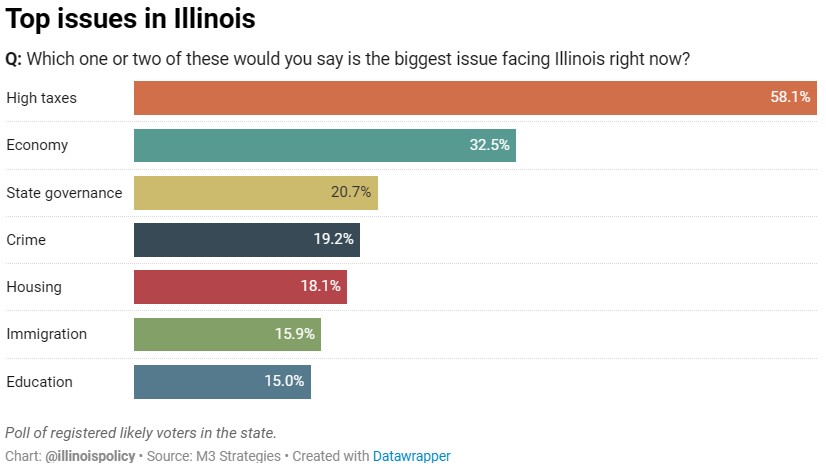
In the Illinois Policy Institute’s statewide tracking poll, fielded quarterly since 2025, high taxes has been the single most-cited concern every time, named by 52% to 60% of respondents as one of their top two issues, roughly double the next-closest answer.

In the most recent poll, from August 2026, 58.1% named high taxes as their No.1 or No. 2 issue, compared with 32.5% for the economy generally and 20.7% for state governance.

Property taxes in particular seem to be the aggravation behind that number. The May 2026 version of the same poll asked residents how satisfied they are with the value their community receives for the property taxes paid. Over 61% said they were dissatisfied, against just 23.5% satisfied.

Article continues here.

Read Full Post »

State Rep. Martin McLaughlin, R-Barrington Hills, and Maria Peterson debate issues at a League of Women Voters forum in Barrington on Tuesday ahead of the Nov. 3 election. | Steve Sadin/For the Lake County News-Sun

By Steve Sadin | For the Lake County News-Sun

A mere 27 votes separated state Rep. Martin McLaughlin, R-Barrington Hills, from his 2024 Democratic challenger and current reelection opponent, Maria Peterson of North Barrington.

While Peterson and McLaughlin agree that making changes in the tax laws is legislation they will attempt to tackle in the 105th Illinois General Assembly, their approach to easing taxpayers’ burdens is different.

McLaughlin said he lowered the real estate tax levy seven of the eight years he served as mayor of Barrington Hills. He sees providing municipalities the 10% of state income taxes they once received instead of the current 5% as giving the towns an alternative source of revenue.

“That money would come back to your community and your community could lower your property taxes,” he said.

State Rep. Martin McLaughlin, R-Barrington Hills, left, talks to a voter before a League of Women Voters forum in Barrington on Tuesday ahead of the Nov. 3 election. | Steve Sadin/For the Lake County News-Sun

McLaughlin and Peterson shared views on taxes, artificial intelligence, reduced federal funding, and more, campaigning for the Nov. 3 election before more than 150 people Tuesday at a Barrington forum sponsored by the League of Women Voters.

After the moderator asked the candidates what they would do to reduce property taxes for homeowners, she queried them several questions later about their top priorities should they be chosen to serve in the 105th General Assembly. Taxes were on both their lists.

Using tax credits as a form of relief, McLaughlin said he had ideas for both younger people and seniors. He would push for a tax credit for young families to “make life more affordable for young families so they can afford a home.”

“I will push for the senior tax credit to be increased to $75,000,” McLaughlin said. “If two seniors are in a home with Social Security, it’s too low. It should be higher, at least $95,000 so seniors can get a break on their property taxes.”

Read the full article here.

Related: “League of Women Voters 52nd District Candidate Forum recordings released”

Read Full Post »

By Warner Todd Huston | Breitbart News

Critics are bashing Boston’s Democrat Mayor Michelle Wu* for funding a program that trains migrants in political activism.

Wu’s funding benefits the city program called Immigrants Lead Boston operated by Wu’s Mayor’s Office for Immigrant Advancement designed to identify and give aid to “emerging leaders” in the migrant community, Fox News reported.

The program is taking heat for explicitly excluding U.S.-born residents from being qualified to win one of the scholarships while using tax dollars for the sole benefit of migrants.

Wu’s administration is paying migrants $575 to enroll in a ten-week civic-engagement and community-organizing course to help migrants grow their political power to replace Americans.

Registration documents tell enrollees that no legal status is required to earn a grant.

“Classes cover organizing, public narrative, city government, immigration history, racism, and equity,” according to the New Bedford Guide.

The program is also sponsored by the Massachusetts Immigrant and Refugee Advocacy Coalition, which funds deportation-defense lawyers and opposes Immigration and Customs Enforcement (ICE).

Report continues here.

*”One of four children, (Michelle) Wu graduated from Barrington High School in 2003 as the valedictorian of her class.[14] Wu received perfect scores on the SAT and ACT and in 2003 was selected as a Presidential Scholar from Illinois.[15][8] Wu’s parents hoped that she would pursue a career in medicine; in part due to their experiences of the Chinese Civil War, they discouraged her from a career in politics. Wu has also recounted that prior to university, she had not known whether she aligned with the Democratic or Republican parties.[8]”


Read Full Post »

« Newer Posts - Older Posts »