Feeds:
Posts
Comments

Archive for the ‘Immigration’ Category

By Sarah Roderick-Fitch | The Center Square

A majority of American voters are concerned with socialist candidates running and possibly winning political office, according to a new poll.

The Center Square Voters’ Voice poll found that 55% of American voters are concerned about Democratic Socialist candidates running for and winning elected office in the U.S., while 37% aren’t concerned.

A slew of candidates running as democratic socialists appears to be raising alarms with a majority of American voters.

Of the 55% who are concerned, 35% are very concerned, while 20% say they are “somewhat concerned.”

(Click on image to enlarge)

Of those not concerned, only 17% say they are not too concerned, while 20% say they are not at all concerned.

The poll comes as several Democratic Socialist candidates have risen in popularity across the country. The Democratic Socialists of America are touting 67 wins across the country, with 93 running. However, the group includes 62 DSA candidates who have lost.

Report continues here.


Read Full Post »

By Paul Vallas | John Kass News

October 11th, 2026

Illinois leadership is sustaining policies that have done nothing to improve equity or affordability while swapping out middle- and upper-income families for the poor and illegal migrants.

JB Pritzker’s greatest legacy will be the acceleration of the “Great Displacement,” the demographic upheaval in which Illinois is losing scores of affluent residents through outmigration while gaining relatively poorer ones through both interstate and international migration.

This shift is largely the product of the state’s so-called progressive policies. High taxes and fees remain the primary reason Illinoisans cite for leaving, followed by failing schools, rising crime, limited economic opportunity, and expansive sanctuary measures that encourage low-income in-migration.

According to Wirepoints, Illinois continues to hemorrhage wealthy residents. Since 2000, the state has lost roughly 1.6 million people — third most in the nation, behind only California and New York. Chicago’s population, even with the recent influx of migrants, is now at its lowest level in nearly a century. Almost every county in Illinois has experienced a decline in population. Even more troubling, Illinois isn’t merely losing residents — it’s losing income. [1]

The IRS reports that in 2022 alone, 87,311 residents left Illinois, taking with them $9.9 billion in adjusted gross income. The real damage runs deeper: The outflow disproportionately includes residents in their prime earning and spending years. This brain and income drain erodes the tax base, shrinking critical property, sales, and consumption tax revenues that support state and local budgets. [2]

A detailed Wirepoints analysis of IRS migration data for 2022 shows Illinois was the nation’s second-biggest loser of households aged 26-35 earning more than $200,000. Unsurprisingly, zero-income-tax states such as Florida and Texas were the leading destinations for these upwardly mobile millennials. Illinois has been bleeding this cohort for more than a decade, but the acceleration is alarming. [3]

Wirepoints also found that in 2022, the average adjusted gross income for these departing young households was $435,000. The exodus continues among those aged 35-45 with incomes over $200,000 — another key demographic of high earners. Illinois ranks 48th nationally for losses in this income bracket. More concerning, the average AGI among this group leaving approaches $700,000. [4]

Vallas’ report continues here.

Paul Vallas formerly ran the public school systems in Chicago, Philadelphia and the Louisiana Recovery School District. He was a candidate for Mayor of Chicago.

Read Full Post »

Data suggest the state is on pace to lose a U.S. representative in 2030.

By Lilly Rossi | Illinois Policy Institute

Illinois is on pace to lose its second congressional seat because of population loss under Gov. J.B. Pritzker.

Since Pritzker was elected in 2018, Illinois has lost more than 168,000 residents. In a recent poll of Illinois voters, more than half said they would leave the state if given the opportunity.

Of those who would leave, almost 69% cited taxes as a top one or two issue facing Illinois. In 2024, 95% of those leaving Illinois fled to states with lower tax burdens.

Pritzker entered office as Illinois was already struggling with outmigration. He identified reversing it as a goal in his 2019 economic plan.

Nearly eight years later, that has not happened.

Illinois lost a congressional seat after the 2020 census, continuing a decades-long decline in the state’s representation in Washington. Illinois has lost 10 U.S. House seats since 1910, falling from 27 to 17.

Now past the halfway point in the decade, census data suggest that Illinois is on pace to lose another House seat in the reapportionment after the 2030 census.

In 2030, a decennial census will tally the state’s population and determine how congressional seats are distributed nationwide. Despite small population increases from 2023 to 2025 because of international migration, Illinois has lost residents overall under Pritzker’s administration. Also, international migration to Illinois is declining while the state continues to struggle with outmigration.

Read more here.

Read Full Post »

Maria Peterson is running for the IL House District 52 seat. Nabeela Syed is running for IL Senate District 26. Currently both choose only to campaign publicly as “Democrats.” | Images courtesy Facebook

Much has been said and written about the, “Democratic Socialists of America (DSA),” in recent months leading to the mid-term elections. Their website states:

“Capitalism is a system designed by the owning class to exploit the rest of us for their own profit. We must replace it with democratic socialism, a system where ordinary people have a real voice in our workplaces, neighborhoods, and society.

We believe there are many avenues that feed into the democratic road to socialism. Our vision pushes further than historic social democracy and leaves behind authoritarian visions of socialism in the dustbin of history.

  • We want a democracy that creates space for us all to flourish not just survive and answers the fundamental questions of our lives with the input of all.
  • We want to collectively own the key economic drivers that dominate our lives, such as energy production and transportation.
  • We want the multiracial working class united in solidarity instead of divided by fear.
  • We want to win “radical” reforms like:
    • Single-payer Medicare for All,
    • Defunding the police/refunding communities,
    • The Green New Deal, and
    • More as a transition to a freer, more just life.

We want a democracy powered by everyday people. The capitalist class tells us we are powerless, but together we can take back control.”

They have further stated their priorities, including:

That’s pretty much all we needed to read to form our opinions, and most who have read these pages for nearly two decades know what they likely are.

However, feel free to visit the Democratic Socialists of America website to learn more so that you might be enlightened before reaching your own opinions before casting your ballots.

Related: “Inside the DSA’s audacious quest for power in the Democratic Party“

Read Full Post »

Illinoisans can vote on races ranging from U.S. Senate and governor to state lawmakers and local officials in the Nov. 3 election.

By Jon Josko and Lilly Rossi | Illinois Policy Institute

Some recent Illinois state legislative races have been decided by just dozens or hundreds of votes.

A look since 2022 shows where the closest races have been, how few votes separated the candidates and what voters in competitive districts identified as their biggest concerns.

Casting a ballot gives Illinoisans a voice in who represents them, while understanding voters’ concerns gives lawmakers a clearer picture of what their constituents want addressed.

How close are races in Illinois?

In 2024, a mere 47 votes out of nearly 59,000 decided who represents Illinois’ 52nd House District. State Rep. Martin McLaughlin, R-Lake Barrington, held onto his seat over Democrat Maria Peterson by less than one-tenth of 1% of the votes.

That was the slimmest margin in Illinois’ most recent two election cycles, but not the only close one. Nine other state House and Senate races since 2022 were decided by fewer than 1,700 votes apiece — and they were concentrated in a handful of places worth knowing if you live nearby.

10 closest state legislative races 2022-2024

Margin of victory in the 10 closest Illinois House and Senate races, 2022-2024

Seven of the 10 sit in Chicago’s outer suburbs and exurbs, stretching from Lake and McHenry counties through DuPage, Kane and Will. The other three are downstate: one anchored around Danville and Champaign, one around Springfield and Decatur and one in the Metro East region across the river from St. Louis.

10 closest state legislative races 2022-2024

Margin of victory in the 10 closest Illinois House and Senate races, 2022-2024

How many people does it take to decide these races?

If you’ve ever wondered whether your vote matters in a state regarded as relatively uncompetitive, consider this: Among the 175 contested state House and Senate races since 2022, half were decided by a margin smaller than 1-in-10 of the eligible adults in that district. A quarter of contested races came down to fewer than 1-in-17.

90 contested legislative races decided by fewer than 1 in 10 adults

Number of contested state legislative races, 2022-2024, by win margin as share of district’s eligible adult population.

That pattern held across both chambers and both years, though state Senate races have generally been decided by a somewhat smaller share of eligible adults than House races. Roughly 6-in-10 Senate races came in under that 1-in-10 mark, versus about 46% of House races, consistent with Senate districts being larger and drawing more votes.

What do Illinoisans care about?

In districts with tighter election margins, candidates will have to make sure they are addressing their constituents’ major issues.

In the Illinois Policy Institute’s statewide tracking poll, fielded quarterly since 2025, high taxes has been the single most-cited concern every time, named by 52% to 60% of respondents as one of their top two issues, roughly double the next-closest answer.

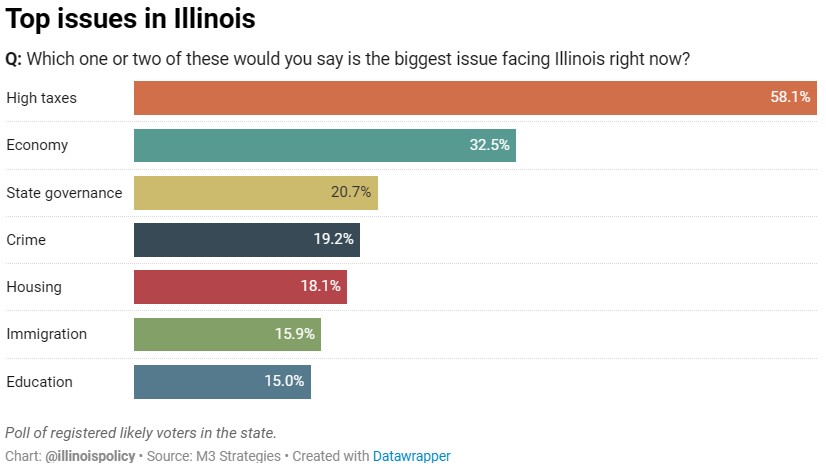
In the most recent poll, from August 2026, 58.1% named high taxes as their No.1 or No. 2 issue, compared with 32.5% for the economy generally and 20.7% for state governance.

Property taxes in particular seem to be the aggravation behind that number. The May 2026 version of the same poll asked residents how satisfied they are with the value their community receives for the property taxes paid. Over 61% said they were dissatisfied, against just 23.5% satisfied.

Article continues here.

Read Full Post »

By Warner Todd Huston | Breitbart News

Critics are bashing Boston’s Democrat Mayor Michelle Wu* for funding a program that trains migrants in political activism.

Wu’s funding benefits the city program called Immigrants Lead Boston operated by Wu’s Mayor’s Office for Immigrant Advancement designed to identify and give aid to “emerging leaders” in the migrant community, Fox News reported.

The program is taking heat for explicitly excluding U.S.-born residents from being qualified to win one of the scholarships while using tax dollars for the sole benefit of migrants.

Wu’s administration is paying migrants $575 to enroll in a ten-week civic-engagement and community-organizing course to help migrants grow their political power to replace Americans.

Registration documents tell enrollees that no legal status is required to earn a grant.

“Classes cover organizing, public narrative, city government, immigration history, racism, and equity,” according to the New Bedford Guide.

The program is also sponsored by the Massachusetts Immigrant and Refugee Advocacy Coalition, which funds deportation-defense lawyers and opposes Immigration and Customs Enforcement (ICE).

Report continues here.

*”One of four children, (Michelle) Wu graduated from Barrington High School in 2003 as the valedictorian of her class.[14] Wu received perfect scores on the SAT and ACT and in 2003 was selected as a Presidential Scholar from Illinois.[15][8] Wu’s parents hoped that she would pursue a career in medicine; in part due to their experiences of the Chinese Civil War, they discouraged her from a career in politics. Wu has also recounted that prior to university, she had not known whether she aligned with the Democratic or Republican parties.[8]”


Read Full Post »


Juliana Stratton

By Mark Glennon* | Wirepoints

Abdul El-Sayed is unquestionably the most controversial and radical major party candidate in memory to run for the United States Senate, which he is doing in Michigan as a Democrat. He is disavowed even by some fellow Democrats, and his critics on the right routinely call him a jihadist, terrorist, radical Islamist or the like.

Juliana Stratton is now using her campaign fund to help El-Sayad win. She is Illinois’s Democratic candidate for the Senate facing Republican Don Tracy.

Linked here and here are recent campaign blast emails signed by El-Sayed but sent by Stratton’s organization and clearly marked, “Paid for by Juliana Stratton for Illinois.” Unknown at this point is how much further financial support she is providing, but Stratton is clearly helping El-Sayed, financially and otherwise, to some degree.

In the case of El-Sayed, any amount of support would have been unthinkable for Democrats and Republicans alike until the left became the nightmare it is today.

To top it off, Stratton is funded mostly by Gov. JB Pritzker, who has long purported to be a rock solid supporter of Israel’s right to exist. El-Sayed is anything but.

Some background on El-Sayed

For starters, El-Sayed has likened Oklahoma’s Sharia law ban to the Trail of Tears and said that ban and the Oklahoma City bombing are products of “white supremacy.” He is repeatedly criticized for dismissing the importance of the 9/11 attacks on America, saying the war on terror that ensued should have been directed to domestic programs.

He opposes Israel’s right to exist as a Jewish state and consistently refuses to say it has a right to exist at all. He would end all military aid not just for Israel but Egypt, Saudi Arabia and Jordan. He often condemns terrorism but proceeds to explain it away. After a Muslim terrorist drove a truck full of explosives into a Jewish temple in Michigan this year, for example, he condemned it but said “hurt people hurt people.” He is not a member of the Democratic Socialist party, but supports much of its most controversial agenda, including abolishing ICE (which he says “cannot be reformed”), Medicare for all, ending all military aid for Israel, and housing as a right. “When they go low, we don’t go high. We take them to the mud and choke them out,” Piker has said.

It gets worse: El-Sayed and Hasan Piker

El-Sayed has regularly platformed and campaigned with Hasan Piker, a prominent and open America-hater, radical Islamist and fan of Joseph Stalin and Mao Zedong “I say I hate America all the time,” Piker has said. “A lot of motherfuckers want to kill me over that take, but at least I say it with my fucking chest.”

Article continues here.

*Mark Glennon is founder of Wirepoints.

Read Full Post »

A Cato Institute analysis says the DSA agenda leaves a gap of up to $169T even after taxing all billionaires

By Eric Revell | FOXBusiness

The policy agenda of the Democratic Socialists of America (DSA) would cost between $71 trillion and $212 trillion in fresh spending over a decade, according to a new analysis.

The progressive wing of the Democratic Party has had electoral success recently, with some candidates backed by the DSA advancing in primaries in the wake of Zohran Mamdani’s election as mayor of New York City.

Angie Nixon, a DSA member in Florida, won the Democratic nomination for the U.S. Senate. Progressives who have touted similar policies as those in the DSA platform have also found recent success in Democratic primaries for U.S. Senate races, with Abdul El-Sayed winning in Michigan and Peggy Flanagan prevailing in Minnesota.

Adam Michel, the director of tax policy studies at the Cato Institute, wrote in the New York Post that the “DSA promises a world of plenty, paid for by somebody else. Simple math says otherwise.”

New York City Mayor Zohran Mamdani, center, celebrates with Sen. Bernie Sanders, I-Vt., and Rep. Alexandria Ocasio-Cortez, D-N.Y. | Andres Kudacki/Getty Images

Michel analyzed the DSA platform and found that while the platform is “thin on details,” he was able to estimate the spending policies would total between $71 trillion and $212 trillion in new spending over the next decade.

He noted that, at the high end of that estimate, the total government spending would reach as high as 92% of U.S. economic output.

“The socialists claim their plan will do away with rent. They’ll make healthcare free and forgive student loans. Their system will provide utilities, college and food at no cost to the consumer,” Michel wrote.

Report continues here.

Read Full Post »

Juliana Stratton (left)

By Mark Glennon | Wirepoints

The balance in the United States Senate after November’s elections is likely to be razor thin, making each Senator’s competence critical in what is among the most dangerous periods America has faced, both internationally and nationally.

Juliana Stratton wants a promotion to the Senate from lieutenant governor — a mostly ceremonial post in Illinois. She’s asking for that promotion from behind a curtain, denying voters any opportunity to see whether she has even a meager understanding of the issues she will face.

Multiple debates and forums would be the best means to learn about Stratton — as well as about Don Tracy, her Republican opponent, whose Senate credentials are also little known to Illinois voters. Tracy accepted offers to no fewer than seven such events from CBS2 Chicago, FOX 32 Chicago, the League of Women Voters of Peoria, the Illinois Farm Bureau, the Illinois Manufacturers’ Association, the Technology and Manufacturing Association and the Illinois Municipal League.

Stratton, however, refused all but one , and it will be very late, set for October 20. Early voting starts September 24 in Illinois, nearly a month before that. And with Chicago’s PBS affiliate, WTTW, being the moderator, we should expect no tough questions for Stratton.

How about a long interview by a fair reporter versed on national issues?

Forget it. You will find none. For that matter, you won’t find one on any matter for the entire duration of her political career in Illinois. When asked for an interview in July by one source that can be reasonably expected to ask hard questions, The Center Square, Stratton declined. Tracy, in contrast, has given multiple interviews to sources both left- and right-leaning.

In fairness, Stratton did participate in multiple debates and forums when running in the Democratic primary. However, that was against fellow progressive Democrats who largely agreed with her and she was never challenged on the major issues that divide the country and would be important to undecided and swing voters.

What do we know about Stratton, aside from her record of complete allegiance to Gov. JB Pritzker on Illinois issues?

On her web pages and elsewhere you can find the standard list of the far left’s policy positions. They include abolishing ICE, which she says is unfixable; a national $25 per hour minimum wage, even in rural areas; Medicare for all, with no cost analysis provided; and ending the 51-year old Senate filibuster rule.

Her top priority, however, is fighting back against President Trump, she has emphasized. We might therefore expect some substance in her views about Trump, right?

Her most notable words about Trump were in an ad that did get her national and international attention, but it was ridiculed for its vacuous crudeness, even by left-leaning sources like Britain’s The Guardian. It was a 30-second ad in her primary race with a string of “F— Trump.”

Article continues here.

Mark Glennon is founder of Wirepoints.

Read Full Post »

The District 220 Board of Education meets this evening at 6:00 PM at the District Administration Center, 515 W. Main Street. Items on their agenda include:

  • Student Report – Countryside Elementary School
  • FOIA Reports
  • Revised Personnel Report
  • Consideration to Approve 2026-27 Budget
  • Consideration to Approve Transfer to Capital Projects
  • Consideration to Approve Terms of IGA for Proposed Village of South Barrington Higgins Corridor TIF District
  • Bond Review Presentation
  • Proposed Village of South Barrington Higgins Corridor TIF District

A copy of the agenda can be viewed here. The meeting will be live streamed on the district YouTube channel.

Related: “Barrington parents ask District 220 to reduce students’ screen time,” “District 220 board members violated campaign policies, investigation finds”


Read Full Post »

« Newer Posts - Older Posts »