Feeds:
Posts
Comments

Archive for August, 2025

The Barrington Area Library posted the following late yesterday:

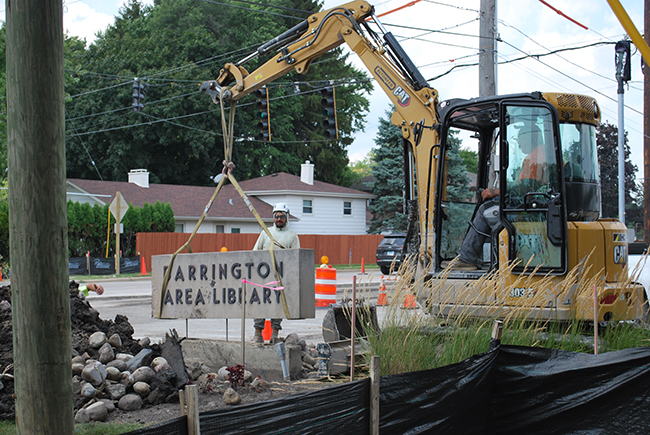
“PLEASE NOTE: Beginning Wednesday, August 27, extensive construction work will begin to rebuild the Library’s entrance driveway, as part of the Route 14 project. This work requires that the driveway be reduced to accommodate only one lane of traffic at a time. Traffic exiting the Library lot will be stopped at a distance from the traffic light, to allow plenty of room for incoming traffic. The traffic light camera will be adjusted to sense the traffic waiting to exit. Please allow extra time and use an abundance of caution and patience when traveling through this area.

Each half of the driveway must be excavated, stoned, poured, and cured before traffic can be switched onto the new driveway half, when the process will begin again. The construction company estimates that this project will take more than two weeks to complete.

In general, we anticipate that visitors will have access to the Library throughout the Route 14 project. We will continue do our best to keep you informed of these situations. We encourage you to visit the Village of Barrington’s dedicated website for the project, where you may also sign up for email updates.

Pro tip: this is great time to try some of our convenient, innovative services like Borrow By Mail and other remote pick-up and return locations!”

Read Full Post »

Alexander Grey | Unsplash

By Catrina Barker | The Center Square contributor

Reports of a transgender student being accepted onto the Conant High School girls volleyball team has supporters and opponents sharing their thoughts with the Palatine-Schaumburg High School District board.

While critics voiced concerns about potential injuries to female athletes, others defended the decision as a matter of inclusion and equal rights.

Marsha McClary, chair of Lake County Moms for Liberty, expressed concerns about fairness in girls’ sports.

“There’s an innate difference in strength, size, and performance of biological males versus females,” said McClary. “Even the Olympic Committee has rules that elite athletes compete based upon biological sex. High school athletes deserve the same fairness.”

The U.S. Olympic and Paralympic Committee recently banned transgender athletes from women’s sports, following President Donald Trump’s executive order “Keeping Men Out of Women’s Sports.”

Read more here.

Read Full Post »

The Village of Barrington Plan Commission meets this evening at 6:30 PM.  Their agenda includes:

  • PC 25-01: 617 W Main Street – Continued Public Hearing

The Petitioner is seeking approval of a Special Use Planned Development and Rezoning from O-R: Office/Research District to R-5: Single-Family Residential District for the construction of eighty-eight (88) single-family residential homes and related site improvements including but not limited to a gatehouse, clubhouse, sports courts, utilities, private roads, parking, lighting, landscaping and trash enclosure.

  • PC 25-03: Comprehensive Plan Amendments – 200 S Hough Street – Continued Public Hearing

The Petitioner is requesting approval of amendments to the Village of Barrington 2021 Comprehensive Plan with regards to Chapter 4 “Land Use”, Chapter 11 “Neighborhood” and Map 3 “Land Use Plan”.

A copy of the agenda can be viewed here.

The Village recently posted an update to their Facebook page stating:

“The continued public hearing for the pending Claremont subdivision proposed on the former PepsiCo site at 617 W. Main St. will be held at 6:30 p.m. on Tuesday, Aug. 26 at Barrington Village Hall, 200 S. Hough St. A site plan and project renderings can be found at the link below.⁠⁠

Keep up to date with all the exciting changes and improvements taking place in Barrington by visiting the development updates page on the Village’s website at Barrington-il.gov/development-updates. The page is regularly updated with the most current information available.”

Related: “‘It is an enclave’: Developer defends concept of gated community on former PepsiCo site in Barrington,” “Barrington Plan Commission Public Hearing regarding proposed 88 single-family home development at former PepsiCo site continues Tuesday,” “Barrington luxury home proposal draws criticism from plan commissioners, residents, park district,” “Barrington Plan Commission Public Hearing tomorrow night regarding planned 88 single-family residential homes at former PepsiCo site,” “Barrington posts further information on proposed Claremont development,” “Barrington posts Public Hearing notice regarding proposed 88 home development at former PepsiCo site,” “88 custom home development planned for former PepsiCo Research & Development Center property in Barrington

Read Full Post »

By: Mark Glennon* | Wirepoints

About $26 billion of State of Illinois liabilities for public employee healthcare just vanished – a decrease of over 56% of that liability in one year. Any questions? Never mind, because you won’t find explanations here or anywhere else, but read on.

The long overdue 2023 financial statements are contained in what’s called the Annual Comprehensive Financial Report (ACFR, formerly called a CAFR) published on August 7. It’s the state’s key financial report because it’s audited, based on actual results and is on an accrual basis. That means that, unlike phony state budgets, growing debts are included in the bottom line and borrowed money is not counted as if it’s income.

On the surface, the bottom line in the new CAFR would appear to be good news. The state’s Net Position (which you can think of as net worth) improved from negative $185 billion to negative $170 billion.

Why the improvement?

It wasn’t that the pension situation eased. That actually worsened, with unfunded liabilities increasing $5.7 billion from the fiscal year 2022 balance of $139.8 billion. (Notably, that deterioration occurred despite an exceptionally good year in the markets that saw the S&P 500 returning over 22%, pushing up pension asset values).

The answer is the magical erasure of liability for what are called OPEBs (Other Post Employment Benefits). OPEBs are basically healthcare promises made to state employee pensioners. For nearly 75% of state-employee (SERS) retirees, the state covers healthcare from the day they retire until Medicare kicks in, plus some supplemental benefits thereafter. OPEB liabilities are measured by actuaries much like pensions, except that OPEBs are entirely unfundedThat is, no money is set aside by the state for estimated future healthcare obligations based on work already performed.

Read on here.

*Mark Glennon is founder of Wirepoints.

Read Full Post »

The “Cecola Room” depicted in planned $328,500 Village Hall renovations.

The Village Board of Trustees will be conducting their regular monthly meeting this evening beginning at 6:30 PM. Items on their agenda include:

A copy of their agenda can be viewed and downloaded here.

Related:‘It is an enclave’: Developer defends concept of gated community on former PepsiCo site in Barrington,” “Barrington Plan Commission Public Hearing regarding proposed 88 single-family home development at former PepsiCo site continues Tuesday,” “Barrington luxury home proposal draws criticism from plan commissioners, residents, park district,” “Barrington Plan Commission Public Hearing tomorrow night regarding planned 88 single-family residential homes at former PepsiCo site,” “Barrington posts further information on proposed Claremont development,” “Barrington posts Public Hearing notice regarding proposed 88 home development at former PepsiCo site,” “88 custom home development planned for former PepsiCo Research & Development Center property in Barrington

Read Full Post »

Barrington Hills Country Club employees and local neighbors cleared damage on Oak Knoll Road immediately after the storm on the August 16th. The damage was extensive and the volunteer action cleared the roads for residents.

Photo above is of a massive tree being removed by volunteers on Oak Knoll Road near HARPS.

Read Full Post »

Much like their namesake, crab spiders usually walk around using only their back legs, moving side-to-side or backwards. | Crab Spider (Thomisidae), Photo by: Mark Kasick

In this Issue:

  • A Message from General Superintendent Adam Bianchi
  • How the Forest Preserves Supports Hummingbird Migration
  • Submit Your Work for Our Annual Photo Contest Now!
  • Forest Preserves Expands Conservation Corps Thanks to Inaugural Grant from IDNR
  • A+ Adventures Start at Forest Preserves’ Nature Centers; Nearly 90 HACC Youth Graduate from Summer Jobs Program in the Forest Preserves; Don’t Call it Quits on Your Summer Bucket List Just Yet!; North Branch Trail Closure Will Pave the Way for Safer, Smoother Rides; 14th Annual Conservation Cup and New Party Under the Pavilion Blend Purpose with Play
  • Upcoming Events
  • Volunteer Resources Set to Launch Mobile Outreach Trike

Read it here.

Read Full Post »

Proper watering of plants before and after planting is critical during the hot summer season. | RJ Carlson/Chicago Botanic Garden

By Tim Johnson | Posted in the Chicago Tribune

Spring got away from me this year, and I missed out on installing a large new garden in my backyard. A friend gave me the impression that I should wait until next spring to do the planting. Do you think that was good advice? I suspect there is still plenty of hot weather to come and wonder how a new planting will fare if I go ahead and plant now.

— Hal Peterman, Elgin

I think it is fine to continue planting all summer long and do so myself. My springs tend to be very busy, so I often do not get around to planting until mid- to late summer. Some gardeners agree with your friend that planting is best done in the spring and fall. But in my opinion, there is no reason to stop planting during the summer. In fact, I have always had good results with my summer plantings.

Chicago Botanic Garden staff continues to plant all summer long. There is not enough time to get all the planting done only in spring and fall. The garden centers that I have visited recently all still have a great selection of plants grown in containers as well as trees and shrubs that are ready for planting, with their root balls burlapped for protection. The new trees and shrubs are typically dug in late winter or early spring, while they are dormant and held above ground in the garden centers. Production nurseries are limited in which plants can be dug during the summer season. Bare root plant material (with no soil around the roots) is generally planted in very early spring before growth has begun. Bare root plants can be held by suppliers in coolers to extend the planting window in spring, but summer is not a good time for installing bare root plants.

Proper watering of plants before and after planting is much more critical during the hot summer season. Plants can be quickly damaged during hot and dry spells if they are not watered enough and can quickly dry out while sitting above ground before installation. It is important to keep plants moist before planting to minimize stress on the new plant material. The growing medium of containerized plants can sometimes be difficult to moisten if they are planted in your beds when dry. It is best to water them before planting if the pots have dried out. Plants that are grown in containers have a lighter growing medium that generally dries more quickly than garden soil and thus need more frequent, light watering until the roots grow out into the surrounding soil. This may mean watering a couple times a week during very hot periods for the first few weeks.

Newly installed balled and burlapped plants need about 1 inch of water a week — be sure the root ball is getting watered. Watering by hand with a garden hose at the base of the tree or shrub works best and will likely need to be done occasionally, even if you have a sprinkler system. Evergreen trees can shed water away from the root ball when a sprinkler is used. The garden bed will then be moist while the root ball of the tree is dry. In time, the roots will grow out into the bed, but you need to focus on moistening the root ball throughout the summer. The amount and frequency of watering will vary depending on the soil conditions in your garden and weather conditions. Sandy, very well-drained soils dry out more quickly than heavier clay loam soils.

Go ahead and plant this summer. There is no need to wait until next spring. Then mulch the new plants to improve the appearance, prevent weeds and help conserve soil moisture.

For more plant advice, contact the Plant Information Service at the Chicago Botanic Garden at plantinfo@chicagobotanic.org. Tim Johnson is senior director of horticulture at the Chicago Botanic Garden.

Read Full Post »
Submitted by Ruth Groth

Anyone looking to establish their lineage to a Revolutionary War Patriot in advance of America’s 250th anniversary coming in 2026 is invited to start their research by attending the Daughters of the American Revolution-hosted workshop “Everything You Ever Wanted to Know about Daughters of the American Revolution” being held at 7 p.m. on Thursday, Aug. 28, at the Barrington Area Library. To register, visit balibrary.org.

Registrar Jenny Fisher of Barrington-based Signal Hill Chapter, National Society Daughters of the American Revolution, will provide an overview of the DAR organization and give insights into the application process. She will also provide details on how the public may gain access to DAR’s rich library of digitized records, including a 66,000,000, all-name index of books and other items in its vast collections.

Participants will receive hints on how to identify a patriot ancestor in their lineage, and how to start building a family tree using large genealogy sites such as Ancestry or Family Search. Each participant will also receive detailed handouts and tools necessary to start their research. Local DAR volunteers will provide valuable one-on-one assistance following the presentation.

The Signal Hill Chapter of the National Society Daughters of the American Revolution was founded in Barrington in 1972. NSDAR is a volunteer women’s service organization headquartered in Washington, D.C.

DAR members promote historic preservation, education and patriotism via commemorative events, scholarships and educational initiatives, citizenship programs, service to veterans, meaningful community service, and more.

Since its founding in 1890 over one million women have joined NSDAR. Membership is open to any woman aged 18 and over who can prove lineal descent from a patriot of the American Revolution. For more information about the Barrington-based chapter, visit signalhilldar.com.

Read Full Post »

Illinois students are struggling to meet proficiency standards on state assessments. Instead of working to improve student learning, the state is lowering standards to hide the crisis.

By Hannah Schmid | Illinois Policy Institute

Most Illinois students are struggling to read or do math at grade level on their end of year state assessments. The State Board of Education’s solution? Lower the standards.

The board of education approved a plan to lower the scores needed to be considered proficient in reading and math on the Illinois Assessment of Readiness. It also determined the scores needed to be considered proficient in reading and math for 11th graders as the state moves from the SAT to ACT as the state-required assessment for high school students.

The most recent state data available shows only 41% of students in third through eighth grade could read at grade level in 2024 and just 31% in 11th grade. In math, 28% of third through eighth graders were proficient and 26% of 11th graders

New proficiency rates will be implemented on the 2025 Illinois Report card released in October, leaving Illinoisans unable to compare scores to previous years’ proficiency rates.

Lowering proficiency benchmarks will inflate the percentage of students meeting proficiency standards this year and moving forward, but it will do little to improve students’ actual performance in core subjects. Instead of addressing low proficiency, the board is minimizing the problem by changing the definition of a student struggling.

New scoring allegedly aligns proficiency benchmarks to rest of nation

The state board approved the lowering of “cut scores,” or proficiency benchmarks, on state assessments because it claims Illinois has been “misidentifying students as being ‘not proficient’… due to misaligned cut scores established several years ago.”

Cut scores are the state test results placing students into one of four performance levels:

  • Below proficient
  • Approaching proficient
  • Proficient
  • Above proficient

According to the board, the new cut scores mean 53% of students will be considered proficient in reading and 38% would be proficient in math on the spring 2025 state assessment data, which will be officially released October 2025. That marks an increase of 12 percentage points in reading proficiency and 10 percentage points in math proficiency.

Read more here.

Related:Editorial: Illinois moves the goalposts (again) on reading, math and science

Read Full Post »

« Newer Posts - Older Posts »