Feeds:
Posts
Comments

Archive for the ‘Springfield’ Category

Former ComEd CEO Anne Pramaggiore walks to U.S. Dirksen Courthouse for her sentencing on July 21, 2025. (Eileen T. Meslar/Chicago Tribune)

By The Editorial Board | Chicago Tribune

A 7th Circuit U.S. Court of Appeals order to release former Commonwealth Edison CEO Anne Pramaggiore and longtime Springfield lobbyist Michael McClain from prison came as a surprise to many. We too were taken aback, we confess, at the speed at which the three-judge panel moved.

Just hours after the conclusion of their Tuesday hearing on Pramaggiore and McClain’s appeals, they sprung the two from the federal prisons that had held them for more than three months. Both were serving two-year prison sentences.

But we were far less surprised that the appellate judges ordered new trials for these two of the so-called ComEd Four defendants found guilty in 2023 of conspiring to bribe then-House Speaker Michael Madigan in order to win highly lucrative state legislation for ComEd and its corporate parent Exelon. The other two defendants, former ComEd lobbyists John Hooker and Jay Doherty, didn’t appeal and now are serving the remainder of their time in halfway houses.

In 2024, the U.S. Supreme Court upended prosecutors’ interpretation of federal law used to convict the ComEd Four. The high court’s ruling in a separate case involving former Portage, Indiana, Mayor James Snyder effectively required an explicit quid-pro-quo arrangement to find an officeholder guilty of bribery, as the ComEd Four were.

Also separately found guilty of bribery, by the way, was Madigan himself, who’s serving a 7.5-year sentence in federal prison and has appealed his 2025 conviction. This ruling may well portend a new trial for Madigan as well.

Which in part is why Andrew Boutros, U.S. attorney for the Northern District of Illinois, quickly ought to green-light a retrial of Pramaggiore and McClain.

U.S. Attorney Andrew Boutros at the Dirksen U.S. Courthouse, April 3, 2026. (E. Jason Wambsgans/Chicago Tribune)

For better or for worse, the Supreme Court has clarified how — and how not — to prosecute public officials caught corruptly conspiring with favor-granting and clout-heavy players, as ComEd was during that era. Best to test out now what sort of evidence and trial approach will be convincing to a jury faced with complex public-corruption charges in this new legal landscape.

Editorial continues here.

Related: Appeals court says it will reverse convictions, orders two ‘ComEd Four’ defendants released from prison

Read Full Post »

From Wednesday, April 8, 2026, Illinois state Rep. Brad Halbrook, R-Shelbyville, references an investigation by The Center Square

By Jared Strong | The Center Square

State lawmakers expressed public, bipartisan concern again Wednesday over an Illinois commission’s efforts to increase access to state contract money for businesses that are owned by racial minorities, women and people with disabilities.

The lawmakers’ concerns are largely based on the reporting of The Center Square in recent months, which has found that the commissioners have fewer responsibilities than their counterparts elsewhere in government and that their decisions have led to a dramatic decline in businesses that are certified for contract preference.

“It seems to be in shambles,” said state Rep. Brad Halbrook, a Shelbyville Republican.

Halbrook made the remark and fired numerous questions at staff of the Commission on Equity and Inclusion during a committee budget hearing Wednesday night. He questioned the pay of the seven commissioners who lead the agency — who each make about $150,000 a year — and their switch to a new computer system nearly two years ago that has effectively blocked more than 2,000 businesses from enhanced access to the contracts.

Other lawmakers had their own concerns, which led them to request that the commission’s staff return to the Capitol for further questioning before they decide whether to approve their $5.6 million budget request for the next fiscal year.

None of the six other agencies that were also subjects of the Wednesday budget hearing were asked to return. The commission’s next appearance before the committee has not yet been scheduled.

Rep. Angelica Guerrero-Cuellar, a Chicago Democrat, was “taken aback” that the commission had failed for a year to coordinate with the Secretary of State’s Office to contact businesses that might be eligible for certification, as she has previously requested.

Article continues here.

Read Full Post »

Tents sit near a burned section of ground in a homeless person encampment in Legion Park in the North Park neighborhood on March 4, 2026. (Eileen T. Meslar/Chicago Tribune)

By The Editorial Board | Chicago Tribune

Homelessness is punishing in itself without the fear of being fined or arrested simply for surviving outdoors. On the other hand, abandoning public spaces — such as parks — to lawless tent encampments isn’t fair to residents, either.

That’s why we’re concerned about a bill making its way through the statehouse. While well intentioned, House Bill 1429 would restrict when governments can impose fines or criminal penalties on unhoused people for certain “life-sustaining activities” on public property — and in doing so may actually make it harder to address encampments in public parks.

Some Chicago neighbors who have been fighting to resolve sprawling tent cities compassionately view this seemingly well-intentioned legislation — House Bill 1429 — as another potential obstacle. The bill wouldn’t bar cities from clearing encampments or moving people, but it does prohibit ticketing or arresting unsheltered individuals for basic survival activities, broadly termed “life-sustaining activities” in the legislation.

It defines “life-sustaining activities” expansively to cover essentially all basic human behaviors required to survive outdoors, such as sleeping and eating. But it also goes beyond basic survival to include storing personal property, which in practice is how encampments form and persist, as well as “protecting oneself from the elements,” which is incredibly broad and could create ambiguity around enforcement of activities like using propane tanks or open flames in the parks.

The bill also would require advance notice (generally seven days) and outreach before enforcement, absent an emergency, creating “a system where action can only be taken after a problem occurs, instead of allowing communities to prevent issues before they escalate,” said Restore Gompers Park Coalition’s Lynn Burmeister, whose group has long advocated for housing and services for people living in the encampments in addition to safety for neighbors.

Meanwhile, the encampment problem on the Northwest Side has become unsafe, untenable and unchanging. When the city clears one encampment, another pops up, often nearby.

With these settlements come reports of unsanitary and dangerous conditions, including reports of public sex, drug and alcohol use, and fecal matter in the parks.

Editorial continues here.

Related: “Illinois bill would override local law to allow homeless living in all public parks


Read Full Post »


Get ready to see homeless camps in parks across Illinois if a bill gaining traction in the Illinois House becomes law. It would override local restrictions to allow homeless encampments in all public parks. Local towns, park districts, cities, forest preserves and all other municipalities of any kind would have their home rule authority on the matter stripped away.

It’s House Bill 1429, the Local Regulation of Unsheltered Homelessness Act, which says local governments wouldn’t be able to establish or enforce a rule fining or criminally punishing homeless people for participating in “life sustaining activities.”

But “life sustaining activities,” under the bill’s definition, means most anything people routinely do. It would include, but not be limited to, “moving, resting, sitting, standing, lying down, sleeping, protecting oneself from the elements, eating, drinking 5(excluding alcohol), and storing personal property as needed to shelter oneself.”

It has 21 sponsors to date including House Speaker Chris Welch, and 872 homeless advocates and organizations have filed witness slips supporting the bill. An April 15 Housing Committee hearing is the next step.

Article continues here.

*Mark Glennon is founder of Wirepoints.

Read Full Post »

Drivers paid nearly $27 billion in tolls from 2024 back to 1973, the year the roads were to become toll-free. Now the largest passenger toll hike in Illinois history is possible.

By Patrick Andriesen | Illinois Policy Institute

In the 53 years since they were supposed to become free, drivers have paid nearly $27 billion to use Illinois’ toll roads.

Those drivers now face the possibility of the largest passenger toll increase in state history.

In a move to gain union support, last year’s transit bailout bill allows the Illinois State Toll Highway Authority board to implement a hike that could raise $1 billion more in tolls a year starting in 2027.

Passenger drivers could see an increase of 45 cents per toll, driving the average up to $1.24, based on the most recent data. Commercial tolls could rise 30%.

That’s despite the fact that since 1973, the authority has collected more in tolls each year than it needed to operate and maintain the system. The agency reported more revenue from tolls in 2024 than any year in the tollway’s history.

For a hike to take effect Jan. 1, the board must vote by Dec. 2.

Record toll revenue in 2024

Illinois has five toll roads totaling almost 300 miles, mainly in Northern Illinois. The tollway authority took in nearly $1.44 billion in tolls in 2024, the most in any year since tolls were first charged in 1959.

Commercial drivers paid $742 million of that, again more than any other year in the tollway’s history, and passenger drivers paid $697 million. The total of almost $1.44 doesn’t count revenue recovered from fare evasion and penalties.

Article continues here.

Read Full Post »

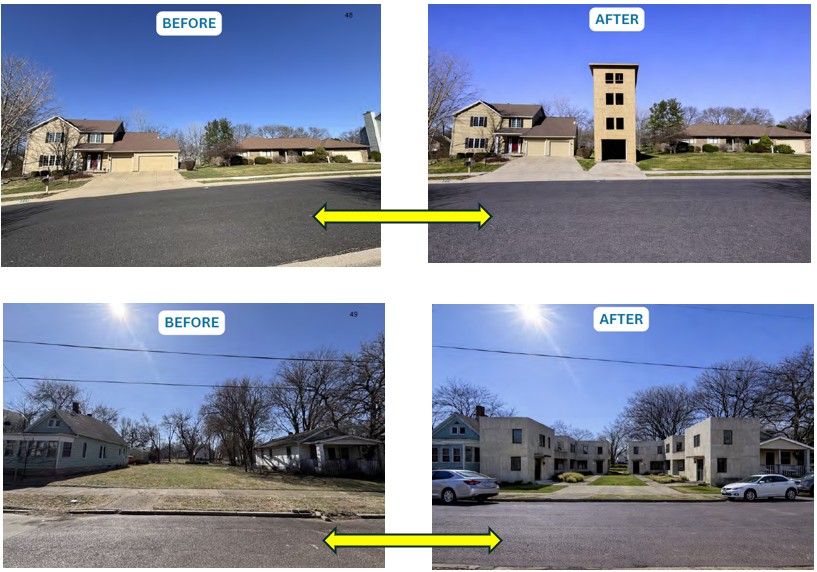
Developer Nick Serra steps April 7, 2026, onto the future balcony of a newly constructed third floor unit in a building he’s redeveloping to add rental apartments in Chicago’s Uptown neighborhood. (Brian Cassella/Chicago Tribune)

By Olivia Olander | Chicago Tribune

Above the bay windows that run up the center of a two-story apartment building in Uptown, Nick Serra stands on what had been the roof but will soon be the balcony for a new third-floor unit he’s adding.

In many circumstances, the construction work would be a sure sign that another traditional Chicago apartment building was being gutted and converted into a single-family home that could fetch more than $1 million.

Instead, the new top floor will be a four-bedroom apartment that, along with other changes Serra is making, will turn the entire building into a six-unit development capable of housing a dozen people.

“Versus, you know, two people and their golden retriever,” Serra said, as he stood last week on the unfinished top floor.

Serra is part of a cohort of developers adding units to existing buildings rather than tearing them down or converting them to single-family homes — a practice many housing advocates say helps with affordability in high-demand neighborhoods. But finding lots zoned to allow the additional square footage and density he needs is difficult, particularly on the North Side, where he primarily works. Under current rules, he has managed roughly two dozen such projects over five years.

Those difficulties finding lots for such projects could change significantly under a package of proposals from Gov. JB Pritzker that would make it easier for developers and property owners across Illinois to build the kind of multiunit housing Serra specializes in.

The plan, a cornerstone political and policy piece of Pritzker’s State of the State address in February, would loosen zoning restrictions that currently limit the residential density allowed on a given lot and, supporters say, open the door to new multifamily buildings across the state.

Additional local rules for building size and height could still apply, potentially restricting a building of the exact dimensions of the one in Uptown.

But the prospect of allowing four-flats or six-unit apartments on quiet suburban streets, and granny flats in backyards across the state, has raised alarms among many local leaders.

The response from the governor’s office? Something has to be done in the face of a housing shortage across the state, and the Pritzker administration is pushing forward anyway.

Story continues here.

Related: Pritzker to propose statewide zoning laws to spur homebuilding, limit local control,” “McLaughlin’s press conference video recording regarding Pritzker’s proposed municipal zoning powers grab posted,” “‘It’s just a bad idea’: Suburban officials oppose Pritzker’s plan to reduce local control over residential It’s just zoning

Read Full Post »

A LifeSafer intelligence speed assistance device installed in a vehicle. (Capitol News Illinois photo by Ben Szalinski)

By Ben Szalinski | Capitol News Illinois

SPRINGFIELD — Illinois drivers who have their license suspended for speeding or reckless driving violations could have an alternative under legislation being considered in the Statehouse.

Rep. Marti Deuter, D-Elmhurst, is pushing a bill that would allow drivers to have a speed control device installed in their car rather than having their license suspended.

“Speeding is a chronic problem on our streets and is a threat to public safety,” Deuter told a House committee last month. “Speeding is a factor in nearly half of all deadly crashes. Risk of fatality increases as speed increases.”

Under House Bill 4948, drivers who have their license suspended following two infractions within 12 months for either reckless driving or speeding 26 mph or more over the speed limit would qualify to apply for a permit with the secretary of state’s office to join the program. If approved, they’d have to pay a $30 monthly fee to have the device installed in their car. Drivers would be required to use the device for one year after their first suspension, two years after their second suspension and three years after three or more suspensions.

Participants would still be subject to some prohibitions, however, such as driving a commercial vehicle or school bus.

“We know that the primary penalty for extreme or repeat speeders, which is license suspension or revocation, doesn’t work,” Deuter said. “Data indicates that about 75% of the people whose licenses are suspended continue to drive.”

The bill was approved unanimously by the committee but is still being negotiated before getting a full vote in the chamber.

Article continues here.

Read Full Post »

Environmental advocates rally for greater data center regulation in Illinois at the Capitol on Wednesday. (Capitol News Illinois photo by Jenna Schweikert)

By Nikoel Hytrek and UIS Public Affairs Reporting (PAR)

SPRINGFIELD —Illinois lawmakers are digging deep on data centers, with a House committee hearing from mayors, labor groups, and agriculture representatives about the facilities’ local impacts in the first of three planned meetings.

Rep. Ann Williams, D-Chicago, the chair of the House Executive Committee, said she wanted to hear about the benefits and challenges of data centers as the General Assembly considers regulations like the POWER Act.

“Whatever we do here, we have to put people first,” she said. “We have to put communities first. Data’s important, business is important, revenues are important, but people must come first.”

Water use, energy use, noise and how community benefit agreements are constructed were the primary concerns lawmakers wanted to address on Wednesday.

Generally, the speakers acknowledged data centers are part of a growing economy and are needed to support technology like AI, cloud computing and data storage used by various industries, from education to health care.

Some cautioned against regulation, saying it could dissuade companies from investing in Illinois while others aired different concerns they’ve encountered.

An Illinois Senate committee has two data center-related hearings scheduled for later this week as well. Environmental advocates on Wednesday also lobbied in the Capitol for data center regulation.

Story continues here.

Read Full Post »

“As a resident of Barrington, IL, I am deeply concerned about the actions of one of our School Board members, Erin Chan Ding, who has admitted to violating School Board policy, using her position for personal gain and political leverage. Her recent activities have raised eyebrows in our community, as it seems she is prioritizing her run for the Democratic candidate for State Representative of the 52nd District over her duties and responsibilities to our children and community. The Board has already voted that she has flagrantly violated School Board policy.

School Board members should exemplify unbiased dedication to the educational needs and welfare of our students. However, it has come to light that this individual is leveraging her role for publicity to further her political career, diverting attention from our District’s educational priorities. Our students deserve leaders who are fully committed to their well-being, not those looking for personal advancement or caught in political machinations.

Evidence of this misuse includes multiple occasions where she solicited petition signatures during school events in violation of Board policies. She was warned by the Board President in July of the violations and her need to adhere to Board policies and she agreed to do so. Despite these admonitions and Chan Ding’s agreement to adhere to policy in July, she’s continued to repeatedly violate policy. The Board voted for remedial training as the consequence for her violations. This is not an acceptable response to her conscious decision to repeatedly violate the very policies she presided over as one of the 2 Board members on the Policy Committee; particularly where Chan Ding was warned by Board President Bradford publicly at the July Board meeting of the violations but continued violations despite the public admonitions.

Chan Ding’s interests align more with her political campaigning ambitions than with School Board responsibilities. Furthermore, decisions made on critical educational issues are now being scrutinized for potential conflicts of interest influenced by her political agenda. This is not the kind of behavior we can afford to permit, as it undermines the trust and integrity essential to governing bodies like our Board of Education.

Removing this member will not only help restore the Board’s focus on its core mission but also sends a clear message that our community will not stand for misconduct or exploitation of elected positions for ulterior motives. It’s crucial that our School Board reflects the best interests of our students and maintains an unwavering commitment to their education and growth.

Join me in calling for the removal of Chan Ding to ensure our Board remains a place for sincere, student-centered service. Let’s protect the integrity of Barrington’s educational system and hold our officials accountable. Sign this petition today to take a stand for our schools and community.”

Read more here.

Related:New Evidence of Chan Ding’s Policy Violations and Conflicts of Interest,” “Candidate Erin Chan Ding’s opinion on Data Centers,” “Barrington area Democrats condemn Chan Ding mailers,” “The D220 Board of Ed gets another ‘F’ in accountability & transparency,” “School district’s parking plan defies logic,” “Zoning change defies village policy,” “The Real Issue in Barrington 220 Isn’t Parking or Levies — It’s Leadership Culture,” “Change.org Petition: ‘For the Resignation of Erin Chan Ding ~ D220 Resources are Not for Political Campaigns’,” “BOARD OF ED VOTES, MEMBER CHAN DING MADE FLAGRANT POLICY VIOLATIONS – Part 2,” “BOARD OF ED VOTES, MEMBER CHAN DING MADE FLAGRANT POLICY VIOLATIONS,” “Erin Chan Ding: The violations just keep piling up…,” “Erin Chan Ding starring in another episode of, ‘Rules For Thee But NOT For Me…’,”  “District 220’s Lack of Transparency (Updated),” “District 220’s Lack of Transparency,” “Ding Politicking on School District Property,” “Dual School Board and State Rep Positions Legally Incompatible,” “D220 Abuses Taxpayer Funds in favor of Partisan Campaign,” “Ding In Her Own Words – CONFLICTED!,” “Ding Doubles Down,” “Ding’s D220 Deception,” “Chan Ding running in Democratic primary in 52nd,” “Three (3) Democratic candidates queued to run for the IL 52nd District House seat in 2026

Read Full Post »

Sheridan G. Gorman (Via Instagram)

By William McGurn | Wall Street Journal

Sheridan Gorman should still be alive. The 18-year-old freshman should be with her family and catching them up on what’s new at Chicago’s Loyola University. Instead she’s gone, and this weekend her family came with moist eyes and broken hearts to her funeral at the First Presbyterian Church in her hometown of Yorktown, N.Y.

This family has been through the unspeakable: The light of their lives snuffed out before her time, cut down as Ms. Gorman gathered by the Chicago lakefront with friends to catch a glimpse of the Northern Lights. The politicians who failed to protect her from a criminal have since compounded the pain with ill-conceived statements about who’s to blame. These statements—by the governor, the mayor, a Chicago alderwoman—weren’t intended to wound, but they did.

Our political class, apparently, has lost all sense of what’s important in moments like these. It’s become all about scoring political points against your enemies. Comforting the afflicted, supporting communities and individuals, all that comes later—or not at all. This is not normal.

Begin with Illinois Gov. JB Pritzker. A week ago he admitted there were “real failures” in the immigration and criminal-justice systems that led to this murder. The accused murderer is 25-year-old Jose Medina, a Venezuelan who crossed into the U.S. illegally amid the border chaos of the Biden years. He has been arrested and charged with Ms. Gorman’s murder.

Mr. Pritzker’s real message wasn’t the “real failures.” It was: This is Donald Trump’s fault, notwithstanding that there’s hardly a Republican to be found in Illinois. “I know that the Gorman family has suffered mightily,” the governor said. “I agree. There have been real failures. Those failures, of course, extend beyond the borders of Illinois. There [are] national failures, a failure to have comprehensive immigration reform, a failure of the president to follow his own edict to go after the worst of the worst.”

Alderwoman Maria Hadden told Fox32’s Chicago Live last week that Gorman “might have been a wrong-place-wrong-time, running into a person who had a gun. They might have startled this person at the end of the pier unintentionally.” Ms. Hadden has since apologized for suggesting the victim caused her own death while blaming media for “intentionally creating sound bites to misconstrue my words during this tragedy.”

Not to be outdone, Mayor Brandon Johnson gave a master class in deflection when asked if he would apologize to Gorman’s parents for her death. He then characterized it as “senseless violence.” This was followed by a filibuster, in which he said the city’s sanctuary status was established 40 years ago and was somehow shaped by a 2021 criminal justice reform, which he incorrectly said was passed under Gov. Bruce Rauner who was—wait for it—a Republican. (The law was signed by Gov. Pritzker.)

Finally he, too, went to the old reliable: Mr. Trump. “He points the finger at everything and everyone else versus doing some real self-reflection on what his responsibility is.”

Article continues here.

Read Full Post »

« Newer Posts - Older Posts »