Feeds:
Posts
Comments

Archive for the ‘Barrington Education Association’ Category

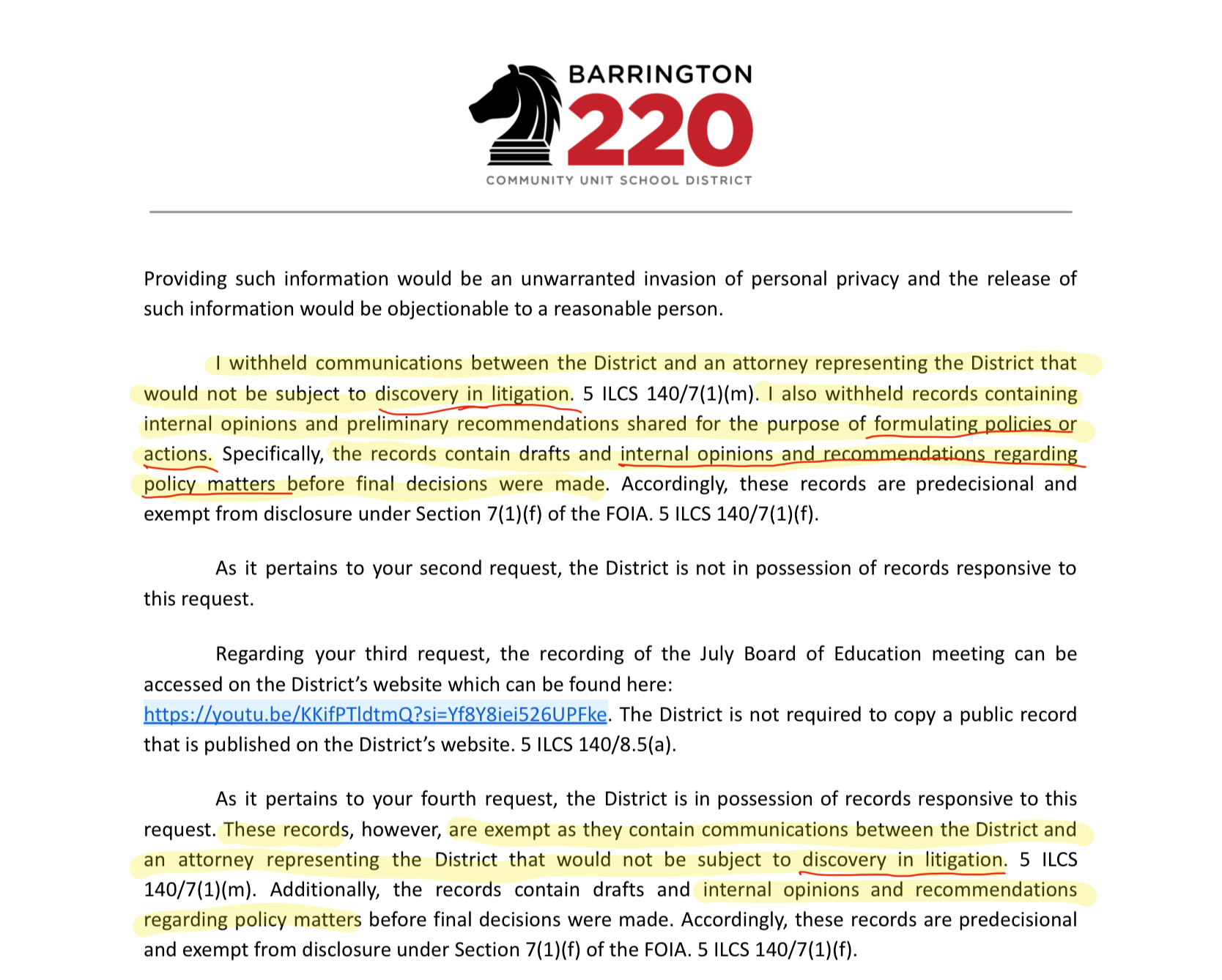
Following this morning‘s article on Erin Chan Ding confirming, in her own words, her conflict of dually serving on the D220 Board of Education (BOE) while simultaneously running for a partisan Democratic office for Illinois House Representative in the 52nd District, we have received information obtained by a resident pursuant to a Freedom of Information Act (FOIA) request to D220.

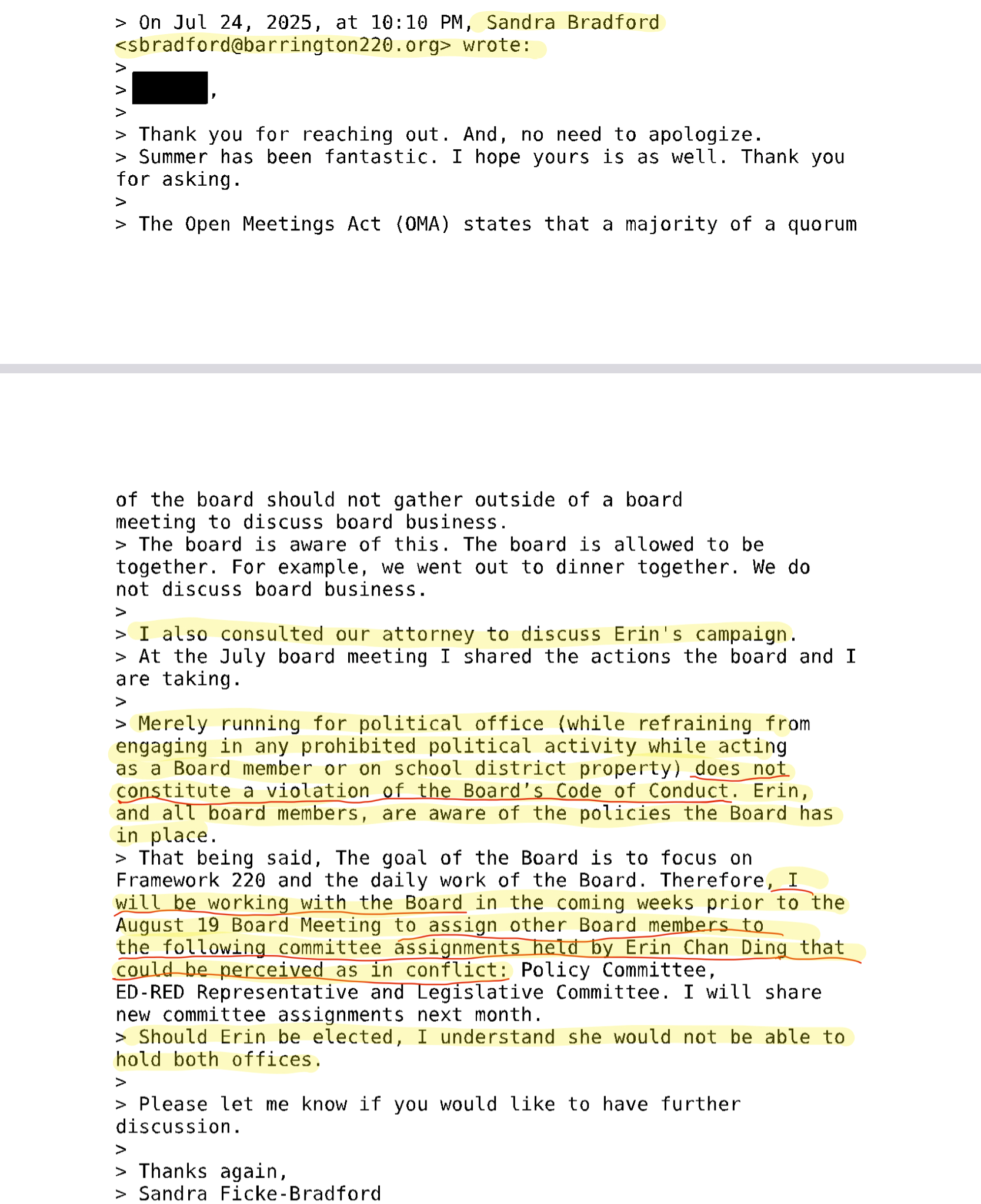
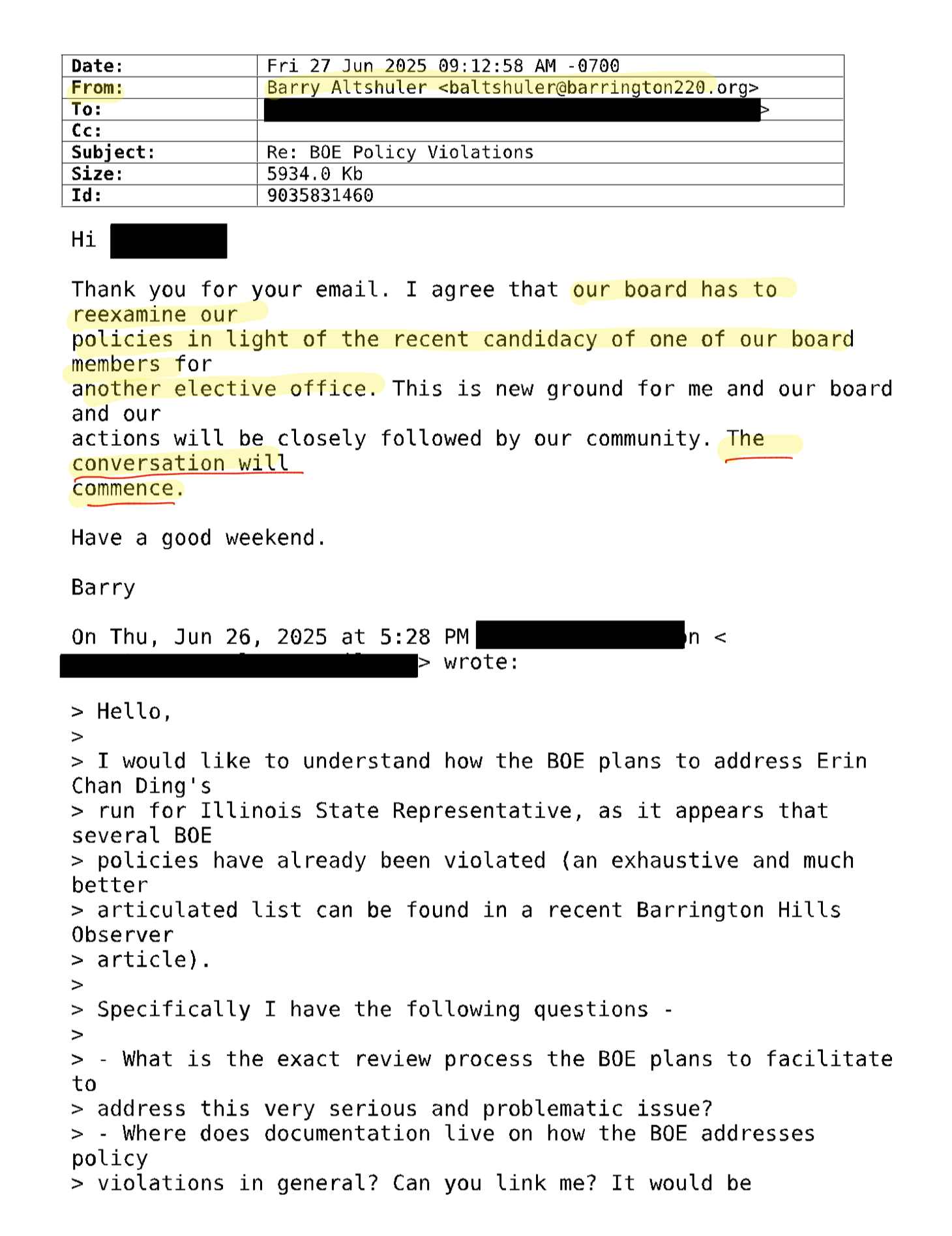
These records confirm that D220 Superintendent Winkelman and BOE President Ficke-Bradford have used D220 taxpayer funds to obtain attorney opinions on Ding‘s ability to run for the 52nd District while simultaneously serving on the BOE. (The Observer queried in a recent article why taxpayer funds would be utilized by the D220 School District to obtain attorney opinions in this regard.) They further confirm that the BOE is engaging in closed door sessions regarding Ding and her campaign for the 52nd District. We posit whether this is a violation of the Open Meetings Act.

Ding is raising her own campaign funds for her run for the 52nd. Isn’t it more appropriate that Ding’s Erin for Illinois Campaign pay for these attorney consultations rather than the D220 taxpayers? Additionally, why would D220 need taxpayer paid attorney consultations related to BOE Policy and Code of Conduct questions?

Are we seriously paying attorneys to opine on whether a BOE Member has violated Board Policy or Code of Conduct? Does our Superintendent and BOE President need an attorney to tell them if a BOE Member has “surrendered her responsibilities to special interest or partisan political groups”? Do they need an attorney to tell them whether a BOE member has engaged in the “appearance of impropriety” or that she has used her “Board of Education membership for personal gain or publicity”? This is beyond absurd.

Additionally, these records show that these policy discussions are taking place behind closed doors rather than in front of the public? Isn’t policy something that should be discussed and set with full BOE participation and public scrutiny? Since when is the policy of how our duly elected officials conduct themselves in their duly elected positions determined without the public’s participation?

Craig and Sandra, we urge you to get back to the business of running the D220 School District instead of using your D220 positions and the taxpayer’s resources to engage in the partisan politics of the Ding campaign for the 52nd District.

Related: “Ding In Her Own Words – CONFLICTED!,” “District 220 Board of Education meets this evening (07.15.25)” “Ding Doubles Down,” “Ding’s D220 Deception,” “Chan Ding running in Democratic primary in 52nd,” “Three (3) Democratic candidates queued to run for the IL 52nd District House seat in 2026

Read Full Post »

In 2021 Erin Chan Ding first campaigned for a position on the Barrington 220 Board of Education (BOE). At that time she created a website “ERIN CHAN DING for 220.” Curiously, some might say suspiciously, the Website for Ding’s 220 campaign has been scrubbed from the internet and one must use a special search engine to attempt to find the deleted files. Ding, as we’ve previously reported, recently won re-election to the BOE and, shortly following that win, announced that she would be running in the Democratic Primary for the chance to be the Democratic candidate in the 2026 election for State Representative of the 52nd District ~ a partisan political position.

Ding’s scrubbed BOE website says several things about the conflict this run poses to her current position on the BOE and demands, in her own words, that she either immediately resign from her BOE position or forego her run for the 52nd District.

As some may recall, Ding set off a hot bed of controversy when, during the 2021 BOE campaign, she accepted the endorsement of the Barrington Education Association (BEA), 220 teacher’s union, and a donation from the BEA’s political action committee, IPACE. Ding, realizing the controversy in bringing partisan politics to what she took an oath to be a non-partisan position, explained why it was okay for her to accept the BEA endorsement and IPACE donation in 2021:

Each of us… candidates running for the … BOE are political candidates in a municipal election. What we are NOT supposed to be is partisan, affiliated with a particular political party. It is my commitment, if elected as a school board member, to maintain independence and making decisions and be free of influence from political parties and special interest groups. I will be accountable only to our community.

I have heard there’s been misinformation going around that has conflated the … BEA with a Political Action Committee, or PAC… The BEA is the union that represents more than 700 teachers and educational professionals in Barrington 220… this year, the BEA specifically stated it would endorse candidates with integrity, teamwork, a heart for racial and social equity and a sense of service over self… I am honored to have received one of four BEA endorsements.

The BEA is affiliated with a statewide organization called … IPACE, a nonpartisan, pro-education organization to which BEA members … can voluntarily contribute. IPACE regularly donates to pro-education, pro-public school candidates.

Because I was endorsed by the BEA, IPACE offered a contribution… to my campaign fund, Friends of Erin Chan Ding. Before accepting the donation, I researched IPACE to ensure it was strictly non-partisan and concluded that it is, as according to its website, recommendations for contributions… “are not determined by partisan politics.

Our local BEA officers are also clear that I am not and will not be beholden to the teachers union or to any special interest groups.  I have not and would never accept partisan donations that will compromise my ability to offer excellent stewardship to our community.

(Click on any image above to enlarge)

Clearly, Ding recognized the import of being nonpartisan in her position on the BOE during her 2021 and 2025 campaigns for BOE. Yet, at the same time she was taking her oath of office to be a nonpartisan member of the BOE on April 22, 2025, pledging that she would:

…refuse to surrender (her) responsibilities to special interest or partisan political groups… avoid any conflict of interest or the appearance of impropriety which could result from (her) position, and shall not use (her) Board of Education membership for personal gain or publicity…,

Ding had already begun her quest for a partisan political position, using her BOE membership to bolster her candidacy (indeed her time on the BOE provides her only cited credentials on her social media and Erin for Illinois pages). Additionally, in a flagrant showing of impropriety, Ding posts D220 educators, whose discipline and contracts she votes on, as endorsers of her partisan run for the 52nd.

Then, sometime following the several posts that the Observer has put out regarding Ding’s blatant conflict of interest in remaining as a BOE member at the same time she is actively campaigning and raising funds for a partisan political position (see “Ding’s D220 Deception” and “Ding Doubles Down”), Ding scrubbed the internet of her very own acknowledgment of the impropriety of her serving on the BOE under these circumstances.

BOE President Ficke-Bradford has similarly acknowledged the impropriety of Ding remaining on the BOE under these circumstances where she unceremoniously, without Ding’s presence and without a public vote of the BOE, removed Ding from all of her BOE committee assignments.

Since pushing forward with her campaign for a partisan political position, Ding has

  • Affiliated with a particular political party;
  • Accepted partisan donations*, compromising her ability to offer excellent stewardship to our community;
  • Failed to maintain independence; and
  • Failed to remain free of influence from political parties and special interest groups.

In further affront to her BOE oath, Ding has also partnered with Barrington Area Dems (BAD) to promote her run for the 52nd District. BAD has posted a fundraiser being thrown by them for Ding and other local Democratic candidates, commenting on Ding as a “current School Board member” and “a dual-elected District 220 Board of Education member” with a “commitment to equity and inclusive school communities.” Ding even ‘liked’ the post from her personal “luvpiggies” instagram account:

The next regular meeting of the BOE is scheduled for this evening. This is a good opportunity for the public to remind Ding, Superintendent Winkelman, and the Members of the BOE, that the oath of office taken by each is not to be taken lightly. It is our belief that Ding is unfit to serve any longer on our Board of Education and it’s time for the Regional and D220 Superintendents and the BOE to take action in removing her.

D220 Superintendent: cwinkelman@barrington220.org

D220 Board of Education: stwang@barrington220.org, dclopton@barrington220.org, baltshuler@barrington220.org, sbradford@barrington220.org, lcollisterlazzari@barrington220.org, echanding@barrington220.orghsrivastava@barrington220.org

Dr. Michael Karner Lake County Regional Superintendent of Schools: Mkarner@lake.k12.il.us

*Ding’s Erin for Illinois disclosures show $3,000.00 in donations from Friends of Josina Morita, the Democratic Committee formed to support Democratic Candidate Josina Morita for Office of Cook County Commissioner for the Democratic Party. These contributions were not made by Morita in her personal capacity, but specifically made from her Democratic Committee. https://www.elections.il.gov/CampaignDisclosure/CommitteeDetail.aspx?ID=NC181bT0yRx6vp8tMkKtSg%3d%3d

Related: “District 220 Board of Education meets this evening (07.15.25)” “Ding Doubles Down,” “Ding’s D220 Deception,” “Chan Ding running in Democratic primary in 52nd,” “Three (3) Democratic candidates queued to run for the IL 52nd District House seat in 2026

Read Full Post »

The District 220 Board of Education meets Tuesday evening at 6:00 PM at the District Administration Center, 515 W. Main Street. Items on their agenda include:

  • FOIA Reports
  • Personnel Report
  • Salem United Methodist Church Parking Agreement
  • Consideration and Approval of Resolution Approving contract for purchase of 502, 506, 510 W. Main St. and 112 N. Hager Ave. (Nearly $1M total) properties.
  • Consideration to Approve the Destruction of Verbatim Recordings
  • Consideration to Approve the Release of Confidentiality of Closed Session Minutes
  • 2025-26 Tentative Budget Presentation
  • Capital Improvement and Facility Maintenance

A copy of the agenda can be viewed here. The meeting will be live-streamed on the district YouTube channel.

Read Full Post »

“Say hey to our newest class of educators in Barrington 220!” | Barrington 220 School District Facebook post August 7, 2025

By Catrina Barker | The Center Square contributor

With the Illinois Education Association’s mid-September opt-out deadline approaching, critics call for a permanent opt-out option instead of yearly reaffirmation, arguing union influence restricts school choice and teacher autonomy in Illinois.

Sarah Fletcher, a former charter school educator and now the Head of School at White Horse Academy, a private school, said her own teaching career trajectory was shaped by a desire to avoid union involvement altogether.

“When we moved here to Illinois from Arizona, I had very little interest in teaching at the public school,” Fletcher said. “Part of that was because I didn’t want to be pressured into or have to be mandated to pay dues. The IEA and IFT, which are part of larger organizations like the NEA, use the majority of their funds not to represent teachers, but for political advocacy.”

Fletcher said she founded White Horse Academy in part to provide a space where teachers wouldn’t be required to hold state certification or pressured into union membership. She says the high cost of dues isn’t justified by what little teachers get in return.

“Oftentimes unions don’t advertise opting out is an option. I experienced something similar in a different sector where there was a union. I was heavily pressured into signing paperwork to pay union dues and was basically told I had no choice,” said Fletcher. “Much of the money from the dues collected fund political agendas, even opposing public and private school options. For example, [state Rep.] Terra Costa Howard, who wrote the homeschool bill HB 2827, received nearly $500,000 from teachers’ unions.”

According to Illinois Policy, Chicago Teachers Union members pay over $1,400 in dues annually, but less than $149 is spent on representing Chicago teachers.

The U.S. Supreme Court ruling in Janus v. AFSCME on June 27, 2018 means teachers nationwide are no longer required to be part of a teachers union in order to keep their jobs.

Read more here.

Read Full Post »

There is one time a year for most public education employees to opt out of their teachers union. That time is now. Here’s why it might make sense for you/them.

By Lilly Rossi | Illinois Policy Institute

Illinois teachers’ unions spend little on representing teachers, what should be their core focus. So why should teachers fund union bosses’ politics, excesses and salaries with their union dues?

They don’t have to. Education employees in public schools can opt out of union membership, save their hard-earned money and keep all the benefits of the union contract.

But time is limited: most unions require notification during August to stop pulling dues from teachers’ paychecks.

From classroom teachers to the support staff in public schools, here are the answers to frequently asked questions about opting out of a teachers union.

What is “opting out?”

“Oping out” is the process public school education employees can use to leave the union and stop paying dues, while continuing employment and keeping pay and benefits.

How do I opt out?
If you are an education employee in a public school within the state of Illinois, you will want to send a letter directly to the union. Visit one of these sites to get the paperwork you need:

  • For education employees represented by an affiliate of the Illinois Federation of Teachers: LeaveIFT.com
  • For education employees represented by an affiliate of the Illinois Education Association: LeaveIEA.com
  • For education employees represented by the Chicago Teachers Union: LeaveCTU.com

Why would I want to opt out?

  • The union spends too much on politics and on causes with which I disagree.
  • The union doesn’t represent its members well.
  • The family budget is tight, and that extra money could go a long way.
  • Opting out gives you the freedom to make choices you think are best.

Whatever your reason, you have the choice and cannot be forced to pay dues.

Read more here.

Read Full Post »

Just 15% to 26% of Illinois teachers union spending was on representing teachers in 2024. But public education employees can opt out of union membership and keep their hard-earned money.

By Mailee Smith | Illinois Policy Institute

Illinois teachers unions have a terrible track record when it comes to spending money on what’s important, but August is when teachers can reclaim their priorities and pay.

The Illinois Education Association and the Illinois Federation of Teachers – the state affiliates representing most teachers in Illinois – spend very little on representing teachers, which should be their core focus. Chicago Teachers Union, a local affiliate of IFT, does just as poorly.

Public education employees upset with the way their unions spend their dues have a choice. They can opt out of union membership and stop sending dues to the union without repercussion. They keep all their employer-provided pay and benefits. And they can obtain liability insurance and job protection coverage at a fraction of the price of union membership.

But time is of the essence. Most teachers unions will only stop deducting dues if teachers opt-out in August.

Illinois teachers unions spend little on teachers

Teachers spend hundreds – and some over a thousand – on union dues each year. But their unions don’t prioritize representing teachers.

The unions’ abysmal spending on teachers is admitted in own their federal filings with the U.S. Department of Labor. It’s a significant indicator that unions take teachers’ money yet don’t put those same teachers’ interests first.

IEA is the largest teachers union in Illinois with 132,565 members, according to its 2024 federal filing. But just 15% of its spending in 2024 was on “representational activities” – what should be its core purpose. The rest was on administration, politics and other union leadership priorities.

Nationally, IEA members are represented by the National Education Association, which fared even worse. Just 9% of its spending was on representing teachers.

Read more here.

Read Full Post »

State employees represented by AFSCME Council 31 received an automatic annual raise on July 1, highlighting the salary discrepancy between government and private sector workers.

By Mailee Smith and Bryce Hill | Illinois Policy Institute

It pays to be a state employee in Illinois.

July brought “pay raise day” for the tens of thousands of state employees represented by the American Federation of State, County and Municipal Employees Council 31.

But it’s also the month which emphasizes the salary discrepancy between government workers and every other worker in Illinois.

Since 2021, state government worker salaries have grown 57% faster than pay for workers in the private sector.

As of 2024, the average Illinois state employee made $85,689 compared to an average of $78,267 in the private sector, according to the Bureau of Labor Statistics Quarterly Survey of Employment and Wages data. That’s a $7,422, or 9.5%, difference.

The July 2025 raise was just part of a total 19.28% pay hike agreed to by Gov. J.B. Pritzker when he approved the state’s contract with AFSCME Council 31 in 2023. The agreement provides an automatic raise of 2.5% to 4.0% for each year of the contract. Compounded annually, that’s 19.28%.

No matter what happens to the economy and the private sector, the state is committed under the contract to raises that outpace what other workers are earning. Between 2023 and 2026, these AFSCME raises are expected to outpace private sector raises by 51%.

Read more here.

Read Full Post »

A bill in Congress would hold the National Education Association accountable, forcing it to once more put students and educators first or risk losing its special status as a chartered organization.

By Rich Witzel | Illinois Policy Institute

The National Education Association was given a federal charter to be a professional advocate for teachers and public education, but it has morphed into a hyper-partisan advocacy group.

Spending tens of millions of dollars on campaigns, lobbying and ideology-driven resolutions that have little to do with students has real consequences. It hurts teachers. It politicizes the classroom. It undermines trust in public education. And it’s happening under the recognition of a federal charter, a rare privilege possessed by fewer than 100 national-interest groups, such as the American Legion.

Congress is considering fixing that. The Stopping Teachers Unions from Damaging Education Needs Today Act, would hold the NEA to the same standards of neutrality, transparency and public service expected of any nationally chartered nonprofit. The STUDENT Act is intended to refocus the NEA on education.

NEA is more focused on power than education

In 2024, the NEA spent $23 million on political campaigns and another $3 million lobbying Congress. That same year, just 9% of the NEA’s spending was on representing its members, while the rest went to political causes and other union leadership priorities.

Its ideological drift isn’t hidden; it’s celebrated. At its 2025 Representative Assembly, the NEA passed a series of extremely partisan resolutions:

  • Praised anti-ICE and “No Kings” protests as models for “mass democratic demonstrations.”
  • Declared Trump’s political platform to be a form of “fascism” that the union must resist.
  • Denounced a Supreme Court ruling that supported parental opt-out rights from LGBT instruction.

This isn’t normal union advocacy for teachers. It’s a highly politicized agenda.

Educators join unions to advocate for better pay, safer classrooms and professional dignity, not to fund politically divisive causes. The results speak for themselves: the NEA has lost nearly 400,000 members since its peak in 2009. Teachers are walking away, and public trust is eroding.

Read more here.

Read Full Post »

Recently reelected District 220 Board of Education member and now candidate Erin Chan Ding poses with 220 Board of Education Vice President Barry Altshuler (giving thumbs up) for a photo at her June 18th launch of her Illinois State Rep campaign.

The District 220 Board of Education (BOE) met last Tuesday, and BOE President Sandra Ficke-Bradford began her presentation by addressing the elephant in the room (the elephant wasn’t actually in the room, as Member Erin Chan Ding was absent from the July 15 BOE Meeting) stating:

“As many are aware, District 220 Board Member Erin Chan Ding has declared her intent to run for State Representative of the 52nd District, and it’s within Erin’s right to do so, and Erin is aware of the Board policies and the laws that are in place.

We have consulted with our counsel, um, to confirm that merely running for an office, um, for political office, while refraining from engaging in any prohibited political activity while acting as a Board member or on School District property does not constitute a violation of the Board’s Code of Conduct. Erin and all Board Members are aware of the policies the Board does have in place.

Um, that being said, the goal of this Board is to focus on Framework 220 and the daily work of the School Board. Therefore, I will be working with you guys, the Board, um, in the coming weeks prior to our next Board meeting in August to assign other Board Members to the following committee assignments that Erin holds currently. Um, Policy Committee, ED-RED Representative and Legislative Committee. So, if you’re interested in those, please let me know. Um, but we will be making those changes before the next, before those meetings.”

Ficke-Bradford did not ask the other BOE Members if they had any questions or comments relative to the removal of Ding from her committee assignments. Following Public Comment, where a member of the community spoke about the conflicts presented by Ding’s decision to run for a partisan political position, Ficke-Bradford chose to reiterate some of her prior statements adding:

“I just want to touch on, I just want to repeat what I had said earlier, that um, regarding Erin Chan Ding running for um State Representative, um, we did consult with our counsel, and um, we did confirm that merely running for political office, again, while refraining from engaging in any prohibited political activity while acting as a Board Member or on School District property does not constitute a violation of the Board’s Code of Conduct. Um, but I would like to remind the Board, right, that we do have policies that are in place and we should be very careful to make sure that we do not violate the Open Meetings Act. So, thank you for that.”

In watching the video from the July 15th meeting, at 37:52, one can see Ficke-Bradford pointedly look towards Members Altshuler and Srivastava while she reminds the BOE Members of their obligations under the Illinois Open Meetings Act (OMA). As reported on by The Observer in Ding’s D220 Deception, both Altshuler and Srivastava were present at Ding’s launch party for her run for the 52nd. The Observer further pointed out the potential for an OMA violation in that article, as three Members of the BOE constitute a quorum and Ding’s platform for the 52nd District mostly surrounds her activities on the BOE. So, now Ficke-Bradford has put the entire BOE on notice due to Ding’s decision.

For nearly a month, The Observer has written about the conflict of interest Erin Chan Ding created when she announced her political ambitions weeks after being reelected to the BOE (seeDing’s D220 Deception” and “Ding Doubles Down”).This past Tuesday evening, apparently without discussion or vote, Ficke-Bradford decided Ding’s position on 3 BOE committees would be eliminated, and not one Member of the BOE or the Superintendent voiced an objection to this decision.

It should be noted that the BOE had a lengthy Closed Session prior to the regular meeting of the BOE, with one of the Closed Session Agenda items being “Self Evaluation.”  School boards can hold closed-session meetings to discuss specific topics legally permitted under the OMA. These sessions are not open to the public, and the topics discussed are specifically limited by the OMA. It’s certainly possible that the BOE and Superintendent Winkelman determined to discuss Ding’s run for the 52nd in Closed Session, as Ficke-Bradford’s statement appeared to be prepared written comments. The Observer, however, cannot identify a legally recognized exception to the OMA and the premise that BOE actions should take place in front of the public which would have allowed for such discussions in Closed Session.

Ficke-Bradford’s choice clearly confirms her belief that Ding’s decision to run for a partisan political position makes her conflicted if she remains on the Board of Education. Further, so long as Ding remains on the BOE, every Board vote will require scrutiny for objectivity and everything Ding says or posts in her Democratic campaign for the 52nd District must also be scrutinized before it’s determined whether or not she should abstain from BOE activities.

The baggage Ding has now burdened our Board of Education with is one taxpayers were not bargaining on when they voted in April. And, if Ding chooses to keep her BOE seat, it will only serve to increase the burden of responsibility on her peers.

We believe that Ficke-Bradford, without calling for Ding to step down, has opened the door for Ding to do the right thing by taking that action on her own and step down before further action must me taken. The removal of Ding from committee assignments is a clear admission that her run for the 52nd District, including her website and social pages that actively advertise her BOE activities as support for her run, constitute violations of BOE policies.

Additionally, we’d like to point out from Ficke-Bradford’s comments, it appears that our BOE believes that the burden should be on the D220 taxpayers, as opposed to the Erin for Illinois Democratic political committee organized and raising funds on behalf of Ding’s run for the 52nd District, for the responsibility for obtaining legal opinions as to whether Ding is conflicted from serving the dual functions of partisan and non-partisan. We suggest to Ficke-Bradford, the BOE, Superintendent Winkelman and the D220 attorneys that this is an irresponsible use of taxpayer money and this burden should be on the Erin for Illinois campaign, not the taxpayer.

Related: “Ding Doubles Down,” “Ding’s D220 Deception,” “Chan Ding running in Democratic primary in 52nd,” “Three (3) Democratic candidates queued to run for the IL 52nd District House seat in 2026

Read Full Post »

The District 220 Board of Education meets this evening at 6:00 PM at the District Administration Center, 515 W. Main Street. Items on their agenda include:

  • FOIA Reports
  • Personnel Report
  • Declare Property Surplus and Authorize its Sale or Disposal
  • Consideration to Approve Second Reading of Board Policy
  • Consideration to Approve the Sunny Hill Elementary School Improvement Plan
  • Instructional Minutes/Calendar Update

A copy of the agenda can be viewed here. The meeting will be live-streamed on the district YouTube channel.

We believe each of the identified Agenda items allows for reflection on two recent articles posted by The Observer (see related posts below) relative to Board of Education member Erin Chan Ding and her violations of her oath of office as a nonpartisan member of the D220 Board of Education.

As a reminder, Ding has announced she is running in the Democratic primary for State Rep for the 52nd District. In doing so, she has promoted her candidacy publicly on social media and at meet and greets using her position as a Board of Education member. This is a violation of Ding’s oath of office as a nonpartisan member of the D220 Board of Education:

2:80-E Exhibit – Board Member Code of Conduct

Each member of the Community Unit School District 220 Board of Education ascribes to the following code of conduct:

  1. I will represent all school district constituents honestly and equally and refuse to surrender my responsibilities to special interest or partisan political groups.
  2. I will avoid any conflict of interest or the appearance of impropriety which could result from my position, and shall not use my Board of Education membership for personal gain or publicity.

We encourage our readers to remind the Board of Education, Superintendent Winkleman and Lake County Regional Superintendent of Schools, Dr. Michael Karner, either by email or in Public Comment of the importance of Board of Education members upholding their oath to the public they serve.

D220 Superintendent: cwinkelman@barrington220.org

D220 Board of Education: stwang@barrington220.org, dclopton@barrington220.org, baltshuler@barrington220.org, sbradford@barrington220.org, lcollisterlazzari@barrington220.org, echanding@barrington220.orghsrivastava@barrington220.org

Regional Office of Education: ROEISC@isbe.net

Dr. Michael Karner Lake County Regional Superintendent of Schools: Mkarner@lake.k12.il.us

Related:Ding Doubles Down,” “Ding’s D220 Deception,” “Chan Ding running in Democratic primary in 52nd,” “Three (3) Democratic candidates queued to run for the IL 52nd District House seat in 2026

Read Full Post »

« Newer Posts - Older Posts »