Feeds:
Posts
Comments

Archive for the ‘Commodius Maximus’ Category

By LGIS News Service | Lake County Gazette

Deerfield School District 109 administrators forced teen girls at Shepard Middle School to change in front of a boy in the school locker room.

That’s according to parent testimony heard during public comment Thursday’s District 109 School Board meeting.

After receiving a complaint from girls in early February that a boy was in their locker room while they were changing for gym class, District 109 “Assistant Superintendent for Student Services” Joanna Ford, “Assistant Principal” Cathy Van Treese and “Director for Student Services” Ginger Logemann reprimanded the girls, then escorted them to the locker room and tried to force them to change in front of the boy.

Parent Nicole Georgas, whose daughter refused and ran out of the locker room, described her daughter’s experiences to the school board Thursday.

“The male student was present in the girls locker room,” Georges said. “Feeling violated, the girls made the choice not change into their PE (physical education) clothes with a biological male present.”

The next day, Georgas said, Ford, Van Treese and Logermann tried to bully them into to changing in front of the boy.

“(The administrators) all came into the girls locker room, making them change into uniform. This went on all week,” Georgas said. “My daughter refused to take part in her privacy being violated. How dare they!”

She said Shepard School Principal Rob Wegley told her daughter that any male student can use any girl’s bathroom or locker room at his school so long as they say claim to “identify as female.”

Georgas said Wegley told her this was the school policy as dictated by Ford and “legal counsel.”

Georgas said she has filed a civil rights complaint on behalf of her daughter with the U.S. Department of Justice.

Read more here.

Read Full Post »

Image courtesy U-Haul

(The Center Square) – A Republican state legislator says Illinois’ liberal policies are to blame for the state’s poor demographic showing.

U.S. Census Bureau data shows Illinois lost 56,235 people to other states in 2024 to rank 48th across the country in losses from domestic migration, with many of the now former residents pointing to the state’s high taxes as the top reason for them deciding to walk away.

“I think it’s a direct result of 20 years of progressive policies that have done nothing but make it harder to work here, or difficult to start and maintain a business here,” state Rep. Martin McLaughlin, R-Barrington Hills, told The Center Square. “Those policies altogether have created an unsustainable environment.”

With some lawmakers in Springfield now again pushing to eliminate the state’s flat income tax system in favor of a progressive tax structure, McLaughlin worried about what could come next for already stressed-out taxpayers.

“It’s going to put a greater and greater burden on those that remain,” he said. “We’re at a tipping point and I think it’s evident that even the governor and Democrats are panicked, they are panicked that we don’t have the revenue to sustain their spending and they’re starting to talk about it.”

McLaughlin reflected on Gov. J.B. Pritzker’s budget address last month when the governor discussed taking a more conservative approach to the budget, despite his proposal being the most expensive state spending plan in state history.

“When the governor took the podium … for his budget address, he used words like cost cutting and efficient,” McLaughlin said. “That was astounding because it was an admission of failure by the governor.”

More here.

Read Full Post »

Illinois families will pay the highest combined state and local tax burden in the nation this year on the median U.S. income. That’s $13,099, which will consume more than 16.5% of their money.

By Patrick Andriesen | Illinois Policy Institute

Illinois will impose the nation’s highest state and local taxes on residents in 2025, costing each household $13,099 – or more than 16.5% of their annual income – a new WalletHub report found.

Illinois households earning the median U.S. income of $79,004 will face the highest taxes in the nation. Those taxes will be $4,472 higher than the national average, or nearly 52% more.

Illinois is surrounded by states with lower tax rates, a driving factor behind the continued loss of Illinoisans that has only recently been offset by involuntary and other relocation by international migrants.

A move to Iowa, the neighboring state with the next-highest combined state and local tax rate, would save an Illinois family $2,715 on that $79,004 U.S. median household income. A move to Missouri, which boasts the lowest combined tax rate among Illinois’ neighbors, would save the family $5,315.

Over 50% of Illinois voters polled said they would move out of state if given the chance, citing high taxes as the main reason.

Read more here.

Read Full Post »

By Ted Dabrowski and John Klingner | Wirepoints

Love Trump or hate him, he won on an agenda to disrupt the country’s broken border, the economy, and how Washington itself works. But even as many Trump detractors soften their stance against him, agreeing that too much has gone too far in America, Illinois is going the other way. Gov. J.B. Pritzker and leaders of the Democratic party are working hard to Trump-proof Illinois. They, their public sector union allies and a friendly media don’t want any disruption of their ironclad control over Illinois, never mind the continuing decline of the state.

Now, we’re not arguing for Trump to come and directly target Illinois for disruption, though we’ll benefit from much of what the president does at the federal level. Disruption at the border, great. We’ll happily accept the relief. Disruption of the massive, distortionary green energy subsidies, also great. Illinoisans’ energy costs have been jumping of late. Disruption of the rules and actions that limit free speech and force feed DEI on our institutions. Absolutely. Good riddance to the cancel culture of the past few years.

But the real disruption Illinois needs is local and Illinois-specific. We don’t need Trump for that. We don’t need the feds. We don’t need outsiders. What we need is for us to do it ourselves. Ordinary Illinoisans disrupting what’s wrong with our state. Dismantling the laws that now make Illinois an extreme outlier on the many fiscal, economic and demographic issues that matter most.

That disruption starts with clawing back the extreme powers that state legislators have given the public sector unions over the last few decades – in exchange for support at the ballot box. There’s perhaps no other state in the country where the politicians and the public unions are more intertwined than Illinois. Take Chicago, where the unions and the politicians have become one and the same: Brandon Johnson is a CTU boss, the head of Chicago Public Schools and the Chicago mayor all in one.

It’s gotten so bad that Illinoisans are now subservient to their public servants.

How about disruption at Illinois’ failed schools, where 1.1 million of the state’s public school children can’t read at grade level? We’ve written ad nauseam about how Illinois’ education system gave up long ago on ensuring kids learn how to read and do math. It’s not an exaggeration, as we wrote recently in Fresh data: Illinois officials graduate record 88% of students despite tragic literacy, numeracy rates.

The disruption must be 100% universal school choice, like what’s happening all around Illinois. Universal choice means any family – of any race and any means – that wants to send their kid to a school of their choice can access an $8,000-$10,000 voucher or an education savings account. Imagine a single mom in Decatur being able to take her kid out of the Decatur Public Schools, where just 10% of all kids read at grade level, and to try instead a private school obsessed with reading and learning.

Read more here.

Read Full Post »

Photo by charlesdeluvio on Unsplash

By Kevin Bessler | The Center Square

If some Democratic lawmakers have their way, sex work in Illinois may no longer be illegal.

A push is underway to implement the full decriminalization of sex work in Illinois and strengthen protections for sex workers in the state. Members of the Sex Worker Advisory Group, or SWAG, said a bill to be filed in the 104th General Assembly that started last week will modernize existing laws and will prioritize the safety, privacy and dignity of adults engaged in consensual sex work. If approved and enacted into law, the measure would also establish a sex workers bill of rights.

Such a measure was not filed as of Monday afternoon. 

The group, many of whom identify as transgender, gender diverse, and/or queer, said they have been advocating for over three years to address the unique challenges faced by sex workers in Illinois.

“This bill represents a monumental step forward in recognizing the rights, safety and humanity of sex workers,” SWAG chair Reyna Ortiz said. “By passing this legislation, we will make Illinois a safer place for everyone, especially the most vulnerable in our communities.”

The measure would establish a sex workers bill of rights, and remove past criminal arrest and conviction records for sex workers.

“Full decriminalization of adult consensual sex work is proven to keep workers safe,” said the bill’s sponsor, state Rep. Will Guzzardi, D-Chicago. “It’s a policy that respects everyone’s rights to make private choices about their bodies, while freeing up law enforcement to focus on traffickers and violent abusers.”

More here.

Read Full Post »

Former Gov. Pat Quinn has been pushing for a 3% surcharge on incomes above $1 million since 2014. A decade later, he’s still trying to make it a reality. | Ashlee Rezin/Sun-Times file

By Davis Giangiulio | Chicago Sun*Times

In 2024, former Gov. Pat Quinn found himself with a case of déjà vu.

He was campaigning across Illinois, urging voters to approve a ballot referendum recommending a 3% surcharge on incomes above $1 million.

It was all so familiar to Quinn, and with good reason: He’d championed an advisory referendum for the exact same proposal a decade earlier. And though it was supported by voters back then, the Legislature did nothing.

Now, Quinn is back at square one.

Just like 10 years ago, Illinois voters in November supported a referendum recommending that millionaires pay a 3% income tax surcharge. Both referendums garnered similar support — over 60%. Now, supporters hope the second time’s the charm and the General Assembly will act.

“Point them to the election returns,” Quinn said about his argument to legislators, who will again determine the proposal’s future. “We’ve had two referendums, separated by a decade, clearly indicating what the voters want.”

Despite support at the polls, turning the nonbinding referendum into law isn’t easy. State lawmakers would have to turn it into a constitutional amendment, sending it back to the voters as a binding ballot measure.

A vote on amending the Illinois Constitution, similar to the fight in 2020 over the graduated income tax amendment, would likely attract more interest than an advisory referendum. A high-profile campaign could yield a result that contradicts those of the referendums.

Still, supporters are working to get Springfield to take action and put a constitutional amendment on the ballot in 2026.

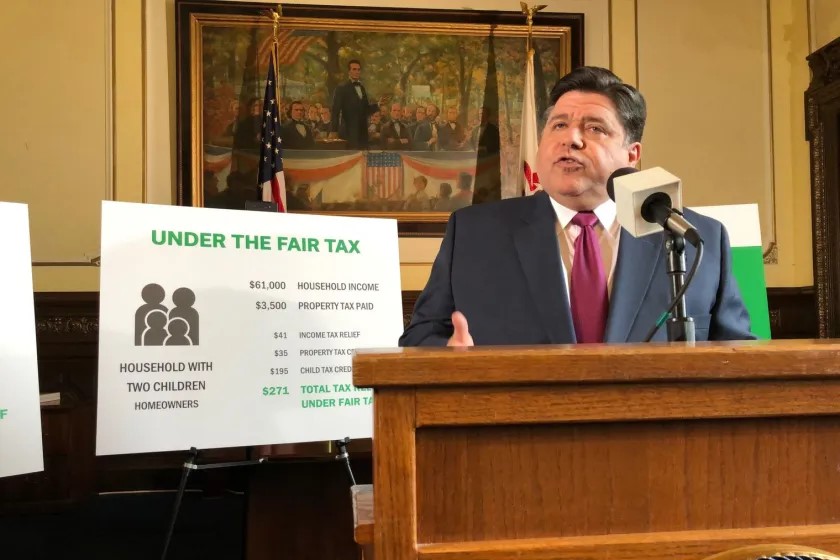
Gov. JB Pritzker at a 2019 news conference outlines his plan to replace the Illinois flat-rate income tax with a graduated structure. Pritzker’s push for a constitutional amendment for his proposal overshadowed the millionaire surcharge. | AP photos

The failed 2014 effort

Quinn said he proposed the 3% surcharge on millionaires to help Illinois boost education spending while also allowing schools to rely less on local property taxes for funding.

After the advisory referendum passed in 2014 with nearly 64% support, then-House Speaker Mike Madigan’s efforts to turn the proposal into a constitutional amendment in 2015 and 2016 failed due to insufficient support from his own Democratic caucus.

Then, Democrats lost their House supermajority — when one party controls at least three-fifths of a legislative chamber, which also is the threshold to put a constitutional amendment on the ballot — in 2016, dooming its future.

In 2018, Gov. JB Pritzker won the governor’s mansion and Democrats returned with supermajorities in both legislative chambers. But Pritzker campaigned on a different tax proposal: moving the state from a flat tax to a graduated one, where the rate progressively increases as income rises. That tax proposal got on the 2020 ballot.

The campaign for the graduated income tax constitutional amendment generated more than $100 million in spending, roughly coming equally from supporters and opponents. Billionaires Pritzker (in support) and Kenneth Griffin (in opposition) alone shouldered a majority of that spending.

Voters rejected it by 6 percentage points.

Read more here.

Read Full Post »

Gov. JB Pritzker and ABC’s George Stephanopoulos

By: Mark Glennon* | Wirepoints

Gov. JB Pritzker has said repeatedly that Donald Trump is an “adjudicated rapist.” That’s false, and those statements are not meaningfully different than the basis of a defamation claim made by Trump, which has now been settled in his favor.

ABC News and its program host, George Stephanopoulos, on Saturday settled a defamation suit brought by Donald Trump. Under the terms of the settlement, ABC News will pay $15 million as a charitable contribution to a presidential foundation and museum to be established by or for Trump and pay $1 million in Trump’s attorney fees. Additionally, ABC and Stephanopoulos issued statements of “regret” about comments made earlier this year that prompted Trump to file the defamation lawsuit.

The statements by Stephanopoulos that were the subject of the defamation action are substantially identical to a claim repeatedly made by Gov. JB Pritzker.

Specifically, Stephanopoulos said several times during an interview broadcast in March that Trump was found “liable for rape.” That was in reference to a civil case brought by E. Jean Carrol over an assault by Trump she alleged occurred in 1995 or 1996. However, the court in that 2023 case found Trump liable for sexual abuse, not rape. The jury expressly rejected a rape allegation, as shown in its written findings here.

Read more here.

Read Full Post »

The condo building, center, at 9 W. Walton St. in Chicago’s Near North Side neighborhood on Nov. 25, 2024. (Antonio Perez/Chicago Tribune)

By JEREMY GORNER, and BOB GOLDSBOROUGH | Chicago Tribune

In such a polarized country, even billionaires like JB Pritzker and Ken Griffin won’t let their political archrivalry get in the way of doing business.

The Illinois governor earlier this month paid the founder of the Citadel investment firm $19 million for the top two floors of a 38-story luxury building on Chicago’s Near North Side where Griffin once resided, sources familiar with the transaction told the Tribune.

The combined purchase at the 9 W. Walton St. building represents the highest price anyone has paid this year for a Chicago-area residence, and it’s the fourth-highest price anyone has ever paid for any home within Chicago’s city limits. But it also meant that Griffin, who relocated to Florida along with his company two years ago, lost more than $15 million on the two condominiums in the real estate deal with his political nemesis.

An entrance to the condo building at 9 W. Walton St. in Chicago’s Near North Side neighborhood on Nov. 25, 2024. (Antonio Perez/Chicago Tribune)

A Pritzker spokesperson would only say “the Governor and First Lady recently purchased a condo in Chicago. They love the city and Chicago has been home to them for many years.” A spokesperson for Griffin did not immediately respond for comment.

The Pritzker-Griffin rivalry goes back to at least 2018, when the Democrat largely self-funded his campaign to defeat one-term Republican Gov. Bruce Rauner, a wealthy equity investor whose reelection bid was backed by more than $20 million from Griffin.

The battle of the billionaires escalated two years later, when Pritzker spent more than $56 million of his wealth to unsuccessfully push a proposed state constitutional amendment to switch Illinois to a graduated-rate income tax system with higher levies based on wealth. Griffin led the opposition to the proposed amendment, also spending nearly $54 million of his own money.

Read more here.

Read Full Post »

By Ted Dabrowski and John Klingner | Wirepoints

It’s the only reasonable conclusion. Illinois politicians who continue to oppose pension reform via a constitutional amendment should be booted from office. The latest state-by-state pension report from Fitch Ratings demonstrates why.

At $172 billion,* Illinois has the nation’s biggest pension shortfall by far, the agency says. Fitch also calculates that Illinois’ pension debt as a share of its economy is the largest in the country. Either way, Illinois is the nation’s extreme outlier.

To get an idea of just how out of whack Illinois is, consider the pension shortfalls of its neighbors. Indiana’s is just $11 billion. Michigan’s, $8 billion. Wisconsin’s, $4 billion. Iowa’s, $2 billion.

Politicians from both sides of the aisle have made this mess over the past few decades. They’ve doled out benefits far faster than Illinois taxpayers could ever pay for them, which we’ve documented in great detail here and here. Lawmakers continued to sweeten those benefits – like compounded colas – even as the crisis deepened. Illinois politicians were even charged by the SEC for securities fraud from 2005 to 2009 when they misled municipal bond investors about the state’s approach to funding its pension obligations.

It’s impossible to overstate just how menacing those massive pension shortfalls are to the future of this state and to the future of everyday Illinoisans. Illinoisans already pay the nation’s highest property taxes. Home values have barely kept up with inflation since 2000 – Illinois has had the country’s worst housing performance. And a net of more than 1.5 million residents have been squeezed out of the state over the last two decades. Households across the state are being impoverished and families are being broken up, in large part due to the crushing cost of pensions.

Read more here.

Read Full Post »

By Jasmine BaehrFox News

Illinois Gov. JB Pritzker pledged Saturday to keep his state open to transgender treatment after the issue, particularly regarding minors, became a bone of partisan contention during the presidential election.

The billionaire governor, whose family is deeply involved in the transgender movement, posted the tweet to mark Transgender Awareness Week.

“This Transgender Awareness Week, I want you to know that I see you and have your back as governor,” wrote Pritzker. “Illinois has enshrined protections for gender-affirming care to meet this moment — and because of that, you will have a home here always.”

His state is one of several, including Minnesota and California, critics say foster a climate that encourages some children to seek so-called “gender-affirming care.” 

Pritzker’s cousin, Jennifer, was born a male but now identifies as a female and is an outspoken proponent of transgender treatment. Jennifer (née James) Pritzker was a lieutenant colonel in the United States Army National Guard and is a father of three. 

Jennifer Pritzker also leads the Chicago-based Tawani Foundation, which awards grants to organizations that support “gender and human sexuality,” according to its website. The Pritzker family fortune was made in Hyatt Hotels.

Col. Jennifer Pritzker, the first openly transgender billionaire, poses for pictures at Hyatt Hotel. (Vince Talotta/Toronto Star via Getty Images)

“Continuing my family’s tradition of putting personal philanthropy into service for the public good, the Tawani Foundation strives to make grants that empower the organizations we support to realize and build on their missions,” Jennifer wrote on the foundation’s website.

More here.

Read Full Post »

« Newer Posts - Older Posts »