Feeds:
Posts
Comments

Archive for the ‘FUBAR’ Category

The Barrington Area Library posted the following late yesterday:

“PLEASE NOTE: Beginning Wednesday, August 27, extensive construction work will begin to rebuild the Library’s entrance driveway, as part of the Route 14 project. This work requires that the driveway be reduced to accommodate only one lane of traffic at a time. Traffic exiting the Library lot will be stopped at a distance from the traffic light, to allow plenty of room for incoming traffic. The traffic light camera will be adjusted to sense the traffic waiting to exit. Please allow extra time and use an abundance of caution and patience when traveling through this area.

Each half of the driveway must be excavated, stoned, poured, and cured before traffic can be switched onto the new driveway half, when the process will begin again. The construction company estimates that this project will take more than two weeks to complete.

In general, we anticipate that visitors will have access to the Library throughout the Route 14 project. We will continue do our best to keep you informed of these situations. We encourage you to visit the Village of Barrington’s dedicated website for the project, where you may also sign up for email updates.

Pro tip: this is great time to try some of our convenient, innovative services like Borrow By Mail and other remote pick-up and return locations!”

Read Full Post »

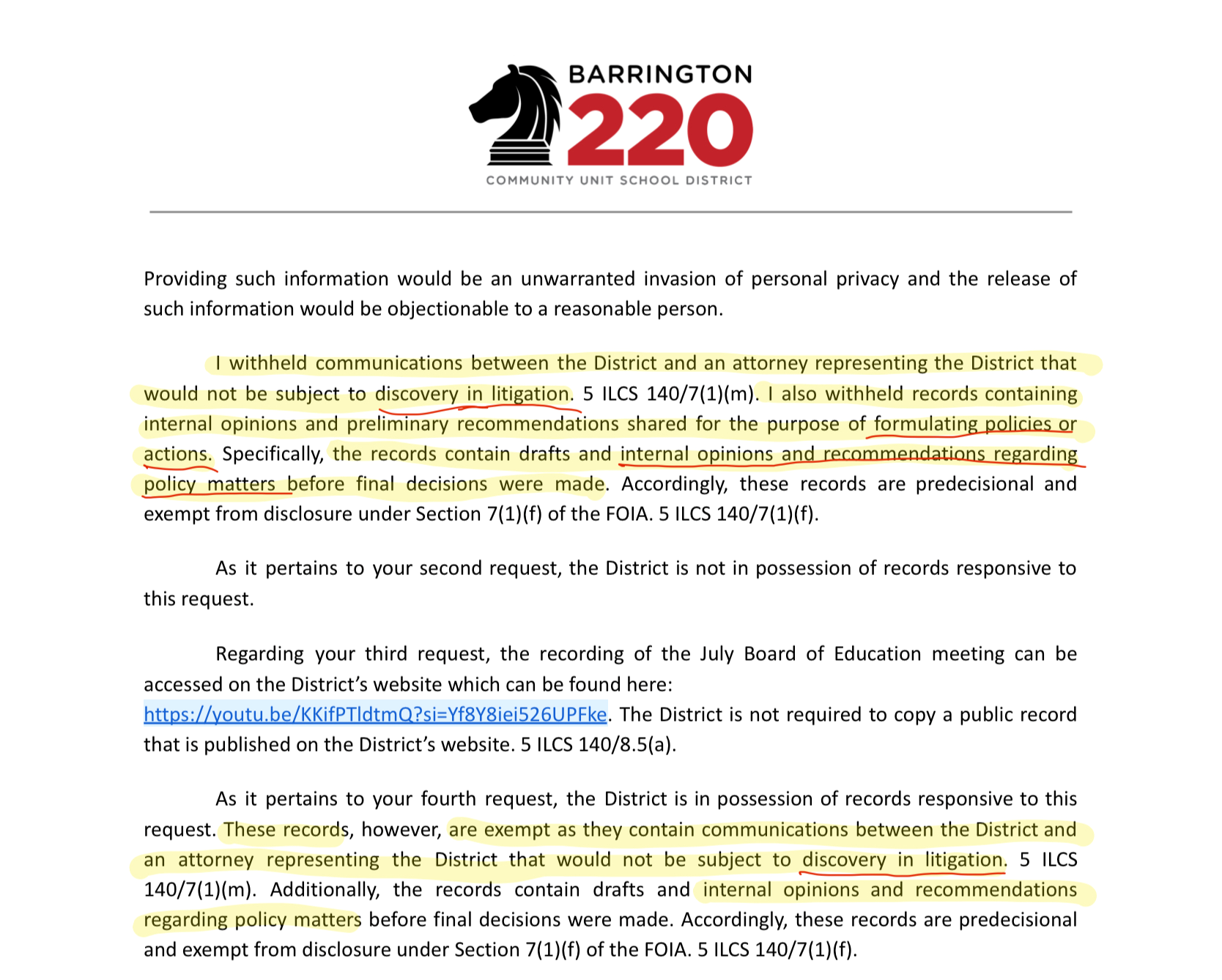
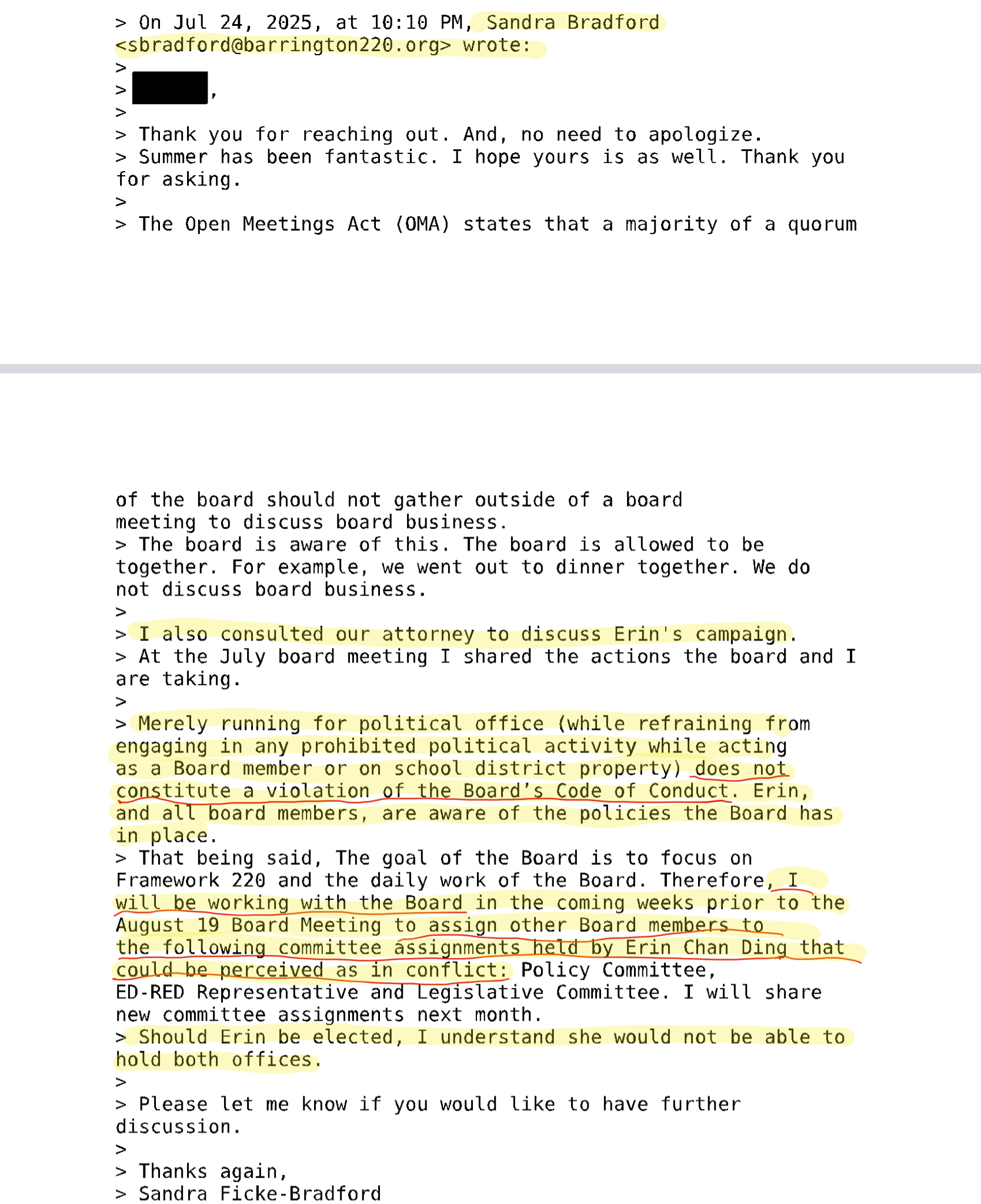
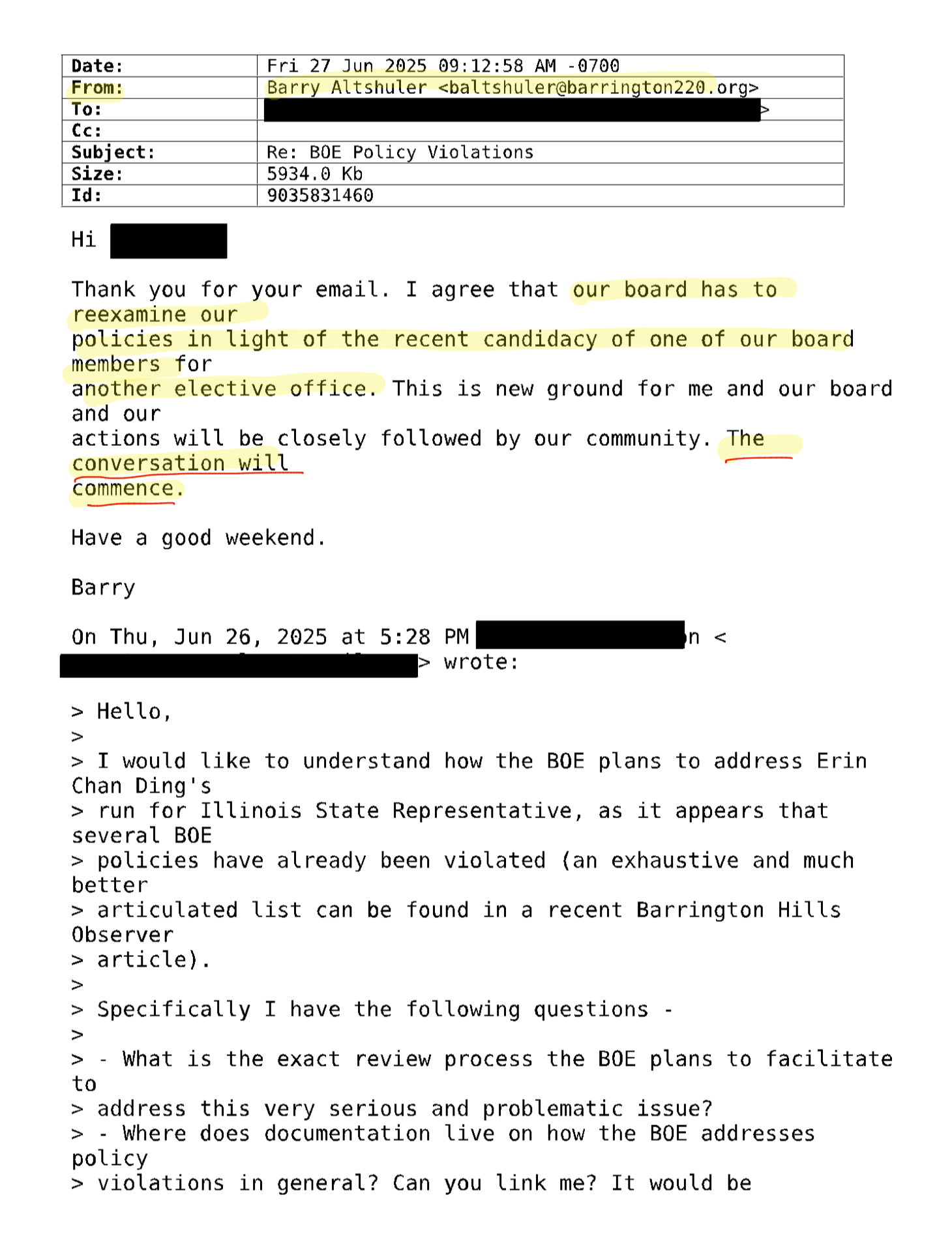
Following this morning‘s article on Erin Chan Ding confirming, in her own words, her conflict of dually serving on the D220 Board of Education (BOE) while simultaneously running for a partisan Democratic office for Illinois House Representative in the 52nd District, we have received information obtained by a resident pursuant to a Freedom of Information Act (FOIA) request to D220.

These records confirm that D220 Superintendent Winkelman and BOE President Ficke-Bradford have used D220 taxpayer funds to obtain attorney opinions on Ding‘s ability to run for the 52nd District while simultaneously serving on the BOE. (The Observer queried in a recent article why taxpayer funds would be utilized by the D220 School District to obtain attorney opinions in this regard.) They further confirm that the BOE is engaging in closed door sessions regarding Ding and her campaign for the 52nd District. We posit whether this is a violation of the Open Meetings Act.

Ding is raising her own campaign funds for her run for the 52nd. Isn’t it more appropriate that Ding’s Erin for Illinois Campaign pay for these attorney consultations rather than the D220 taxpayers? Additionally, why would D220 need taxpayer paid attorney consultations related to BOE Policy and Code of Conduct questions?

Are we seriously paying attorneys to opine on whether a BOE Member has violated Board Policy or Code of Conduct? Does our Superintendent and BOE President need an attorney to tell them if a BOE Member has “surrendered her responsibilities to special interest or partisan political groups”? Do they need an attorney to tell them whether a BOE member has engaged in the “appearance of impropriety” or that she has used her “Board of Education membership for personal gain or publicity”? This is beyond absurd.

Additionally, these records show that these policy discussions are taking place behind closed doors rather than in front of the public? Isn’t policy something that should be discussed and set with full BOE participation and public scrutiny? Since when is the policy of how our duly elected officials conduct themselves in their duly elected positions determined without the public’s participation?

Craig and Sandra, we urge you to get back to the business of running the D220 School District instead of using your D220 positions and the taxpayer’s resources to engage in the partisan politics of the Ding campaign for the 52nd District.

Related: “Ding In Her Own Words – CONFLICTED!,” “District 220 Board of Education meets this evening (07.15.25)” “Ding Doubles Down,” “Ding’s D220 Deception,” “Chan Ding running in Democratic primary in 52nd,” “Three (3) Democratic candidates queued to run for the IL 52nd District House seat in 2026

Read Full Post »

Pedestrians walk past Boeing International Headquarters in Chicago in 2019. Boeing later left Chicago for the suburbs of Washington, D.C. | Terrence Antonio James/Chicago Tribune

By The Editorial Board | Chicago Tribune

In the later years of Richard M. Daley’s mayoralty and especially during the tenure of Rahm Emanuel, the city of Chicago served as a magnet for corporate headquarters relocations, particularly from the suburbs.

United Airlines moved its headquarters to Willis Tower from Elk Grove Village, shifting thousands of employees to the city. Kraft Heinz consolidated its base in Chicago from Northfield. McDonald’s moved its home office to the West Loop from its longtime base in west suburban Oak Brook in 2018. These are just a few of the examples.

At the time of these moves, the city was perceived as hot. Even companies that didn’t go so far as to relocate their headquarters to Chicago opened satellite offices in the city, believing that they needed a physical presence to attract younger workers.

The era we’re talking about wasn’t that long ago — less than a decade — but it feels like ancient history.

Post-pandemic, downtown Chicago lost its mojo and, unlike New York City, has failed to recover adequately in the midst of relentless fiscal crises and poor municipal leadership. Chicago’s progressive mayor, Brandon Johnson, routinely describes the corporate decision-makers in his city as the “ultra-rich” (when he refers to them at all).

With Johnson declaring on Tuesday that the city’s finances are at a “point of no return” — whatever that means — the mayor and his progressive allies believe they may have found the answer to their seemingly never-ending quest for massive revenue infusions that affect only the wealthy. A heretofore obscure advocacy group, the so-called Institute for the Public Good, has proposed a new city tax on companies and other large employers that would require them to pay 5% of their total payroll for anyone working in the city who makes $200,000 or more (including noncash compensation like stock options).

The group estimates such a levy would generate $1.5 billion a year. Voila! A Chicago budget deficit now topping $1 billion in 2026 would disappear thanks to something this group pitches as a “tax on the privilege of doing business in Chicago.”

Read more here.

Read Full Post »

Reported by Russell Lissau | Daily Herald

The Daily Herald reports that, “The nearly 4-mile stretch between Route 62 and Penny Road was shut down in both directions Wednesday after oil applied during a resurfacing project mixed with rainwater and created a slick surface, police spokesperson William Walsh said.

Four auto crashes occurred between 2:45 and 3:45 p.m. Wednesday before the road was shut down, Walsh said. No one needed to be hospitalized.”

Read the full report here, but we must ask why the reasons were not communicated to residents sooner and directly via email or Facebook?

Related:All of Route 68/Dundee Road closed in the Village for unspecified reason until noon tomorrow

Read Full Post »

Per VBHPD:

“Please be advised that Route 68 is currently closed between Route 62 and Penny Road due to a road hazard. The closure is now expected to remain in effect until Thursday, July 31, 2025, 12:00 PM (Noon). Motorists are advised to avoid the area and seek alternate routes. We appreciate your cooperation and understanding. Thank you, Village of Barrington Hills.”

Read Full Post »

What pressing issues did the Illinois General Assembly consider among 6,745 bills this past session? They pondered a sticker commission, “end-of-life” carpets, paper grocery coupons, 15-year-old voters and their own beauty sleep.

By Lilly Rossi | Illinois Policy Institute

The Illinois General Assembly had ample opportunity to tackle the state’s massive public pension debt, curb the nation’s top tax burden or fix the state’s finances, but what did they do instead?

They considered 6,745 bills that included creating a voting sticker commission, regulating end-of-life carpets, stopping grocery store coupons from going paperless, registering teens three years before they could vote and making sure they did not lose sleep doing their jobs.

Here are the details on five bills that lawmakers were wise enough to allow to die this year:

  1. Creation of a “sticker commission”

Senate Bill 1576 would have created an “I Voted” Sticker Commission. The commission would have been tasked with developing a contest to finalize 10 designs that would be used in the 2026 General Election. Any spending for this commission would be in addition to the $55.2 billion budget, sticking Illinois taxpayers with the costs.

2. Death carpet seller registry

House Bill 1876 intended to implement a carpet stewardship program. The purpose of the program would be to promote and market for “end-of-life” carpet recovery and reutilization. HB 1876 would not have allowed carpet to be sold in the state of Illinois if the producer were not registered with the program.

Read more here.

Read Full Post »

By Mike Danahey | The Courier News

Carpentersville may need to spend more than $4 million to bury water and sewer lines below the bottom of the Fox River because dam removal has lowered water levels, officials said.

A water main and a sewer line running along the river’s bottom were exposed this spring, requiring the village to cover them with gravel, Village Manager Brad Stewart said. While the pipes were not damaged and are now “functionally protected,” an engineering review recommended the village bury a new set of pipes at a deeper level, he said.

Preliminary estimates from engineering consultant HR Green put the cost at $3.5 million to $4.2 million.

While the village can afford to pay for the work, the village is pursuing grant money from the Illinois Environmental Protection Agency to help fund the unexpected expenditure, Stewart said. Grants of up to $5 million are available and require a municipality to provide a 20% match, he said.

Village President John Skillman said he and staff have been speaking with local state legislators, including state Senator Cristina Castro, D-Elgin, and state Reps. Anna Moeller, D-Elgin, Suzanne Ness, D-Crystal Lake, and Don DeWitt, R-St. Charles, about the situation.

Skillman noted that installing a deeper sewer line is also being a good neighbor to towns downstream.

“If there were any break in the (existing) sewer line running through the river, it would affect the Fox’s water quality, meaning any waste that got into the water would also affect Elgin, which gets its drinking water from the river,” he said.

Stewart said the two lines in question have been there for about 40 years.

Carpentersville covered exposed water and sewer lines in the Fox River with gravel to protect them from damage but village consultants have advised that such lines should be buried below the river — work that could cost more than $4 million. | Village of Carpentersville

“In my opinion, planning should have foreseen changes in the water levels,” he said. “At no point were we told that water levels near historic lows might affect such lines.”

Read more here.

Related: Free flowing: Dam removal work in Carpentersville nearing completion

Read Full Post »

Illinois is the most inefficient state in the Midwest and the 14th-most inefficient in the country. That’s driven in part by excessive units of local government – more than in any other state. High property taxes are one result.

By Chris Coffey | Illinois Policy Institute

Illinois’ No. 2 in the nation property taxes are partly because it is No. 1 in the nation for units of government, meaning consolidating and eliminating some units could cut property taxes.

A National Business Capital report ranked Illinois the least-efficient state in the Midwest and 14th-least efficient in the country for its governments. The report evaluated states along eight metrics including units of local government per 100,000 people.

Illinois’ inefficiency is driven by almost 7,000 units of local government – the most in the U.S. – and the cost of supporting all that bureaucracy. When population is part of the calculation, Illinois is 14th in the nation in units of local government per 100,000 people because it has the sixth-highest population.

The report included local government as a metric because “while population densities and geographic size vary greatly from state to state and impact the efficiency of local governments, each local government is replicating services that – in many cases – could potentially be offered by another nearby entity.”

Illinois has by far the most units of local government of any state at almost 7,000. The Midwest has more average units of local government than other regions, but Illinois still leads. In 40 states residents live under a maximum of two layers of local government, but in Illinois 61% of residents live under at least three.

Lawmakers have failed to reduce redundancy and waste, which could cut down Illinoisans’ second-highest in the nation property taxes by consolidating or eliminating unnecessary levels of local government. Illinois has had 6,000-7,000 units of local government for 65 years.

Read more here.

Read Full Post »

Illinois Secretary of State Alexi Giannoulias | BlueRoomStream

By Jim Talamonti | The Center Square

Illinois Secretary of State Alexi Giannoulias says there is no need for most Illinoisans to wait in line for a REAL ID.

Starting Wednesday, the U.S. government will require a passport, REAL ID or other REAL ID-compliant identification to board a domestic flight or enter secure federal facilities.

Giannoulias said you can still get a REAL ID after May 7.

“So to see these lines is really frustrating, especially because so many people do not need it,” Giannoulias said.

Courtesy of the Illinois Secretary of State’s Office

The secretary added that, according to federal officials, people will still be able to fly.

“Homeland Security has let us know that even after May 7, there will be essentially a two-year enforcement period where they’re not gonna not let people onto an airplane,” Giannoulias said.

Giannoulias said people should check the Illinois Secretary of State website to see if they need REAL IDs before making appointments. He said people under 18 do not need REAL IDs.

Giannoulias pointed his finger at the federal government for long lines and confusion over REAL IDs.

“The amount of people who are coming because they are worried about being deported or not being American citizens, that fear is real. We see it in people’s faces,” Giannoulias said.

Read more here.

Read Full Post »

Barrington Area Unit School District 220 Superintendent Craig Winkelman, left, Barrington Area Library Executive Director Jason Pinshower and Barrington Countryside Fire Protection District Trustee Tom Long, right, were among the speakers at Thursday’s Barrington Area Chamber of Commerce Town Hall Forum. | Steve Zalusky/szalusky@dailyherald.com

By Steve Zalusky | Daily Herald

From a “showcase” pool to a state-of-the-art high school auditorium, Barrington-area officials shared their gains, as well as their challenges, Thursday during the Barrington Area Chamber of Commerce’s Town Hall forum.

Barrington Park District Executive Director Teresa Jennings told the gathering that the new pool at Langendorf Park, among the projects funded by a successful $18.8 million referendum in 2023, is expected to open in mid-June.*

“We are going to be a showcase pool in the state of Illinois,” Jennings said.

Barrington Area Unit District 220 Superintendent Craig Winkelman said some of its recent successes include implementing full-day kindergarten three years ahead of the state deadline and passing a referendum last year that will fund upgrades that include a new auditorium at Barrington High School.

“In the spring of 2028, we will host our first spring musical,” he added.

Officials also detailed challenges ahead.

Read more here.

*Meanwhile, today marks the one year anniversary of a car jumping a curb and striking the north side of the Advocate Good Shepherd Hospital Health & Fitness Center (pictured below). The club’s pools still remain closed as a result..

Read Full Post »

« Newer Posts - Older Posts »