


Illinoisans can vote on races ranging from U.S. Senate and governor to state lawmakers and local officials in the Nov. 3 election.
By Jon Josko and Lilly Rossi | Illinois Policy Institute
Some recent Illinois state legislative races have been decided by just dozens or hundreds of votes.
A look since 2022 shows where the closest races have been, how few votes separated the candidates and what voters in competitive districts identified as their biggest concerns.
Casting a ballot gives Illinoisans a voice in who represents them, while understanding voters’ concerns gives lawmakers a clearer picture of what their constituents want addressed.
How close are races in Illinois?
In 2024, a mere 47 votes out of nearly 59,000 decided who represents Illinois’ 52nd House District. State Rep. Martin McLaughlin, R-Lake Barrington, held onto his seat over Democrat Maria Peterson by less than one-tenth of 1% of the votes.
That was the slimmest margin in Illinois’ most recent two election cycles, but not the only close one. Nine other state House and Senate races since 2022 were decided by fewer than 1,700 votes apiece — and they were concentrated in a handful of places worth knowing if you live nearby.
10 closest state legislative races 2022-2024
Margin of victory in the 10 closest Illinois House and Senate races, 2022-2024

Seven of the 10 sit in Chicago’s outer suburbs and exurbs, stretching from Lake and McHenry counties through DuPage, Kane and Will. The other three are downstate: one anchored around Danville and Champaign, one around Springfield and Decatur and one in the Metro East region across the river from St. Louis.
10 closest state legislative races 2022-2024
Margin of victory in the 10 closest Illinois House and Senate races, 2022-2024

How many people does it take to decide these races?
If you’ve ever wondered whether your vote matters in a state regarded as relatively uncompetitive, consider this: Among the 175 contested state House and Senate races since 2022, half were decided by a margin smaller than 1-in-10 of the eligible adults in that district. A quarter of contested races came down to fewer than 1-in-17.
90 contested legislative races decided by fewer than 1 in 10 adults
Number of contested state legislative races, 2022-2024, by win margin as share of district’s eligible adult population.

That pattern held across both chambers and both years, though state Senate races have generally been decided by a somewhat smaller share of eligible adults than House races. Roughly 6-in-10 Senate races came in under that 1-in-10 mark, versus about 46% of House races, consistent with Senate districts being larger and drawing more votes.
What do Illinoisans care about?
In districts with tighter election margins, candidates will have to make sure they are addressing their constituents’ major issues.
In the Illinois Policy Institute’s statewide tracking poll, fielded quarterly since 2025, high taxes has been the single most-cited concern every time, named by 52% to 60% of respondents as one of their top two issues, roughly double the next-closest answer.
In the most recent poll, from August 2026, 58.1% named high taxes as their No.1 or No. 2 issue, compared with 32.5% for the economy generally and 20.7% for state governance.
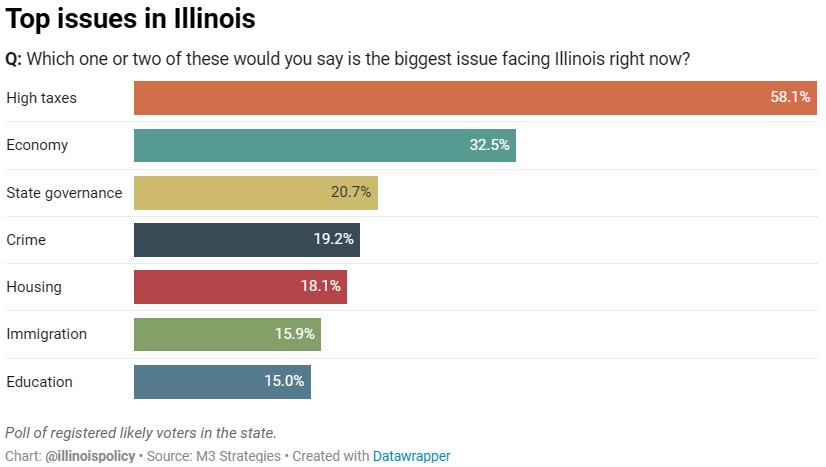
Property taxes in particular seem to be the aggravation behind that number. The May 2026 version of the same poll asked residents how satisfied they are with the value their community receives for the property taxes paid. Over 61% said they were dissatisfied, against just 23.5% satisfied.
Article continues here.