Feeds:
Posts
Comments

Archive for the ‘Audubon Society’ Category

The new owner of the 185-acre property at the northwest corner of routes 59 and 72, just west of the Arboretum of South Barrington, wants to build a third data center campus in Hoffman Estates. | Courtesy Plum Farms

By Eric Peterson | Daily Herald

The recent sale of the 185-acre Plum Farms property at the northwest corner of Route 59 and Higgins Road could lead to a third data center campus in Hoffman Estates, Mayor Bill McLeod announced in his State of the Village address Wednesday.

The undeveloped site lies directly west of The Arboretum of South Barrington shopping center. Until recently, plans centered around residential development.

In his annual update before the Hoffman Estates Chamber of Commerce at the Now Arena, McLeod said no formal plans have been submitted, but the village expressed its openness to the possibility of another data center campus.

Read more here.

Read Full Post »

Carpentersville Dam removal is scheduled to begin this month. Grab some Ektachrome and take some snaps soon. | Courtesy Forest Preserve District of Kane County

By Alicia Fabbre | Daily Herald

The Fox River will soon flow freely from Algonquin to Elgin.

Crews will begin work on a $1.2 million project to remove the Carpentersville Dam this month. The project, which will be finished in November, will create a 10.2-mile unimpeded flow of the Fox River — the longest free-flowing stretch through Kane County.

“May this be the model and lead domino in a movement that carries river restoration efforts progressively downstream,” said Friends of the Fox River President Gary Swick at a ribbon-tying event Wednesday to celebrate the start of the project.

Friends of the Fox River representatives joined officials from the Kane County Forest Preserve District and the village of Carpentersville in a ribbon-tying ceremony to signify the upstream and downstream flow of the Fox River coming together with the dam’s removal.

Officials said a free-flowing river will lead to its improved health. Other portions of the river, where dams have been removed, have seen an increase in the number and species of fish in the river.

“All the science shows us that by putting it back the way it was, it actually is better for everything overall,” said Kane County Forest Preserve Commissioner Jarett Sanchez, who kayaked from a boat launch upstream to the event.

Removing the dam will also allow people to kayak or canoe safely without worrying about portaging around a dam.

More here.

Read Full Post »

By Shaw Local News Network

After nearly a decade of planning, the Illinois Department of Natural Resources has approved a contract to remove Carpentersville Dam in the Fox River Shores Forest Preserve.

Officials announced in a news release that work to remove the dam could begin by the end of the month.

The IDNR approved a dam removal contract on July 2. Kane County Forest Preserve commissioners approved it on July 9.

The Forest Preserve District of Kane County owns the Carpentersville Dam and nearly the entire shoreline for 2.5 miles upstream.

“It took some time to get here, but taking Carpentersville Dam out will be a huge benefit for both recreation and for conservation,” Forest Preserve Executive Director Benjamin Haberthur said in the release.

The dam’s removal will begin healing the Fox River and restoring the natural riverine resource, he said in the release.

“Once the dam is removed, the Fox River will be free-flowing from Algonquin all the way down to Elgin,” Haberthur said in the release. “This will allow the public to safely boat, kayak or canoe in this area, without the safety concerns of the dam, and/or having to portage around it. We’ll also see the health of the Fox River improve. Fish and other aquatic wildlife will be able to swim freely.”

Read more here.

Read Full Post »

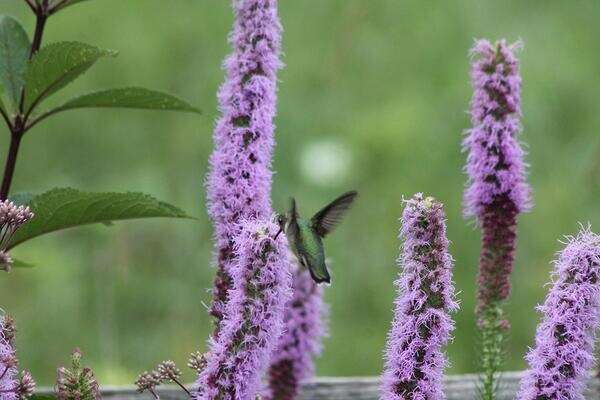
A ruby-throated hummingbird checks out the native prairie blazing star. | Courtesy of Nancy Kreith, Illinois Extension

By Jenna Braasch, Illinois Extension

Hummingbirds are unlike any other bird. Spanning the Americas with over 330 species, hummingbirds belong to Trochilidae, the second-largest bird family in the world.

However, only the ruby-throated hummingbird (Archilochus colubris) inhabits the Midwest. This hummingbird migrates south in late summer, with the males migrating first, typically in August.

Before the nonstop flight to overwintering sites, this bird needs abundant food sources to fuel its journey to Florida, Texas, Central America, or Mexico.

Often, hummingbirds prefer open habitats along forest edges or areas with scattered trees, including urban areas. So it is possible to have them visit any urban or suburban property if the locations have plants they prefer.

Once a hummingbird detects those plants, it often returns around the same time each year. They typically nest in trees or other protected areas, though some have been spotted nesting on top of a wind chime. Moss and lichens are used to camouflage nests made of hairs, spider silk, and plant fibers.

Planting for hummingbirds

There are many ways to support hummingbirds. A container of their preferred plants will invite them to a patio or balcony. Growing plants vertically, including vines, can maximize any space. If you have space, plan to incorporate a steady supply of nectar blooms during each season, especially during migration. Plant species in clumps of at least three so hummingbirds will recognize the blocks of color.

With their long beaks, hummingbirds feed on the nectar of tubular flowers. They have a preference for red, orange, and pink blooms but can be seen visiting other types of flower structures and colors. For instance, black and blue salvia is a favorite tubular flower, although it is purple.

Also, remember that all flowers are not created equally. Double flowers and some cultivars do not produce valuable nectar. Other red showy flowers like geraniums and roses will draw the attention of hummingbirds but do not offer as much nectar as natives and tubular flowers.

A few suggested plants native to Illinois and the U.S. that they prefer include red columbine (Aquilegia canadensis), cardinal flower (Lobelia cardinalis), trumpet honeysuckle (Lonicera sempervirens), and Bee Balm (Monarda didyma).

Hummingbirds have also been observed visiting other Illinois natives, like prairie blazing star (Liatris pycnostachya) and foxglove beardtongue (Penstemon digitalis). Preferred annuals include canna (Canna indica), red hot poker (Kniphofia hirsute), cigar plant (Cuphea ignea), cardinal climber (Ipomoea x multifida), and tall red varieties of zinnia (Zinnia elegans).

Going beyond the blooms

When blooms are scarce, hummingbird feeders work well for supplemental food. A ratio of 4:1 water to white granulated sugar can be used in hummingbird feeders. Other additions to landscapes include water baths, trees for perching within 10 to 20 feet of the garden, dead branches and twigs may be substituted, and fuzzy plants for nesting materials. Avoid using insecticides since hummingbirds also eat insects, and do not use systemic herbicides because they are persistent in flowers.

With the importance of supporting pollinators, plan to incorporate plants for hummingbirds in gardens. Hopefully, adding hummingbird-preferred plants will allow more growers the chance to experience these incredible creatures in action.

Hummingbirds certainly aren’t afraid of humans, so many people are able to experience a quick, close encounter.

* * *

Nancy Kreith is a University of Illinois Extension horticulture educator for Cook County. Gardeners Corner is a quarterly newsletter from gardening experts around the state. Each issue highlights best practices that will make your houseplants, landscape, or garden shine in any season. Join the Gardener’s Corner email list at go.illinois.edu/GCsubscribe for direct access to timely tips.

Read Full Post »

Provided by WBBM Radio Chicago

By Nancy Harty | WBBM Radio

The mass emergence of periodical cicadas has meant a feast for birds but has also led to some health problems in their young offspring.

About three weeks ago, staff at the Willowbrook Wildlife Center in west suburban Glen Ellyn started seeing various problems in fledgling songbirds such as blue jays, grackles, house sparrows and starlings.

Head veterinarian Dr. Sarah Reich said people have brought in birds that are weeks old with eyes that are swollen and crusty, and also have trouble breathing and standing up straight.

“Some of them are in respiratory distress, so they’re open mouth breathing, they’re heavily breathing. Or they’re showing some neurologic signs, so falling over.”

This reminded staff of a mysterious disease that surfaced in 2021 in states experiencing cicada emergencies.

An email to Willowbrook from researchers at the National Wildlife Health Center in Madison, Wisconsin arrived two days after the first suspicious case and helped confirm the source of the disease was vitamin A deficiency.

“Cicadas were almost completely devoid of vitamin A, except for in their eyes. And most animals are not eating their eyes, they’re eating their inner,” Dr. Reich said.

More here.

Read Full Post »

By Kevin Bessler | The Center Square

Illinois livestock farmers dealing with highly-aggressive black vultures now have the means to fight back.

The Illinois Farm Bureau has secured statewide black vulture depredation permits through the U.S. Fish and Wildlife Service effective now through March 31, 2025. As migratory birds, black vultures are protected by the Migratory Bird Treaty Act, and can’t be killed or destroyed without the migratory bird depredation permit.

“Illinois’ black vulture population has increased significantly in recent years, particularly in the southern portion of the state. These birds often prey on young livestock, especially in open pastures, and can create major financial losses for farmers,” IFB President Brian Duncan said.

Tasha Bunting, director of Commodity Programs and Farm Systems with the Illinois Farm Bureau, says black vultures live in southern regions of the state but are expanding their range further north.

“The birds are becoming a bigger issue, they’re pretty aggressive, they’re not like the red-headed turkey vultures, they attack and they are more of a predator than the red-headed birds are,” Bunting said.

Black vultures have a five-foot wingspan and weigh about five pounds. As to why their populations are expanding north, Bunting said the weather may play a part.

Read more here.

Read Full Post »

Eagle

rokopix | Shutterstock

By Zeta Cross | The Center Square contributor

For a real February thrill, Bob Bryerton, program manager of the Forest Preserve District of Will County’s Plum Creek Nature Center near Beecher, Illinois, recommends taking a short winter hike to do some eagle spotting.

“They are really, really big,” he said. “Larger than anything else in our sky, with a 6-foot wingspan.”

More eagles spend the winter in Illinois than in any other state except Alaska.

“In the lower 48 in the wintertime, Illinois has the most eagles,” Bryerton said.

A hike as short as half an hour on a trail along an Illinois river or waterway often will reward you with an eagle sighting.

“When the water freezes in the north, eagles move a little bit south. Illinois seems to be the place where they can find open water,” Bryerton said.

Bring binoculars if you have them, but you don’t need them.

Up in the sky, eagles look something like turkey vultures and hawks. Turkey vultures rock more when they fly, Bryerton said. Their wings tilt up in a V-shape.

“Eagles will flap a little bit more than a vulture. They do glide a lot,” he said.

Hawks are smaller and more streamlined. Eagles have a bulkiness to them. They look heavy.

Read more here and check out eBird for more information.

Read Full Post »

Owl

A great horned owl is seen in a tree in Lincoln Park on Jan. 11, 2024. (E. Jason Wambsgans/Chicago Tribune)

By Adriana Pérez  Chicago Tribune

On her way home from work on a recent wintry night, Kathy Keane ran into a group of people quietly watching a pair of great horned owls perched on a tree in Lincoln Park.

“I started hearing the ‘hoot, hoot,’ and then the other would call back ‘hoot, hoot,’” she told the Tribune. “And it was just so beautiful.”

Excited about the sighting, she made sure to walk by the same spot the next day with her husband, Patrick Keane.

The bird was still on the tree, but then a drone flew toward the owl and scared it away. The Keanes decided to approach the two people piloting the aircraft.

“I’m like, ‘Do you realize you scared the owl with that thing?’” Patrick Keane recalled. “And he got — I’m not exaggerating here — he got a big smile on his face and said, ‘Yeah, we did.’ And he’s like, ‘We scared the other one earlier in the evening.’”

As native great horned owls court and nest in Chicago, and expectations ramp up for rare winter sightings of snowy owls from the Arctic, encounters like this underscore the importance of viewing and photographing these birds safely, experts say.

“The problem of harassing wildlife and specifically owls is not a new one,” said Edward Warden, president of the Chicago Ornithological Society. “There’s something incredibly compelling about them as birds. … People (get) excited to see them when they’re in our midst, whether you call yourself a birder or not, it’s kind of a very universal thing.”

Generally, curious humans disturbing owls is unintentional. But interactions are more likely to occur in the winter, when trees have no leaves and the birds are easier to spot, and as breeding season begins.

The Chicago Bird Alliance says humans can stress out owls by interfering with their hunting, causing fatigue and making them more vulnerable to traffic and predators like peregrine falcons or red-tailed hawks.

Almost 4 million great horned owls can be found in a wide variety of habitats across North America, including in Illinois. This species is often depicted as a wise figure in popular culture and storybooks.

Read more here.

Read Full Post »

C'ville Dam

In Search of Eagles, an outdoor event, will be held from 8 to 10 a.m. Saturday, January 20th, at the McHenry, Algonquin and Carpentersville dams on the Fox River and at the Williams Bay Boat Launch on Geneva Lake in Wisconsin.

Representatives from Friends of Hackmatack National Wildlife Refuge, Geneva Lake Environmental Agency, Illinois Department of Natural Resources, Kettle Moraine Land Trust, McHenry County Conservation District, McHenry County Audubon, and Friends of Moraine Hills State Park will help search for eagles and identify other birds using the river and the lake.

Attendees should dress for the weather and bring their own binoculars, although they aren’t needed to see birds in the wild.

Detailed maps to all locations can be found at http://tinyurl.com/InSearchofEagle2024. There will be scopes and binoculars available at each location. Registration is not required for the free, all-ages event. Weather concerns? A message regarding the status of the event will be available at (262) 448-3558.

Read Full Post »

Crab apple

Crab apples provide fruit for birds in fall and winter. (Robin Carlson)

By Tim Johnson | Chicago Tribune

I have become interested in bird watching and would like to attract more birds to my garden and would appreciate some guidance on how to do so.

— Jeremy Atkinson, Barrington

Thanks for the question, Jeremy. We love to see people getting interested in bird watching — and winter is a good time to plan to enhance your garden with plants that will attract birds all year long. It takes more than feeders, birdhouses, and a bird bath along with some flowers for a truly bird-friendly garden. Birds need a complete habitat that includes food, shelter, nesting areas, and perching spots. A good garden for birds tends to have more of a natural look to it. I’d start by designing your garden so that there re different vertical levels, each attracting and providing something important to different bird species. Some birds prefer the canopy of tall trees while others perch in the understory trees and shrubs. Different species of birds will have varying requirements and preferences for nesting, eating, and shelter, so try to create as many of these levels as possible in your backyard garden to attract a larger variety of birds. Even open areas of soil can be beneficial by providing an area for birds to take a dust bath.

Another good idea is to select plants that provide food for birds at different times of year. Fruits of different plants will ripen in different seasons. For example, serviceberries provide spring-ripening fruit, red-twig dogwood in summer, and hawthorns and crab apples provide fruit in fall and winter. Perennials like purple coneflower and grasses such as a prairie dropseed provide seed for another food source. Sunflowers are quick-growing annual flowers with seeds that birds love. And nectar-producing plants such as penstemon, bee balm, and columbine are attractive to hummingbirds.

Birds also need year-round shelter, so include a mix of evergreens in your garden. When you can, leave some dead branches on living trees to provide zones for the birds to perch on — but prune any dead branches that are safety hazards, of course.

Leave the leaf litter in your garden beds next fall as an easy and environmentally friendly method to recycle material and help meet some of a bird’s basic needs. Other organic materials such as small twigs, fallen seeds, fruits, and berries should be left in the litter too. Many insects will thrive in the leaf litter, which attracts insect-eating birds. Try building a brush pile that is practical in your available garden space ranging in size from 3 to 8 feet tall and 6 to 20 feet wide to provide even more shelter for birds and arrange the materials to create spaces for them. A larger brush pile will be used more.

There are many kinds of seeds and feeders to choose from if you decide to start a feeding program. Squirrels can be a nuisance and eat more seeds than birds do, so choosing a squirrel-resistant feeder is very important. We’ve had good luck with a cylindrical squirrel-resistant feeder at my home. Take time to do some research as different species of birds prefer different types of seeds and feeders, and no one type is preferred by all birds. Ideally, you should avoid buying bags of mixed birdseed as they tend to contain a lot of filler like red millet, which most birds won’t eat. The filler ends up on the ground where it rots. Place your feeder in an open area where it’s easy to see, 10 feet or so away from the protective cover, and convenient to refill. If the feeders are too close to large plants, then squirrels will have easy access to them. Be consistent with feeding birds as they will become accustomed to your feeder and stick around. Stamp the snow down under the feeder to accommodate ground-feeding birds such as doves and dark-eyed juncos. To maximize the number of species that visit your feeders, you’ll want to offer a variety of food installed at different heights above the ground.

Black oil sunflower seeds will attract a wide variety of birds including cardinals, woodpeckers, blue jays, goldfinches, purple finches, chickadees, titmice and nuthatches. Safflower seeds will also attract a wide variety of birds with the advantage of squirrels, blue jays, starlings, and crackles not liking this seed. Nyger is a good seed to attract goldfinches; it’s a very small black seed best used in a feeder specifically designed for it, which can be hung under an eave and near a window so you can enjoy it. A few more good options: White millet seed can be spread on the ground to attract ground-feeding birds. Suet is another option for feeding birds. Suet is rendered animal fat usually mixed with seeds and dried fruit and sold in small cakes. It’s best used in a cool, shaded area in amounts that the birds can eat in a few days to keep it from spoiling, which makes it a great option for winter feeding.

For more plant advice, contact the Plant Information Service at the Chicago Botanic Garden at plantinfo@chicagobotanic.org. Tim Johnson is senior director of horticulture at the Chicago Botanic Garden.

Read Full Post »

Older Posts »