Feeds:
Posts
Comments

Archive for the ‘Citizens for Conservation’ Category

Citizens for Conservation moved its headquarters to Hill ‘N Dale in 2025, taking advantage of an existing building on site. The views are spectacular and staff can witness changes to the landscape in real time, Abigail Derby Lewis said. (Patty Wetli / WTTW News)

By Patty Wetli | WTTW News

First-time visitors to Barrington Hills must think they’ve taken a serious wrong turn somewhere. Between the horse-crossing signs and ubiquitous white rail fencing, this neck of  Chicago’s north suburbs could easily be mistaken for Lexington, Kentucky.

It’s equestrian country here and Hill ‘N Dale horse farm was a long-established part of the area’s culture, but in 2022 the property was put out to pasture.

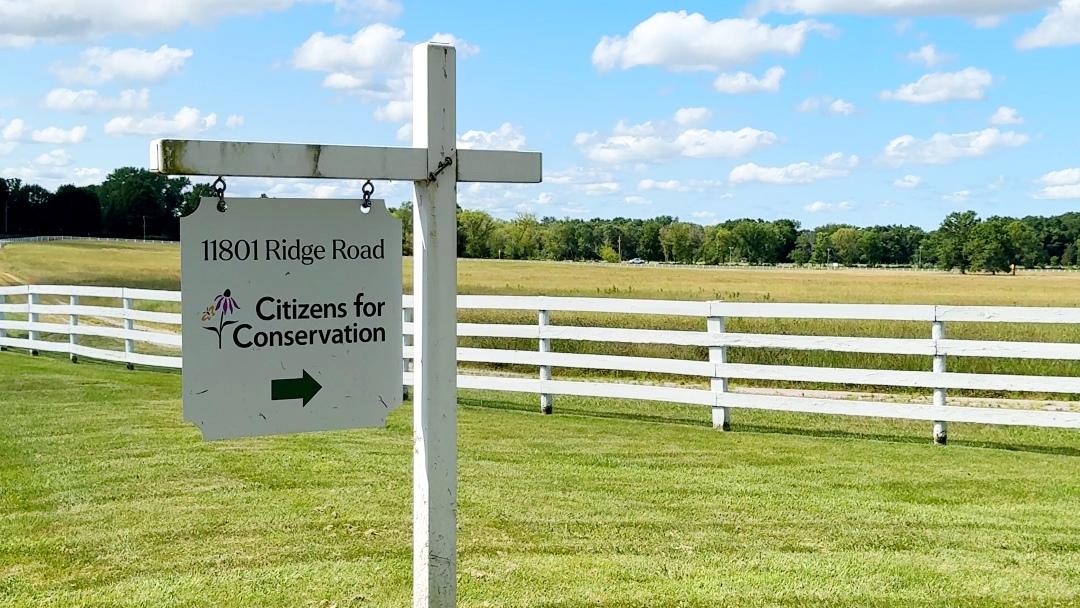
The Barrington-based nonprofit Citizens for Conservation (CFC) purchased the 232-acre parcel with the intent of returning the farm to its native wetland and prairie habitat. Last year, the organization moved its headquarters to what’s now Hill ‘N Dale Nature Preserve — repurposing an existing building — in order to gain an understanding of the land’s seasonal rhythms and to witness changes in real-time.

“This is the best office anyone could ever ask for,” said Abigail Derby Lewis, CFC’s executive director. “We’ll be in a meeting and suddenly you’ll hear the sandhill cranes and we’ll all just jump out of our chairs and go and take a look.”

Some of the first restoration work at Hill ‘N Dale involved removing a horse track and 20 miles of fencing. (Courtesy of Jeff Chemelewski)

After just a handful of years under CFC’s volunteer-led stewardship, the landscape already appears noticeably altered. A large viewing tower, horse track, paddocks and more than 20 miles of fencing were removed in short order to create a contiguous space. Over the past 18 months, efforts have picked up pace.

“When you’re listening, the land will tell you what it wants,” Derby Lewis said. “So, we’re beginning that slow roll.”

This year, burn crews conducted the first prescribed fires to see how plant communities responded. And this past spring, CFC dug out 10 acres of drainage tiles, the first phase in what will be the lengthy process of reviving natural wetlands along the section of Spring Creek (part of the Fox River watershed) that snakes through Hill ‘N Dale.

“Being able to see the amount of some of these native plants that are coming back as we remove that drain tile, having more of those wet areas and seeing what the seed bank is bringing up … it only spurs and energizes and inspires people to do more,” Derby Lewis said.

Additional plans include creating a community hub and increasing the nature preserve’s public visibility and accessibility. Currently the preserve is open Monday to Friday, 10 a.m. to 4 p.m.

But deliberate is the name of the game, especially in these relatively early days.

“This is a long game. This is a multi-decade restoration,” Derby Lewis said.

There are still surveys to conduct of existing wildlife — like the macro- and microinvertebrate populations in the creek, and amphibians and reptiles — before tackling larger projects.

“You need to know what’s already here because when you start changing — when you start putting fire to the ground, when you start seeding — you need to know whether you’re going in the right direction. And the animals will tell you that,” she explained. “So what kind of patterns or shifts that you see will help to inform the management moving forward.”

Citizens for Conservation is restoring grassland in the middle of Barrington’s horse country. (Nicole Cardos / WTTW News)

Hill ‘N Dale was previously owned by the Duchossois family — a prominent name in Chicago’s business and philanthropic circles. (The family maintained ownership of the farm’s northern section.) The nature preserve is located less than 15 miles from another recently unloaded Duchossois property: the 326-acre Arlington Park, which the Chicago Bears bought in 2023 for $197 million, ostensibly as the future home of a new stadium.

By comparison, Hill ‘N Dale’s $10 million price tag sounds like a steal. For CFC, though, the purchase was a huge stretch, but one worth taking given how few properties of that size come on the market, Derby Lewis said.

Donors contributed half of the needed funds and the remaining $5 million came in the form of the largest grant ever awarded by the Illinois Clean Energy Foundation. And then CFC was off to the races.

Article continues here.

Read Full Post »

A composite image of the bobolink nicknamed Black and Tan, showing its male and female sides split down the middle. | Luke Dahlberg / Citizens for Conservation

By Patty Wetli  | WTTW News

Back in early spring, Luke Dahlberg, conservation seed program manager with the nonprofit Citizens for Conservation, was spending his Sunday at the office.

His “office,” to be fair, is the 200-plus acre Hill ‘N Dale nature preserve near Barrington Hills, and Dahlberg wanted to take advantage of the lighting to photograph birds, specifically male bobolinks arriving on their breeding grounds after wintering in the pampas of South America.

“That’s when they’re just singing like crazy, they’re showing themselves,” Dahlberg said. “And usually the female bobolinks will come back a couple weeks afterwards.”

After snapping pictures of every bobolink in sight, Dahlberg went home and began scrolling through his camera roll. One bird stood out.

Male bobolinks, as with many bird species, have far more striking breeding plumage than their female counterparts. Dahlberg described the fellas’ white back and black undersides as looking like a tuxedo worn backwards, with a blonde patch on their heads lending a Dennis Rodman-circa-mid-‘90s vibe.

The bird in question didn’t quite fit the profile.

“It turned its face and it was in non-breeding plumage,” Dahlberg said, which struck him as odd but he chalked it up to a strange molt pattern.

A couple weeks later, Dahlberg pointed out this same unusual bobolink to some visitors from Illinois Audubon Society and that’s when he learned he had stumbled onto something extraordinary.

The bobolink was what’s called a bilateral gynandromorph — half female, half male, split down the middle — as the result of a genetic anomaly.

On its right side, the bird presented as male; on its left, it sported the duller plumage of a bobolink female.

“I had a better chance of photographing a unicorn,” Dahlberg said. “It’s extremely rare in nature.”

So rare that Abigail Derby Lewis, executive director of Citizens for Conservation, reached out to former colleagues at the Field Museum to confirm the ID.

“I’ve never seen one of these gynandromorphs in real life and so I was thrilled. I would definitely say the vast majority of birders will never see a gynandromorph in their life,” said Cameron Rutt, ornithologist and conservation ecologist at the Field. “Your chances of running into one, by yourself, in the wild are vanishingly slim.”

A 100% female bobolink on the left and a 100% male bobolink on the right. | hstiver / iStock; U.S. Fish and Wildlife Service

Of the approximately 11,000 species of birds on the planet, only 45 are mentioned in the scientific literature as exhibiting gynandromorphism, totaling fewer than 100 individuals, according to Rutt.

The bird at Hill ‘N Dale is the first-ever record of a bobolink gynandromorph.

Read on here.

Read Full Post »

Far right, leading a tour group is volunteer and CFC board member Jim Vanderpoel of Arlington Heights on July 20, 2026 at the restored tallgrass Grigsby Prairie in Barrington Hills, managed by the volunteer group (CFC) Citizens for Conservation of Barrington. | Karie Angell Luc/Pioneer Press

By Karie Angell Luc | For the Chicago Tribune

As environmentalists from around the world convened at the Aspen Ideas: Climate event in Chicago from July 20 to July 22, the conversation about conservation moved to Barrington Hills on July 20.

There, local and national conservationists toured the 44-acre Grigsby Prairie in Barrington Hills, managed by the volunteer group (CFC) Citizens for Conservation of Barrington.

Describing Indian Hemp, a native white flowering plant to a tour group, is volunteer and CFC board member Jim Vanderpoel of Arlington Heights on July 20, 2026 at the restored tallgrass Grigsby Prairie in Barrington Hills, managed by the volunteer group (CFC) Citizens for Conservation of Barrington. | Karie Angell Luc/Pioneer Press

CFC is a volunteer-based nonprofit organization that restores and maintains more than 732 acres across 14 separate nearby locations, according to https://citizensforconservation.org.

“CFC first started with response to a lot of land development that was happening in the seventies, so they came to be in 1971,” said Abigail Derby Lewis of Glenview, CFC executive director.

Grigsby Prairie is “the oldest prairie restoration that CFC has and one of the oldest in the State of Illinois,” Derby Lewis said. “It is incredible.

“Every plant you see, every animal you see, all of the habitat there, that is the result of people putting in the time and the energy and the love to that land over decades,” Derby Lewis said.

CFC volunteer Wendy Paulson of Barrington Hills said of Grigsby Prairie (a prairie which was lost), “That’s an example of hope.”

The walk of the tallgrass prairie included tour leader and CFC board member Jim Vanderpoel of Arlington Heights, Dwayne Estes of Dickson, Tennessee, co-founder and executive director of the Southeastern Grasslands Institute (SGI) of Clarksville, Tennessee, and a professor at Austin Peay State University in Clarksville, Tennessee.

SGI is building a movement,” according to https://www.segrasslands.org.

Right, leading a tour group is volunteer and CFC board member Jim Vanderpoel of Arlington Heights on July 20, 2026 at the restored tallgrass Grigsby Prairie in Barrington Hills, managed by the volunteer group (CFC) Citizens for Conservation of Barrington. | Karie Angell Luc/Pioneer Press

Also interpreting Grigsby Prairie on the tour were Derby Lewis, Paulson, plus author and renowned forest preserves site steward Stephen Packard of Northbrook.

Many experts identify prairie grasslands as the most threatened ecosystem in eastern North America, with scattered acres, islands and pockets around the United States unattended to and basically forgotten.

Article and photos  continue here.

Read Full Post »

The agenda for Wednesday’s McHenry County Planning, Zoning and Land Use Staff Plat Review Committee meeting now states, “As of August 4, 2025, the applicant for this case (11719 Ridge Road) has withdrawn their application,” as seen above.

A link to the revised agenda can be found here.

Related: McHenry County Planning, Zoning and Land Use Staff Plat Review Committee Public Meeting scheduled August 6th regarding 11719 Ridge Road application,” “Commercial development planned off Ridge Road in unincorporated McHenry County

Read Full Post »

A meeting of the McHenry County Staff Plat Review Committee is scheduled for Wednesday, August 6th at 8:30 AM to discuss an application for, “seven (7) Conditional Use Permits and one (1) Variance,” at 11719 Ridge Road.

The item on the agenda reads:

4.1    Z25-0062, Goldman, A-1 to A-1CV, Algonquin Twp

PIN:  20-32-400-006, 11719 Ridge Road, Barrington

Applicant is seeking seven (7) Conditional Use Permits and one (1) Variance

1) Intensive Agritourism with a variance to reduce the minimum acreage from twenty (20) to thirteen and a half (13.5) acres, 2) Agriculture Employee Housing, 3) Reception Facility, 4) Community Center, 5) Day Camp, 6) Art Gallery, and 7) Vacation Rental Facility

A copy of the agenda with attachments can be viewed and downloaded here.

Related:Commercial development planned off Ridge Road in unincorporated McHenry County

Read Full Post »

The June Board of Trustees meeting agenda included an item titled, “Proposed Special Use Request in Unincorporated McHenry County.” Recordings from the June meeting have been released, and here is what President Cecola had to say in the item:

“So, um, we got an email and was brought to my attention and I felt it was extremely important to get this out as soon as possible. If you haven’t had a chance to read the packet it’s regarding the property on, on Ridge Road there, right next to the CFC conservation, and they have come to us it says…, people who don’t know, this property is unincorporated McHenry County so we basically have no say in what they do on the property.

Um, but they have come to us for road access, and we are looking in to, and Sean, maybe you can elaborate, uh, the road access, but this is going to be huge, ‘cuz this is, again, a commercial entity if you look at the drawings it’s a pretty big space. It’s massive, and they’re, um, if you haven’t read the…, three hundred, a hundred guests per day, two events per month up to three hundred people twice a month, um, farm store, breakfast lunch dining, ticketed dinners, education classes… . There’s a whole bunch…, yoga…, I know Riff will be there.

But there’s, I mean, it’s a, it’s a…, this is not a small lttle operation, so, uh. For sure going down Ridge Road on a single lane, or you know, twenty-five miles an hour, um they have to have access and they have to get our permission.”

The recordings can be found here, and begin at the 42:41-minute mark for this topic.

A contributor to The Observer obtained documents regarding the development Cecola referred to. They show that a 13.49-acre parcel at 11719 Ridge Road is being planned for development by, “The Gentlemen Farmer LLC,” or “The Farmstead at Hill ‘n Dale.”

According to the plans, the proposed development would include hog sheds (2), a farm store, barns, cottages, barn house etc…

Planned uses include:

  • TICKETED MEALS (BOTH INDOORS AND OUT), AND BREAKFAST AND LUNCH WALK-UP MEALS
  • FARM STORE SALES, READY MADE AND PREPARED FOODSTUFFS
  • AGRITOURISM FOOD CONCESSION STAND: 3RD PARTY VENDORS OF COFFEE/NON-ALCOHOLIC DRINKS, READY MADE AND PREPARED
  • FARM TOURS, COOKING, AND GARDENING CLASSES, FIELD TRIPS, AFTER SCHOOL PROGRAMS
  • COMMUNITY EVENTS AS PERMITTED UNDER LIMITED AGRITOURISM

Plans state, “At peak programming, we anticipate the following maximum attendance levels:

  • Farm Store: Up to 100 shoppers per day during peak season weekends
  • Breakfast & lunch dining: Up to 100 guests per day during peak service days
  • Ticketed Farm-to-Table Meals: Up to 50 guests per seating, with a maximum of four meals per week
  • Ticketed and Timed Casual Community Dinners: Not to exceed 100 guests per event, with a maximum of two events per week
  • Educational Classes (e.g., gardening, cooking, arts, yoga): Maximum of 25 participants per class, with up to five (5) classes per day and 22 classes per week
  • Ticketed Community Events (e.g., lectures, field days): Up to 300 guests per event, with a maximum of three events per month

These numbers represent estimated maximums; most activities will be smaller in scale and vary seasonally.”

A copy of the documentation obtained thus far can be found here.

Read Full Post »

Photo by Diane Bodkin

Online ordering is still open and will continue through April 12th or until order capacity is reached. The sale offers more than 200 varieties of native plants including many species of plants that support local pollinators. Also available for preorder: Six garden kits designed for a variety of light and soil conditions.

Minimum preorder amount is $50; orders filled on a first-come, first-served basis. In-person sale will be 9 a.m.-3 p.m. Saturday and Sunday, May 3-4 at CFC’s Hill ‘N Dale Preserve at Ridge Road and West County Line Road, Barrington Hills. Online order pickup will be 11 a.m.-5 p.m. Friday, May 2, and 9 a.m.-3 p.m. Saturday, May 3, at the sale site.

Visit citizensforconservation.org or call CFC at (847) 382-7283.

Read Full Post »

Citizens for Conservation invites you to celebrate autumn and connect with family, friends and neighbors at an outdoors moonlight festival Saturday, September 21st, from 5-10 PM at the Barrington Hills Park District.  Enjoy a cookout dinner, beer and wine, narrated horse-drawn wagon rides, stargazing with powerful telescopes, native birds of prey, a raffle, live music with dancing under the stars, capped off by a blazing bonfire.

Mindful Waste, a local volunteer group will be working with us to help make Ignite the Night a zero-waste event again. For more information and tickets, go to CitizensForConservation.org/ignite-the-night.

Read Full Post »

By Jenny Whidden | Daily Herald

Several suburbs will see hundreds of unwieldy lawns next month as homeowners partake in “No Mow” programs, which exempt residents from local mowing codes in the name of providing shelter and food for early spring pollinators.

The hands-off lawn care practice, which originated in England, has been gaining traction across North America over the last five years, and suburban communities such as Westmont, Glenview, Lombard and Northbrook are gearing up for another year of “No Mow” programs, including “No Mow ’til Mother’s Day” and “Slow Mow May.”

While the trend has been celebrated for bringing awareness to the needs of pollinators, local experts say in reality, “No Mow” only helps the critters marginally. The key is the trend’s origin. Organizers say a spring lawn that grows longer and lets flowers bloom provides habitat, nectar and pollen for pollinators like native butterflies and bees. But turf grass and common flowering weeds are not native here in America.

Fine fescue, a species of grass native to Europe, is one lawn alternative being studied at the Chicago Botanic Garden. Conservation scientist Becky Barak said it’s a good option for those looking for a one-to-one substitute for traditional turf grass because it looks a lot like regular grass — but it doesn’t have to be mowed as frequently and it doesn’t need as much water. | Courtesy of Chicago Botanic Garden

“(In England), the idea makes a lot of sense. Things like dandelions and clover and a lot of those things are actually native over there, and are adapted to the pollinators,” said Jamie Viebach, a horticulture educator with Illinois Extension’s Naperville office. “Over here, those things are all considered weeds — they’re not native. Our pollinators are not adapted to use them as well.”

And while the habitat provided after a month of not mowing can offer shelter for pollinators and other insects, the critters will nevertheless be in for a rude awakening under the mower’s blades come June 1.

Scientists at the Chicago Botanic Garden are researching a wide range of alternatives to traditional turf grass. The alternatives, which include fine fescue, native sedges and custom mixes of natives grasses and wildflowers, are sampled in these plots. | Courtesy of Chicago Botanic Garden

Diane Blazek of the National Garden Bureau, a nonprofit gardening education organization based in Downers Grove, added that leaving your lawn unmowed for the month could also reap unforeseen consequences, such as encouraging pests and weeds, and even harming your turf grass.

That’s not to conclude the practice is entirely unhelpful. Experts say “No Mow” does bring awareness to the plight of pollinators struggling to find food and shelter in an increasingly urbanized world.

“Pollinators are in decline not only in Illinois but worldwide,” according to the Illinois Department of Natural Resources. “Habitat loss, pesticide use, mites, competition from nonnative species and diseases are killing pollinators.”

Read more here.

Read Full Post »

Citizens for Conservation’s Native Plant, Shrub and Tree Sale will offer more than 200 species of plants for home gardeners. Online ordering is available through April 15. | Courtesy of Donna Bolzman

Citizens for Conservation’s Native Plant, Shrub and Tree Sale: Order deadline is April 15. Online ordering for Citizens for Conservation’s 28th annual Native Plant, Shrub and Tree Sale is available at citizensforconservation.org. CFC’s sale offers more than 200 varieties of native plants, including perennials, ferns, sedges, grasses, shrubs and trees. This year’s sale will also feature two special garden packages, featuring plants that support pollinators. Orders are filled on a first-come, first-filled basis, so order early, and preorders are encouraged if you have a specific plant in mind. There is a pre-order minimum charge; details are on the sale website. The in-person sale will be held from 9 a.m. to 3 p.m. May 4-5 at CFC’s Hill ’N Dale Preserve in Barrington Hills. Online order pickup will be from 11 a.m. to 6 p.m. Friday, May 3 and 9 a.m. to 3 p.m. Saturday, May 4, at the sale site. CFC members will also be able to shop the sale on May 3, and members get a 10% discount all days. For information, contact (847) 382-7283.

Kane DuPage Soil and Water Conservation District Native Trees, Shrubs and Plant Sale: Order deadline is April 12 for trees and shrubs and May 17 for plants. Ordering is open for native trees, shrubs and plants. The digital catalog is available on the organization’s website, it can be printed if you choose. Download the order form, complete your selections and follow the instructions to submit the order and payment. The Northern Illinois Worm Farm will be on hand at pick up days with fresh, local worm casting and worm castings tea for sale. For information, kanedupageswcd.org/kd.

The Schaumburg Community Garden Club Native Plant Sale: Deadline to order is April 19. The Schaumburg Community Garden Club is currently taking preorders only for its annual Native Plant Sale, featuring native wildflowers, grasses, perennials, trees and shrubs. Order at schaumburggardenclub.org. Orders can be picked up from 10 a.m. to 2 p.m. Saturday and Sunday May 18-19, at Spring Valley Nature Center and Heritage Farm. Information regarding pickup location will be shared at the time of your online order. The pre-order deadline is April 19. For information, schaumburggardenclub.org.

Dahlia Plant Sale: 10 a.m. to 4 p.m. Saturday and Sunday, May 4-5, at Chicago Botanic Garden, 1000 Lake-Cook Road, Glencoe. The Central States Dahlia Society is holding its annual Dahlia Plant Sale. Experts will be on hand to answer all your questions. For information, call Jim at (847) 343-4396.

Gardners of Central Lake County Plant Sale: 8:30-11 a.m. Saturday, May 11, at Crawford House, 817 Lake St., Libertyville. Sale, which will be held rain or shine, includes annuals, bedding plants, herbs, houseplants, natives, perennials, vegetables. Plants are grown by seeds, bulbs, bare root and cuttings. Cash or check accepted. For information, gardenersofcentrallakecounty.org or email juliancindy@hotmail.com.

The Garden Club of Lake Zurich Spring Plant Sale: 8:30 a.m. to noon, Saturday, May 18, at Ela Area Public Library, 275 Mohawk Trail, Lake Zurich. The club offers hundreds of member-grown perennials, seed grown annuals, natives, woodland plants, saplings, vegetable seedlings, ground covers, houseplants, herbs, garden décor and plant grow lights. Get expert advice from Master Gardeners and other members of the club. Sale held rain or shine. Cash/check/credit cards accepted. Come early as plants go quickly. For information, gardencluboflakezurich.org.

University of Illinois Extension Master Gardeners’ Plant Sale: 9 a.m. to 2 p.m. Saturday, May 18, at the University of Illinois Extension grounds, 100 S. Highway 45, Grayslake. University of Illinois Extension Master Gardeners will hold its annual plant sale featuring a beautiful selection of nursery grown varieties not readily available at traditional garden centers — natives, new cultivars of perennials, grasses and pollinator-friendly plants. Many varieties of homegrown tomatoes, along with other vegetables and herbs, will be available. In addition, shop the “Garden Treasures” for new and gently used items to enhance your landscape. Master Gardeners will be on hand to answer your gardening questions, help with plant selection and offer gardening advice. All proceeds support projects and programming for volunteers, youth and adults in Lake County. For information, call (847) 223-8627 or visit extension.illinois.edu/events/2024-05-18-lake-county-2024-plant-sale.

Click here for more.

Read Full Post »

Older Posts »