


Former Gov. Pat Quinn has been pushing for a 3% surcharge on incomes above $1 million since 2014. A decade later, he’s still trying to make it a reality. | Ashlee Rezin/Sun-Times file
By Davis Giangiulio | Chicago Sun*Times
In 2024, former Gov. Pat Quinn found himself with a case of déjà vu.
He was campaigning across Illinois, urging voters to approve a ballot referendum recommending a 3% surcharge on incomes above $1 million.
It was all so familiar to Quinn, and with good reason: He’d championed an advisory referendum for the exact same proposal a decade earlier. And though it was supported by voters back then, the Legislature did nothing.
Now, Quinn is back at square one.
Just like 10 years ago, Illinois voters in November supported a referendum recommending that millionaires pay a 3% income tax surcharge. Both referendums garnered similar support — over 60%. Now, supporters hope the second time’s the charm and the General Assembly will act.
“Point them to the election returns,” Quinn said about his argument to legislators, who will again determine the proposal’s future. “We’ve had two referendums, separated by a decade, clearly indicating what the voters want.”
Despite support at the polls, turning the nonbinding referendum into law isn’t easy. State lawmakers would have to turn it into a constitutional amendment, sending it back to the voters as a binding ballot measure.
A vote on amending the Illinois Constitution, similar to the fight in 2020 over the graduated income tax amendment, would likely attract more interest than an advisory referendum. A high-profile campaign could yield a result that contradicts those of the referendums.
Still, supporters are working to get Springfield to take action and put a constitutional amendment on the ballot in 2026.
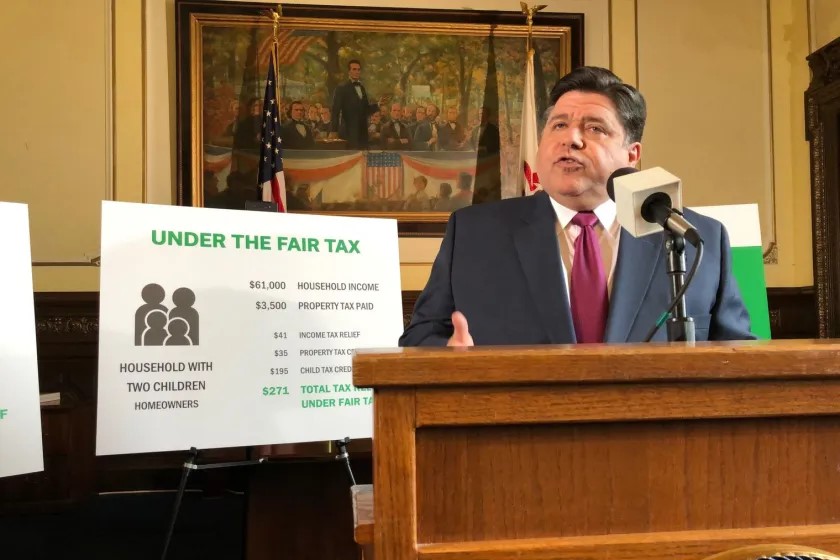
Gov. JB Pritzker at a 2019 news conference outlines his plan to replace the Illinois flat-rate income tax with a graduated structure. Pritzker’s push for a constitutional amendment for his proposal overshadowed the millionaire surcharge. | AP photos
The failed 2014 effort
Quinn said he proposed the 3% surcharge on millionaires to help Illinois boost education spending while also allowing schools to rely less on local property taxes for funding.
After the advisory referendum passed in 2014 with nearly 64% support, then-House Speaker Mike Madigan’s efforts to turn the proposal into a constitutional amendment in 2015 and 2016 failed due to insufficient support from his own Democratic caucus.
Then, Democrats lost their House supermajority — when one party controls at least three-fifths of a legislative chamber, which also is the threshold to put a constitutional amendment on the ballot — in 2016, dooming its future.
In 2018, Gov. JB Pritzker won the governor’s mansion and Democrats returned with supermajorities in both legislative chambers. But Pritzker campaigned on a different tax proposal: moving the state from a flat tax to a graduated one, where the rate progressively increases as income rises. That tax proposal got on the 2020 ballot.
The campaign for the graduated income tax constitutional amendment generated more than $100 million in spending, roughly coming equally from supporters and opponents. Billionaires Pritzker (in support) and Kenneth Griffin (in opposition) alone shouldered a majority of that spending.
Voters rejected it by 6 percentage points.
Read more here.